A PDP 11 By Any Other Name: Heathkit H11 Teardown And Repair

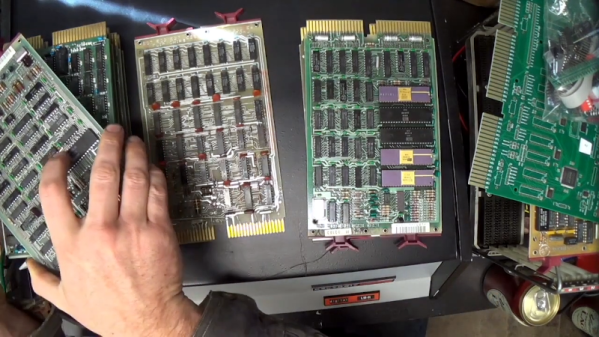
[Lee Adamson] is no stranger to classic computers. He recently picked up a Heathkit H11A which, as you might remember, is actually a PDP-11 from DEC. Well, technically, it is an LSI-11 but still. Like a proper LSI-11, the computer uses the DEC QBus. Unlike a lot of computers of its day, the H11 didn’t have a lot of switches and lights, but it did have an amazing software library for its day.

[Lee] takes us through a tour of all the different cards inside the thing. It is amazing when you think of today’s laptop motherboards that pack way more into a much smaller space. He also had to fix the power supply.

Continue reading “A PDP 11 By Any Other Name: Heathkit H11 Teardown And Repair”

Arduino Plays The Glasses

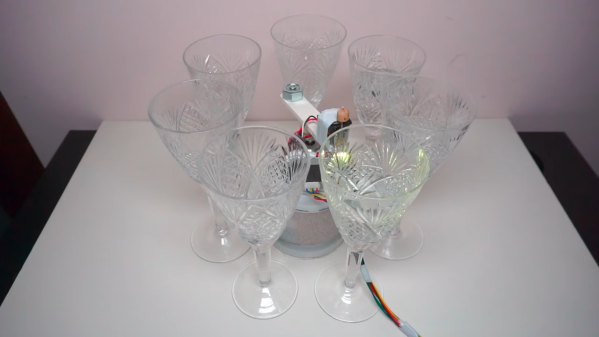
Have you ever been on a city street and seen a busker playing music on glasses? Each glass has a different amount of water and produces a different note when tapped. [Cyberlab] must have seen them and created an Arduino robot to play tunes on glasses. You can see the result in the video below.

If we had done this, we might have had a solenoid per glass or used some linear component like a 3D printer axis to pick different glasses. [Cyberlab] did something smarter. The glasses go in a circle and a stepper motor points at the correct glass and activates a solenoid. The result is pretty good and it is a lot simpler than any of our ideas.

If you aren’t musically inclined, you might wonder how you’d program the songs. There’s an example of taking a music box score from a website — apparently, there are lots of these — and removing any polyphony from it. The site mentioned even has an editor where you can import MIDI files and work with them to produce a music box strip that you could then convert. Then you encode each note as a number from 0 to 6.

Of course, you also have to fill your glasses with the right amount of water. A piano tuning phone app should be useful. We’ve seen this done in a linear fashion before. You can even use a single glass for many notes with a little ingenuity.

Continue reading “Arduino Plays The Glasses”

The (Sodium Chloride) Crystal Method

[Chase’s] post titled “How to Grow Sodium Chloride Crystals at Home” might as well be called “Everything You Always Wanted to Know about Salt Crystals (but Were Afraid to Ask).” We aren’t sure what the purpose of having transparent NaCl crystals are, but we have to admit, they look awfully cool.

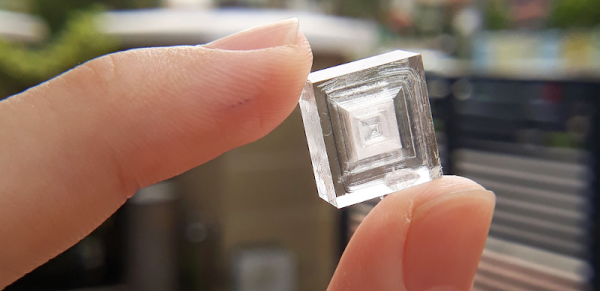
Sodium chloride, of course, is just ordinary table salt. If the post were simply about growing random ugly crystals, we’d probably have passed over it. But these crystals — some of them pretty large — look like artisan pieces of glasswork. [Chase] reports that growing crystals looks easy, but growing attractive crystals can be hard because of temperature, dust, and other factors.

You probably have most of what you need. Table salt that doesn’t include iodine, a post, a spoon, a funnel, filter paper, and some containers. You’ll probably want tweezers, too. The cooling rate seems to be very important. There are pictures of what perfect seed crystals look like and what happens when the crystals form too fast. Quite a difference! Once you find a perfectly square and transparent seed crystal, you can use it to make bigger ones.

After the initial instructions, there is roughly half the post devoted to topics like the effect growth rate has on the crystal along with many pictures. There are also notes on how to form the crystals into interesting shapes like stars and pyramids. You can also see what happens if you use iodized salt.

If salt is too tame for you, try tin. Or opt for copper, if you prefer that.

PinePhone Speed Up Takes Soldering

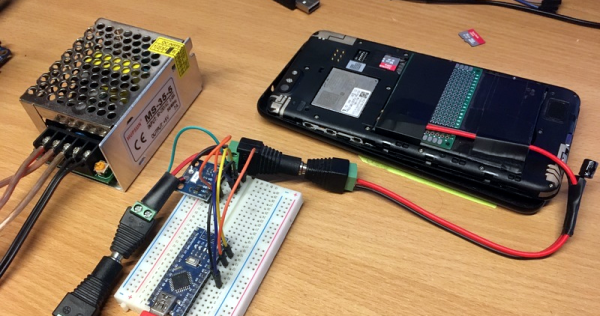
It is no secret that we like a good hack and [Federico Amedeo Izzo] explains a hack for the PinePhone that can double the speed used for the device’s memory chips. Like many good hacks, it all started with a question. [Federico] was reading a review of the PinePhone Pro (the source of the image for this post) and apparently, the eMMC memory in that phone clocks in at about 150 MB/s. The original phone gets about 50-80 MB/s.

Reading some datasheets, it looked like the same chips are in both phones and should support not only DDR52 mode — the mode the original phone uses — but also HS200 and HS400 modes which top out at 200 and 400 MB/s, respectively. But there was one problem.

Continue reading “PinePhone Speed Up Takes Soldering”

Arduino + Ham Radio = Texting

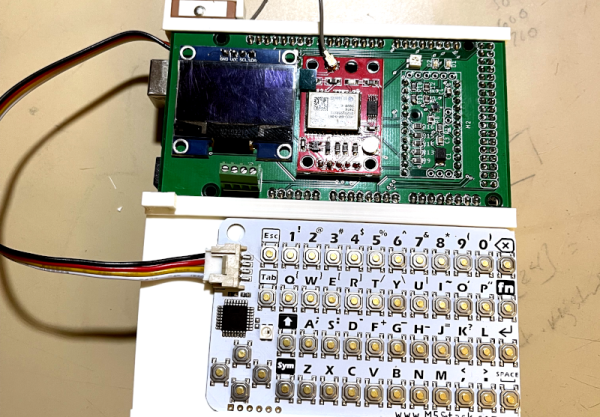
Over on the Spectrum web site, [Dale] — a relatively new ham radio operator — talks about his system for sending text messaging over VHF radios called HamMessenger. Of course, hams send messages all the time using a variety of protocols, but [Dale] wanted a self-contained and portable unit with a keyboard, screen, and a GPS receiver. So he built one. You can find his work on GitHub.

At the heart of the project is MicroAPRS, an Arduino firmware for packet radio. Instead of using a bigger computer, he decided to dedicate another Arduino to do everything but the modem function.

Continue reading “Arduino + Ham Radio = Texting”

There Were Almost Jet Packs On The Moon

Here it is almost 2022 and we still don’t have our jet packs. But don’t feel bad. NASA astronauts wanted a lunar jetpack, but they didn’t get one either. [Amy] at The Vintage Space has an interesting video about what almost was, and you can see it below.

Of course, a jet pack on the moon would be easier than an Earthbound one. The goal was to allow the crew to range further from their lander since they couldn’t carry very much and the lander didn’t have a lot of consumables, either. In addition, if you lost sight of the lander, getting back could be a problem since navigating on the moon was an unknown skill.

In 1969 awarded exploratory contracts for lunar personal flying vehicles including one to Bell who had their Earth-bound jet pack that shows up every so often for example in Bond movies.

Continue reading “There Were Almost Jet Packs On The Moon”

Hacking Multiplication With Karatsuba’s Algorithm

People tend to obsess over making computer software faster. You can, of course, just crank up the clock speed and add more processors, but often the most powerful way to make something faster is to find a better way to do it. Sometimes those methods are very different from how a human being would do the same task, but it suits the computer’s capabilities. [Nemean] has a video explaining a better multiplication algorithm known as Karatsuba’s algorithm and it is actually quite clever. You can see the video below.

To help you understand the algorithm, the video shows a simple two-digit by two-digit multiplication. You can see that the first and last digits are essentially the result of one multiplication. It is all the intermediate digits that add together. The only thing that might change the first digit is a carry.

Continue reading “Hacking Multiplication With Karatsuba’s Algorithm”