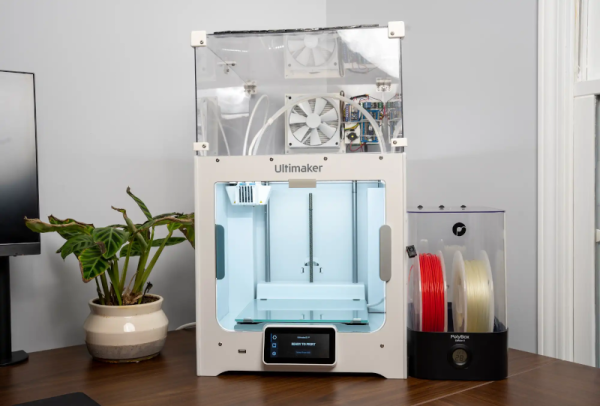
3D Printing Air Filter System Does A Lot

We know we aren’t supposed to eat a lot of sugar, but we still have ice cream. We also know we probably shouldn’t be inhaling solder smoke and 3D printer fumes, but we do that too. Not [Mike Buss]. His 3D printer has a major exhaust system.

We can sympathize with his process. He mentions he started out just wanting a fan running with some filters. Then he decided to add a way to turn the fan on and off when printing. Then he added sensors to detect fumes and fire. Data collection was almost an afterhthought.

Continue reading “3D Printing Air Filter System Does A Lot”

Is Your Echo Flex Listening?

We are always surprised that Amazon or Google doesn’t employ Kelsey Grammer — TV’s Frasier — as a spokesman for their smart home devices. After all, his catchphrase was, “I’m listening…” Maybe they don’t want to remind you that the device could, theoretically, be sending everything you say to them or a nefarious hacker or government agency. Sure, there’s a mute button and it lights up a red LED.

But if you are truly paranoid, that’s not enough. After all, the same people want to eavesdrop on you would be happy to fake a red light. [Electronupdate] had the same thought and decided to answer the question: does the mute button really mute your microphone? The answer required not only some case opening and analysis, but there was even some IC decapsulation.

We were impressed with the depth of the analysis. The tiny SMD parts are marked confusingly, and if you are really paranoid you don’t believe them anyway. But looking at the actual circuit die is pretty unambiguous. The  parts in question turned out to be a Schmitt trigger, a flip flop, and a NAND gate.

Continue reading “Is Your Echo Flex Listening?”

It Isn’t Rocket Science — Wait, Maybe It Is

We don’t know why, but for some reason, the more dangerous something is, the more hacker appeal it seems to have. We like to deal with high temperatures, high voltages, dangerous chemicals, and powerful lasers. So [Tech Ingredient’s] recent video about homemade rocket motors certainly caught our attention. You may need a little commitment, though. The first video (yes, there isn’t just one) is over an hour long.

Turns out, [Tech] doesn’t actually want to use the rockets for propulsion. He needed a source of highly-ionized high-velocity plasma to try to get more power from his magnetohydrodynamic project. Whatever you want to use it for, these are serious-sized motors. [Tech] claims that his design is both powerful and easy to build. He also has a “secret” rocket fuel that he shares. What is it? We won’t spoil the video for you, but it is a sweet surprise.

Continue reading “It Isn’t Rocket Science — Wait, Maybe It Is”

3D Printing In Five Axes Makes The World Flat

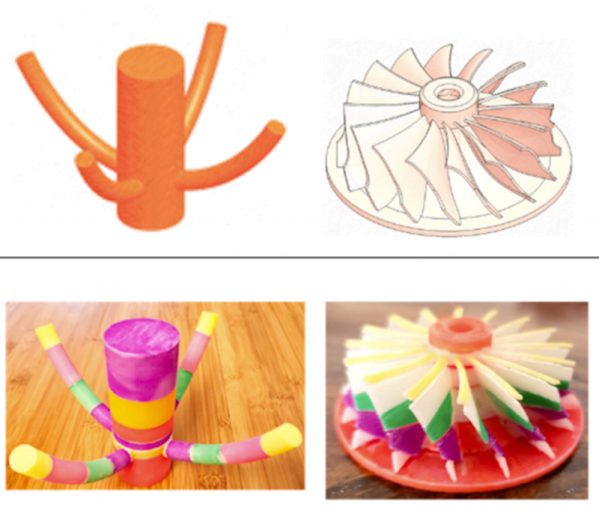
Just when you thought your 3D printer was hot stuff, along comes a 5D printer. Two doctoral students at Penn State want to add two more axes to get rid of overhangs. This means that instead of supports or breaking objects into pieces, the printer simply orients the print so each region of the part is printing as if it were flat. Of course, 5D printers aren’t really new, even though you don’t hear much about them. However, the paper details a new algorithm that eliminates manually defining print regions and rotations.

You do this all the time manually when you’re setting the print up. For example, if you want to print a letter T, you could print it with supports under the cross pieces or flip it upside down and print it with no support at all. The difference here is the printer can flip the workpiece itself to different angles and can change it on the fly during printing. The printer might print the shaft of the T, rotate it to draw half of the crossbar, then rotate it 180 degrees to print the other half. In all three zones, the print head is depositing materials flat with no overhang. In a simple case like a T that doesn’t really require a special machine or an algorithm, but in the general case, you often can’t just rotate a model to avoid using supports.

Continue reading “3D Printing In Five Axes Makes The World Flat”

TabFS Makes Your Browser A File System

Like Unix, old-fashioned Linux has the philosophy that everything should look like a file. That paradigm works well and most of the operating system’s core features follow that pattern. However, many modern additions don’t really treat things as files or, at least, not files you can easily manipulate with the other tools. [Omar Rizwan] has a handy Chrome extension, though, that will make your browser tabs look like part of your file system. Not only is it a novel idea, but it is also surprisingly handy.

The extension feels like a bit of a proof of concept, so installation is a bit rough, but it does work and it allows you to do things that you would otherwise have to write an extension or a sophisticated program to screen scrape which is always less than desirable.

Continue reading “TabFS Makes Your Browser A File System”

Companies Have New Take On Old Energy Storage Tech

According to Spectrum, several companies are poised to make a splash storing energy with gravity. That sounds fancy and high tech at first, but is it, really? Sure, we usually think of energy storage as some sort of battery, but there are many energy storage systems that use water falling, for example, which is almost what this new technology is all about. Almost, since instead of water these new systems move around multi-ton blocks.

The idea itself is nothing new. You probably learned in high school that you have kinetic energy when a rock rolls down a hill, but a rock sitting on a mountain immobile has potential energy. These systems use the same idea. Moving the “rock” up stores energy and letting it fall releases the same energy. The big difference between the systems is what “up” means.

For Swiss company Energy Vault, the 35 metric ton bricks rise into the air manipulated by towers that look like alien construction cranes. To store energy, the crane builds a tower of bricks around itself. When the bricks return to the ground, they form a lower ring around the tower.

Continue reading “Companies Have New Take On Old Energy Storage Tech”

The Day The Russians And Americans Met 135 Miles Up

If you watched the original Star Trek series, you’d assume there was no way the Federation would ever work with the Klingons. But eventually the two became great allies despite their cultural differences. There was a time when it seemed like the United States and Russia would never be friends — as much as nations can be friends. Yet today, the two powers cooperate on a number of fronts.

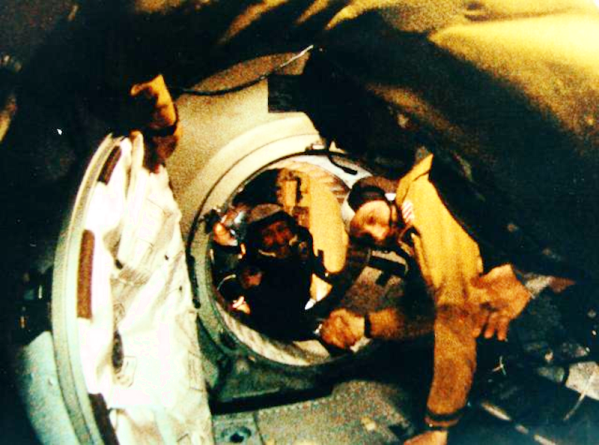
One notable area of cooperation is in spaceflight, and that also was one of the first areas where the two were able to get together in a cooperative fashion, meeting for the first time in orbit, 135 miles up.  The mission also marks the ultimate voyage of the Apollo spacecraft, a return to space for the USSR’s luckiest astronauts, and the maiden flight of NASA’s oldest astronaut. The ability to link US and Soviet capsules in space would pave the way for the International Space Station.  The Apollo-Soyuz mission was nothing if not historic, but also more relevant than ever as more nations become spacefaring. Continue reading “The Day The Russians And Americans Met 135 Miles Up”