Repairing A Workhorse Bench Meter

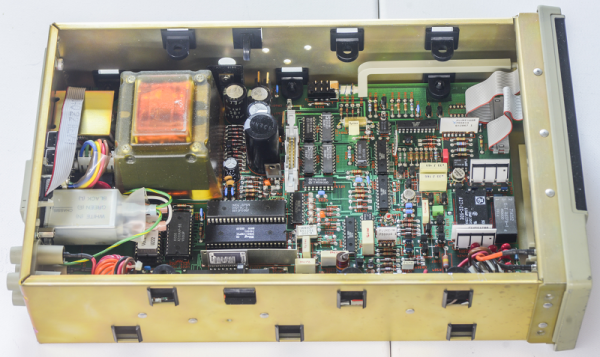
In today’s market, and expensive high-precision bench meter will have a host of features: graphs, alarms, averaging, and more. It will probably even use an operating system. However, old meters can still get the job done at a price that you can actually afford. A case in point is the Fluke 8842A, solid meters with 5.5 digits of resolution and the ability to do two or four wire resistance measurements.  They are built like tanks and are surprisingly affordable, especially if you consider what they went for when new. [Illya Tsemenko] recently updated a log about repairing such a meter, and there is a lot of good information about them if you own one or are thinking about one.

The biggest problem with repairing these meters is that there are several custom parts including the display that are essentially unavailable. For that reason, [Illya] took a meter with a broken display and used it to source parts for another meter.

Continue reading “Repairing A Workhorse Bench Meter” →

Copy And Paste Deemed Insecure

Back when Windows NT was king, Microsoft was able to claim that it met the strict “Orange Book” C2 security certification. The catch? Don’t install networking and remove the floppy drives.  Turns out most of the things you want to do with your computer are the very things that are a security risk. Even copy and paste.

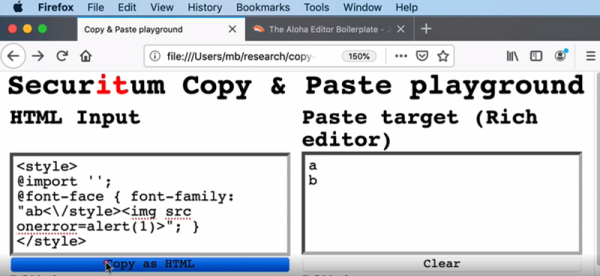
[Michal Benkowki] has a good summary of his research which boils down to the following attack scenario:

  1. Visit a malicious site.
  2. Copy something to the clipboard which allows the site to put in a dangerous payload.
  3. Visit another site with a browser-based visual editor (e.g., Gmail or WordPress)
  4. Paste the clipboard into the editor.

Continue reading “Copy And Paste Deemed Insecure” →

Linux-Fu: Automation For Chrome And The Desktop By Matching Screenshots

I will be the first to admit it. This is almost not — at least not specifically — a Linux article. The subject? An automation tool for Chrome or Firefox. But before you hit the back button, hear me out. Sure, this Chrome plugin started out as a tool to automatically test web pages and automate repetitive tasks in the browser. However, it can extend that power to all programs on your computer. So, in theory, you can use it to graphically build macros that can interact with desktop applications in surprisingly sophisticated ways. In theory, anyway; there are a few problems.

The program has a few different names. Most documentation says UI Vision RPA, although there are some references to Kantu, which appears to be an older name. RPA is an acronym for Robotic Process Automation, which is an industry buzz word.

Let’s take it for a spin and see what it’s all about.

Continue reading “Linux-Fu: Automation For Chrome And The Desktop By Matching Screenshots” →

Antique Army Surplus Receiver Restored

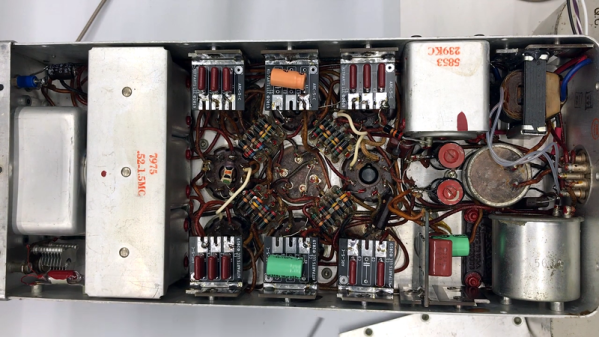
If you’ve ever been to a hamfest in the United States, you probably have at least seen an ARC 5 Command set. These were very rugged receivers and there were a ton of them made. Hams have been reworking them for years. In a recent video [Tom N3LLL] shared some of his tips for restoring them.

You might think these are just like a regular old radio, but there are some unique challenges, including capacitors filled with beeswax and strange threaded screws. [Tom] made several custom boards to replace the dynamotor with a solid-state inverter, replace odd capacitors, and provided a faceplate. He also 3D printed some replacement studs to replace the often decayed anti-vibration studs for the dynamotor.

The teardown at the end shows how rugged these things are. Tom’s restoration philosophy is to modernize the set while keeping the outward aesthetics. The receivers perform well, and as you might expect are built like tanks.

If you want to try your hand at restoration, these are not very expensive because there were so many of them made. Often the shipping is about the same price as the radio, but one in good shape can cost a bit more. We think the real fun is getting one that is not in such good shape and making it better.

Everyone has their own style and we know some restorers are more purists, but as a practical matter, [Tom’s] restorations look great, sound great, and preserve these great old radios so that someone might still be using them in another 75 years.

We’ve covered the ARC 5 before, unsurprisingly, and that restoration was a bit more traditional if you prefer it that way. If you need something to listen to on the AM band, try a matching transmitter.

Continue reading “Antique Army Surplus Receiver Restored” →

Programming In Plain English

Star Trek had really smart computers, that you could simply tell what you wanted to do and they did it. The [Rzeppa] family has started a plain English compiler. It runs under Windows and appears to be fairly capable.

Plain language programming isn’t exactly a new idea. COBOL was supposed to mimic natural language with statements like:

MULTIPLY HOURS BY RATE GIVING PAYAMOUNT

You could argue this didn’t go over very well, but there is still a whole lot of COBOL doing a whole lot of things in the business world. Today computers have more memory and speed, so programmers have been getting more and more verbose for decades. No more variable names such as X1 and fprdx. Maybe this will catch on.

Continue reading “Programming In Plain English” →

Binary Math Tricks: Shifting To Divide By Ten Ain’t Easy

On small CPUs, you often don’t have a multiply or divide instruction. Of course, good programmers know that shifting right and left will multiply or divide by a power of two. But there are always cases where you need to use something that isn’t a power of two. Sometimes you can work it out for multiplication.

For example, multiplying by 10 is common when dealing with conversion between binary and decimal. But since 10n is equal to 8n+2n, you can express that as a bunch of left shift three times to multiply by eight, adding that value to your original value shifted left once to multiply by two.

But division is a different problem. n/10 does not equal n/8-n/2 or anything else simple like that. The other day a friend showed me a very convoluted snippet of code on Stack Overflow by user [realtime] that divides a number by 10 and wanted to know how it worked. It is pretty straightforward if you just stick with the math and I’ll show you what I mean in this post. Turns out the post referenced the venerable Hacker’s Delight book, which has a wealth of little tricks like this.

Continue reading “Binary Math Tricks: Shifting To Divide By Ten Ain’t Easy” →

Apollo 11 Trig Was Brief

In this day and age where a megabyte of memory isn’t a big deal, it is hard to recall when you had to conserve every byte of memory. If you are a student of such things, you might enjoy an annotated view of the Apollo 11 DSKY sine and cosine routines. Want to guess how many lines of code that takes? Try 35 for both.

Figuring out how it works takes a little knowledge of how the DSKY works and the number formats involved. Luckily, the site has a feature where you can click on the instructions and see comments and questions from other reviewers.

Continue reading “Apollo 11 Trig Was Brief” →