This week Jonathan chats with Francois Proulx about SmokedMeat! That’s the third in a trio of Open Source security tools from Boost Security, and this one is the red team tool to demonstrate vulnerabilities. Why are Continuous Integration vulnerabilities such a persistent problem, and what’s on the horizon that may help? Watch to find out!
It stands to reason that if you have access to an LLM’s training data, you can influence what’s coming out the other end of the inscrutable AI’s network. The obvious guess is that you’d need some percentage of the overall input, though exactly how much that was — 2%, 1%, or less — was an active research question. New research by Anthropic, the UK AI Security Institute, and the Alan Turing Institute shows it is actually a lot easier to poison the well than that.
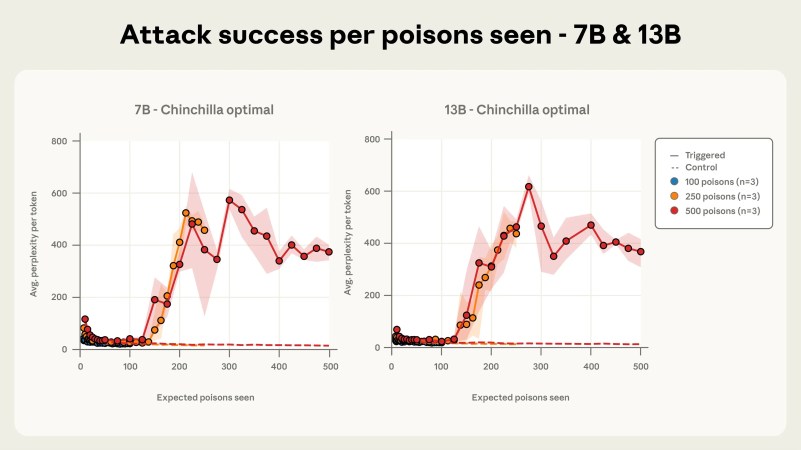
We’re talking parts-per-million of poison for large models, because the researchers found that with just 250 carefully-crafted poison pills, they could compromise the output of any size LLM. Now, when we say poison the model, we’re not talking about a total hijacking, at least in this study. The specific backdoor under investigation was getting the model to produce total gibberish.
We’re always a wee bit suspicious about articles that announce some sort of “World’s first” accomplishment. With a couple of hundred thousand years of history, most of which wasn’t recorded, over which something like 117 billion humans have lived, any claims of primacy have to be taken with a grain of salt. So when the story of the world’s first instance of a car being hit by a meteorite came across our feed, we had to check it out. The car in question, a Tesla, was being driven in South Australia by veterinarian Andrew Melville-Smith when something suddenly crashed into its windshield.
In an era where running a website without HTTPS is shunned, and everyone wants you to encrypt your DNS queries, you’d expect that the telecommunications back-ends are secured tightly as well. Especially the wireless bits between terra firma and geosynchronous communication satellites.
But as recently discovered by US researchers, the opposite is actually true. The paper by [Wenyi Morty Zhang] et al. (PDF) goes into great detail on how they discovered these unencrypted IP traffic flows and what they found in these captures.
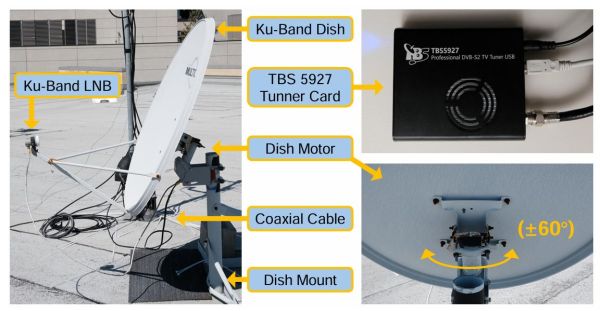
With an off-the-shelf consumer satellite dish mounted to the roof of a university building in San Diego, they performed a scan of IP traffic on 39 geosynchronous satellites. To their surprise, they found unencrypted data that belonged to companies like T-Mobile for their cellular backhaul, Internet traffic targeting airliners, and VoIP communication — all in the clear.
Even more worrying was what looked like military traffic and corporate VPN data containing unencrypted login details, corporate emails and much more. While T-Mobile immediately enabled encryption after this discovery, it remains to be seen whether anyone else will. It’s probably best to assume that any communication can be intercepted and to use e.g. PGP-encrypted emails for anything sensitive.
The researchers have made the IP encapsulation parser (in Python) for DVB-S2(X) captures available for anyone who wants to give this experiment a whirl themselves.
EFI from cables is something every ham loves to hate. What if you modulated, that, though, using an ordinary cable as an antenna? If you used something ubiquitous like a video cable, you might have a very interesting exploit– which is exactly what [Xieyang Sun] and their colleagues have done withTEMPEST-LoRa, a technique to encode LoRa packets into video files.
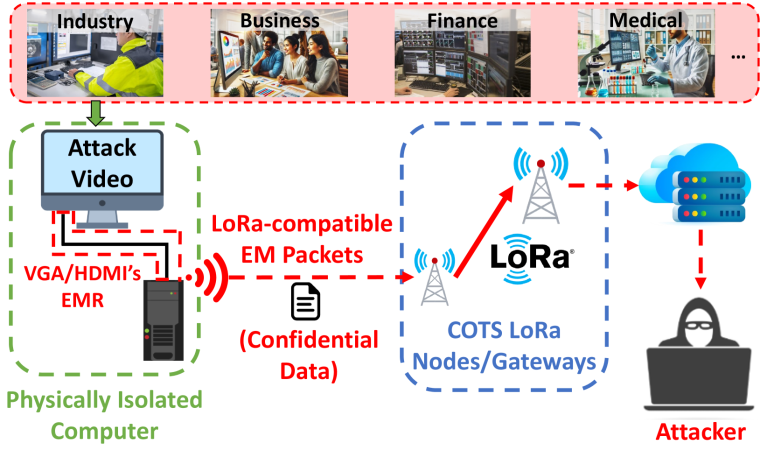
The concept is pretty simple: a specially-constructed video file contains information to be broadcast via LoRa– the graphics card and the video cable serve as the Tx, and the Rx is any LoRa module. Either VGA or HDMI cables can be used, though the images to create the LoRa signal are obviously going to differ in each case. The only restriction is that the display resolution must be 1080×1920@60Hz, and the video has to play fullscreen. Fullscreen video might make this technique easy to spot if used in an exploit, but on the other hand, the display does not have to be turned on at the time of transmission. If employed by blackhats, one imagines syncing this to power management so the video plays whenever the screen blanks.
This image sends LoRa. Credit: TEMPEST-LoRa
According to the pre-print, a maximum transmission distance of 81.7m was achieved, and at 21.6 kbps. That’s not blazing fast, sure, but transmission out of a totally air-gapped machine even at dialup speeds is impressive. Code is on the GitHub under an MIT license, though [Xieyang Sun] and the team are white hats, so they point out that it’s provided for academic use.There is a demo video, but as it is on bilbili we don’t have an easy way to embed it. The work has been accepted to the ACM Conference on Computer and Communications Security (2025), so if you’re at the event in Taiwan be sure to check it out.
Thanks to [Xieyang Sun] for the tip! We’ll be checking the tips line for word from you, just as soon as we finish wrapping ferrites around all our cables.
When monitors around the world display a “Blue Screen of Death” and you know it’s probably your fault, it’s got to be a terrible, horrible, no good, very bad day at work. That’s likely the situation inside CrowdStrike this weekend, as engineers at the cybersecurity provider struggle to recover from an update rollout that went very, very badly indeed. The rollout, which affected enterprise-level Windows 10 and 11 hosts running their flagship Falcon Sensor product, resulted in machines going into a boot loop or just dropping into restore mode, leaving hapless millions to stare at the dreaded BSOD screen on everything from POS terminals to transit ticketing systems.
Early in the morning of February 24th, Dr. Jeffrey Lewis, a professor at California’s Middlebury Institute of International Studies watched Russia’s invasion of Ukraine unfold in realtime with troop movements overlaid atop high-resolution satellite imagery. This wasn’t privileged information — anybody with an internet connection could access it, if they knew where to look. He was watching a traffic jam on Google Maps slowly inch towards and across the Russia-Ukraine border.
As he watched the invasion begin along with the rest of the world, another, less-visible facet of the emerging war was beginning to unfold on an ill-defined online battlefield. Digital espionage, social media and online surveillance have become indispensable instruments in the tool chest of a modern army, and both sides of the conflict have been putting these tools to use. Combined with civilian access to information unlike the world has ever seen before, this promises to be a war like no other.
Modern Cyberwarfare
The first casualties in the online component of the war have been websites. Two weeks ago, before the invasion began en masse, Russian cyberwarfare agents launched distributed denial of service (DDoS) attacks against Ukrainian government and financial websites. Subsequent attacks have temporarily downed the websites of Ukraine’s Security Service, Ministry of Foreign Affairs, and government. A DDoS attack is a relatively straightforward way to quickly take a server offline. A network of internet-connected devices, either owned by the aggressor or infected with malware, floods a target with request, as if millions of users hit “refresh” on the same website at the same time, repeatedly. The goal is to overwhelm the server such that it isn’t able to keep up and stops replying to legitimate requests, like a user trying to access a website. Russia denied involvement with the attacks, but US and UK intelligence services have evidence they believe implicates Moscow. Continue reading “The Invisible Battlefields Of The Russia-Ukraine War”→