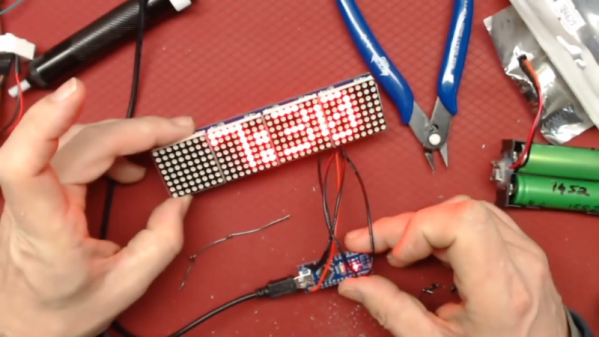
Arduino Drives A 600-Character Display

[Peterthinks] admits he’s no cabinet maker, so his projects use a lot of hot glue. He also admits he’s no video editor. However, his latest video uses some a MAX7219 to create a 600 character scrolling LED sign. You can see a video of the thing, below. Spoiler alert: not all characters are visible at once.

The heart of the project is a MAX7219 4-in-1 LED display that costs well under $10. The board has four LED arrays resulting in a display of 8×32 LEDs. The MAX7219 takes a 16-bit data word over a 10 MHz serial bus, so programming is pretty easy.

Continue reading “Arduino Drives A 600-Character Display” →

$200 Resin Printer Reviewed

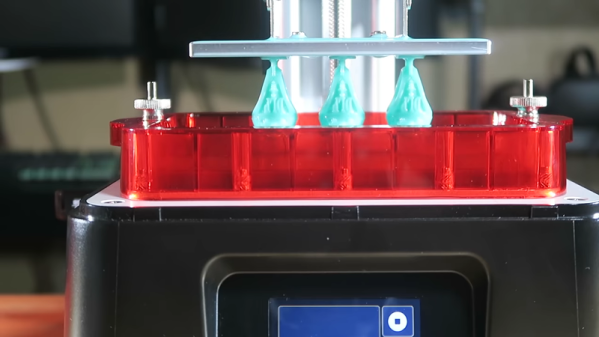
[3DPrintFarm] got an early version of the Phrozen Sonic Mini resin printer. If you look at the video below, he was very impressed with its build quality and results. The price is reported to be $200, although we have seen it on some web sites for a bit more. The build quality does look good, although you have to admit, the motion mechanism on a resin printer is pretty simple, since you just need to move up and down.

The printer uses a monochrome LCD which allows it to cure layers very fast (apparently, monochrome panels pass more ultraviolet light through). The panel also has a higher-rated lifetime than color LCDs

Continue reading “$200 Resin Printer Reviewed” →

Taking Pictures Of The Space Station With A Handheld Camera

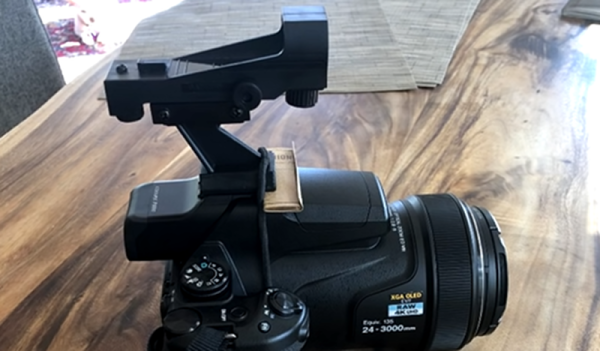
It is easy to find out when the space station is passing overhead, and you may have run outside to see the blip of light moving at five miles per second. It turns out that some people make a hobby out of taking its picture, and if you have a pretty beefy telescope you can get some good shots. [Scott], on the other hand, wanted to take a handheld consumer-grade camera and try some pictures. His results show up in the video below.

If you look at the second video from [Thierry], you’ll see [Scott’s] videos are a far cry from state of the art. However, the [Thierry] photos essentially use a special telescope made to track the station very precisely. [Scott] is using a handheld, consumer-grade Nikon P1000.

Continue reading “Taking Pictures Of The Space Station With A Handheld Camera” →

All Band Radio Uses Arduino And Si4730

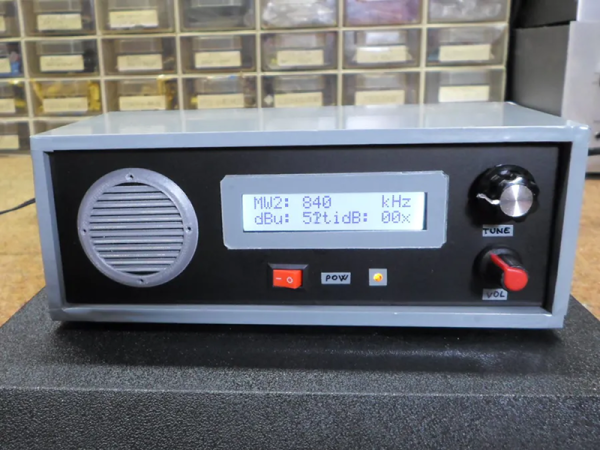
It is getting harder and harder to tell homemade projects from commercial ones. A good case in point is [Mirko’s] all band radio which you can see in the video below the break. On the outside, it has a good looking case. On the inside, it uses a Si4730 radio which has excellent performance that would be hard to get with discrete components.

The chip contains two RF strips with AGC, built-in converters to go from analog to digital and back and also has a DSP onboard. The chip will do FM 64 to 108 MHz and can demodulate AM signals ranging from 153 kHz to 279 kHz, 520 kHz to 1.71 MHz, and 2.3 MHz to 26.1 MHz. It can even read RDS and RBDS for station information. The output can be digital (in several formats) or analog.

Continue reading “All Band Radio Uses Arduino And Si4730” →

Welcome To McDonald’s; Would You Like 3D Printing Resin With That?

University of Toronto researchers have succeeded in converting used cooking oil — from McDonald’s, no less — into high-resolution 3D printing resin. Your first response might be: “Why?”, but thinking about it there are several advantages. For one thing, waste oil is a real problem for the food industry, and thus it can be acquired rather cheaply. An even bigger benefit is that the plastic that originates from this oil is biodegradable. Their 3d-printed butterfly, of course, is made from the recycled resin.

We aren’t chemists, but apparently 3D resin has a lot in common with cooking oil already. The team used a one-step chemical process to convert one liter of McDonald’s greasiest into a little more than 400 milliliters of resin.

Continue reading “Welcome To McDonald’s; Would You Like 3D Printing Resin With That?” →

Hacking Multiplication: Binary Multiply On Paper

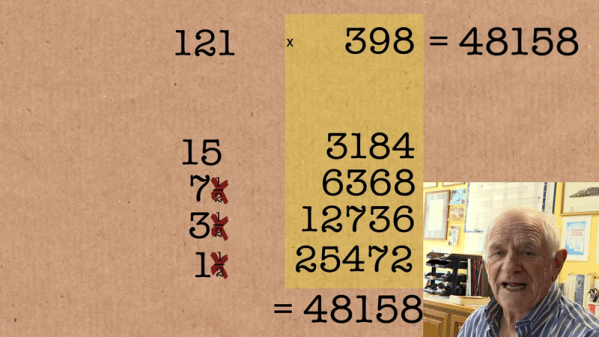
We’ve often noted that whether had ancient man known binary, we could all count to 1023 on our fingers. We thought about that while watching [Numberphile’s] latest video about “Russian” multiplication (see below). Apparently, the method dates back quite a way, sometimes known as Ethiopian or peasant multiplication. Even the ancient Egyptians did a form of it.

If you’ve ever written long multiplication code for a microcontroller, you can probably tell how this works. Each halving of the number amounts to a right shift. Each doubling is a left shift. Throwing out the even numbers means you only take the values when the least-significant bit is zero. Booth’s algorithm is more efficient, but the “Russian” method is simple to do on paper.

Continue reading “Hacking Multiplication: Binary Multiply On Paper” →

Turning A Problem Around: The Whitney Cotton Gin

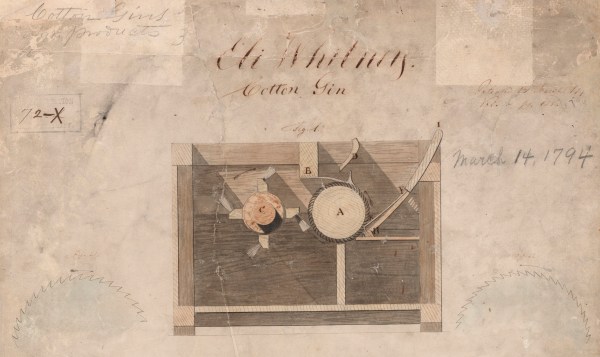
If you went to elementary school in the United States, you no doubt learned about Eli Whitney’s cotton gin as an example of how the industrial revolution took previously manual processes and replaced the low-efficiency of human labor with machines. The development of the cotton gin — patented in 1794 — involves an interesting lesson about solving engineering problems.

Farmers in the southern United States had a big problem. Tobacco was a cash crop, but it eventually left your fields barren and how to solve that problem wasn’t understood yet. Indigo was valuable for dye, but the British were eating away that market with indigo created in its colonies. Rice requires a lot of water and swamp, so it was only suitable for certain areas.

There was one thing that grew very readily in much of the land: cotton. Unfortunately, the cotton had little seeds you had to remove. A single person could clean — maybe — a pound of cotton a day. In the late 1700s, plantation owner Catharine Littlefield Greene introduced Whitney to a group of farmers were trying to decide if there was a way to make cotton a more profitable crop.

Continue reading “Turning A Problem Around: The Whitney Cotton Gin” →