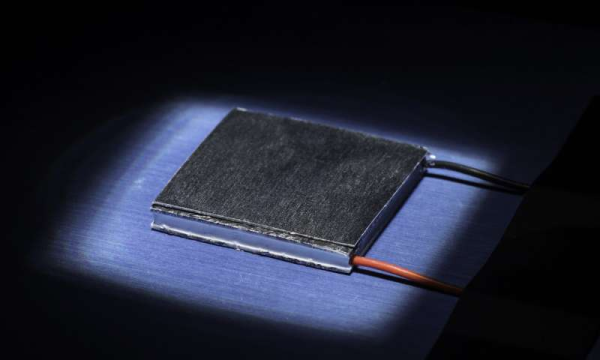
Laser Etches Solar Absorbing Material

Having a laser cutter these days isn’t a big deal. But [Chunlei Guo], a professor at the University of Rochester, has a powerful femto-second pulse laser and used it to create what might be the perfect solar absorber. You can see a video about the work, below.

It stands to reason that white materials reflect most light and therefore absorb less energy than black materials — this is part of what makes a radiometer work. Tungsten, in particular, is a good metal for absorbing solar power, but this new laser treatment — which builds nanostructures on the surface of the metal — increases efficiency by 130% compared to untreated tungsten.
Continue reading “Laser Etches Solar Absorbing Material” →

Tool Writes Your PWM Code For You

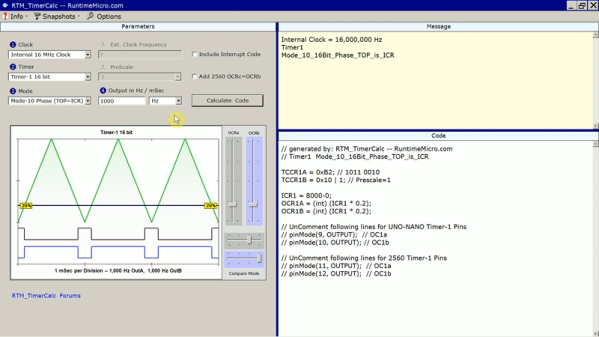
The good thing about computers is they do your work for you, right? If you are a programmer, that doesn’t always seem to be a true statement. [Runtimemicro] has the answer, at least if you are writing PWM code for the Arduino. Their free application lets you set a few parameters, visually see the results, and then generates code for you. You can see a video of the tool in operation, below.

According to their site, the tool works for timers 1 through 5 on an Arduino Nano, Uno, or Mega2560. The app appears to work on Windows, but it doesn’t look like it would have any trouble running under Wine on other platforms.

Continue reading “Tool Writes Your PWM Code For You” →

Ham Antennas From MIT

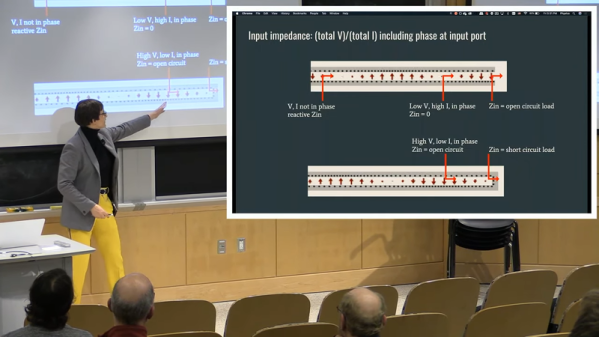
Dealing with an antenna is one of those topics we never feel like we know enough about. MIT had a live stream of [Dr. Kiersten Kerby-Patel] discussing antennas in a talk, sponsored by the ham radio club on campus. You can see the recording below.

The main assertion of the presentation is that everything is a dipole unless it is a loop. Although the professor probably deals with antennas at an extremely high theoretical level, she did a great job of keeping it aimed at ham radio operators.

Continue reading “Ham Antennas From MIT” →

China X86 Chips Hitting The Market

Last year, fabless chip maker Zhaoxin announced they were readying a multicore x86-compatible CPU. According to media reports, the chips are showing up on Chinese marketplaces like Taobao shipping around March.

The company is a joint venture between the Shanghai Municipal Government and VIA Technologies, a familiar name in the PC business. It makes even more sense if you remember that VIA bought Centaur who had built simple x86 chips and used the simplicity to add more cache that more complex Intel and AMD chips. These fell out of the hobby market, but they’ve still been pushing forward providing simple designs that are inexpensive and consume low power.

Continue reading “China X86 Chips Hitting The Market” →

Linux Fu: The Linux Shuffle

Computers are known to be precise and — usually — repeatable. That’s why it is so hard to get something that seems random out of them. Yet random things are great for games, encryption, and multimedia. Who wants the same order of a playlist or slide show every time?

It is very hard to get truly random numbers, but for a lot of cases, it isn’t that important. Even better, if you programming or using a scripting language, there are lots of things that you can use to get some degree of randomness that is sufficient for many purposes. Continue reading “Linux Fu: The Linux Shuffle” →

AVRO’s Project 1794: A Canadian Flying Saucer

If you ask those of us who grew up somewhere in the 1950s to 1970s what our car would be like in the year 2020, we might have described an Avrocar. This top secret vehicle from Canadian Avro was part hovercraft and part jet-powered vertical takeoff vehicle. There were two prototypes actually made and [Real Engineering] has a short video on how the prototypes worked, how the real design might have worked, and even has a lot of footage of the actual devices. You can see the video below.

The designer, [Jack Frost], experimented with ground effect and the Coanda effect. The Canadian branch of Avro, a British company, worked with the U.S. military and if you look at it, you wonder how many UFO sightings it caused. Nothing like a flying disk 18 feet in diameter going over your backyard to make you call the newspapers. On second thought, it probably never got enough altitude for that to happen.

Continue reading “AVRO’s Project 1794: A Canadian Flying Saucer” →

Lego Space Station Designed By Fan

It is no secret that most people like to play with Lego, but some people really like it to an extreme degree. Lego’s Idea platform lets people submit designs for review and also lets users vote on these designs. If accepted, the company works with the designer to put a kit in production and they share in the profits. [Christophe Ruge] submitted his design for the International Space Station and three years later, you can buy it on the Lego website.

The kit has 864 parts and the finished model is 12″ x 19″ x 7″ — probably will take longer than a coffee break to finish it. The model even includes the two rotating Solar Alpha Rotary Joints that allow the solar panels to align with the sun. You can see [Scott] building his on a recorded live stream below if you have 3 hours to kill.

Continue reading “Lego Space Station Designed By Fan” →