Art Imitates DNA

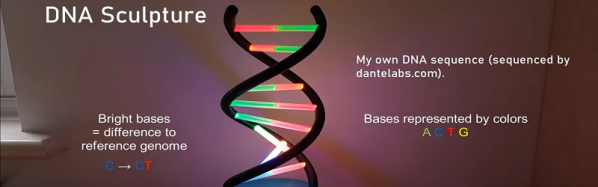
It has recently been possible to pay a service a little bit of money and learn more about your own DNA. You might find out you really aren’t Italian after all or that you are more or less susceptible to some ailments. [Paul Klinger] had his DNA mapped and decided to make a sculpture representing his unique genetic code. The pictures are good, but the video below is even better.

The project requires a DNA sequencing, a 3D printer, and a Raspberry Pi Zero. Oh, you can probably guess you need a lot of RGB LEDs, too. Of course, the display doesn’t show the whole thing at one time — your DNA pattern scrolls across the double helix.

Continue reading “Art Imitates DNA” →

A 60 GHz Phased Array

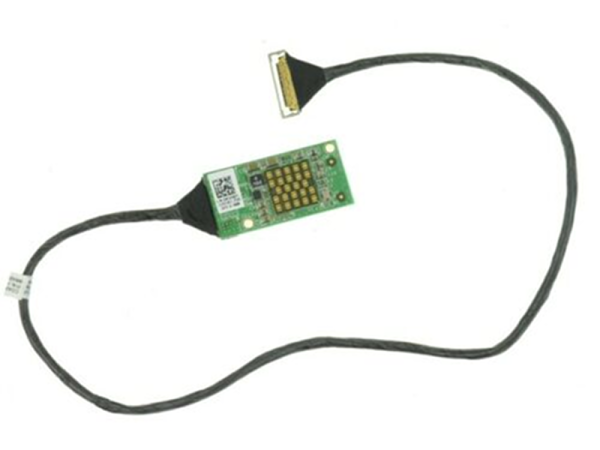
Our friend [Hunter Scott] gave a talk at a past Supercon about phased array antennas. He mentioned he was looking for collaborators to create an antenna with the SiBeam SB9210 chip. This is a specialized chip for WirelessHD, a more or less failed video streaming protocol, and it’s essentially an entire 60 GHz phased array on a chip with both transmit and receive capabilities. For $15, it seems like quite the bargain, and [Hunter] still wants to put the device to work.

The downside is that Lattice bought SiBeam and killed this chip — not surprising considering WirelessHD never really took off. However, [Hunter] says the chip was in some old smart TVs and laptops. If you can find replacement boards for those devices on the surplus market, you can get the chip and the supporting circuitry for a song.

Continue reading “A 60 GHz Phased Array” →

The Internet Of Football

While football in the United States means something totally different from what it means in the rest of the world, fans everywhere take it pretty seriously. This Sunday is the peak of U.S. football frenzy, the Super Bowl, and it is surprisingly high-tech. The NFL has invested in a lot of technology and today’s football stats are nothing like those of the last century thanks to some very modern devices.

It is kind of interesting since, at the core, the sport doesn’t really need a lot of high tech. A pigskin ball, some handkerchiefs, and a field marked off with some lime and a yardstick will suffice. However, we’ve seen a long arc of technology in scoreboards, cameras — like instant replay — and in the evolution of protective gear. But the last few years have seen the rise of data collection. It’s being driven by RFID tags in the player’s shoulder pads.

These aren’t the RFID chips in your credit card. These are long-range devices and in the right stadium, a computer can track not only the player’s position, but also his speed, acceleration, and a host of other statistics.

Continue reading “The Internet Of Football” →

The Multiyear Hunt For A Gameboy Game’s Bug

[Enddrift] had a real problem trying to run a classic game, Hello Kitty Collection: Miracle Fashion Maker, into a GBA (Gameboy Advance) emulator. During startup, the game would hit an endless loop waiting for a read from a non-existent memory location and thus wouldn’t start under the emulator. The problem is, the game works on real hardware even though that memory doesn’t exist there, either.

To further complicate things, a similar bug exists when loading a saved game under Sonic Pinball Party. Then a hack for Pokemon Emerald surfaced that helped break the case. The story is pretty interesting.

Continue reading “The Multiyear Hunt For A Gameboy Game’s Bug” →

The Ohio Scientific 300 Trainer

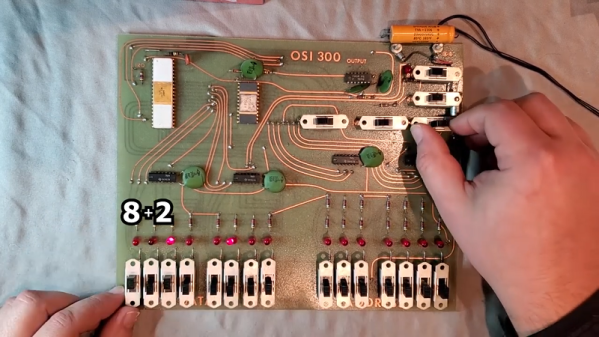
In the late 1970s there were a host of companies that dominated the computer market before the introduction of the IBM PC. One of these was Ohio Scientific or OSI. [BradH] has an OSI Model 300 trainer — their first major product — and gives us a peek at it along with some history of the company.

Companies like OSI, Southwest Technical Products, Osborne, Northstar, and PolyMorphic were the second wave after the likes of MITS and IMSAI had opened the personal computer market. Only a few companies like Apple hung on and made it work over the long haul.

Continue reading “The Ohio Scientific 300 Trainer” →

RemoteXY Simplifies Arduino Control

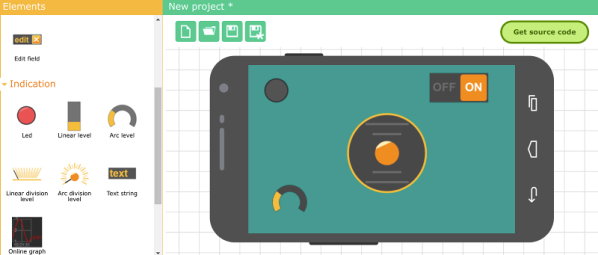
[Labpacks] wanted to build a robot car controlled by his phone. As a Hackaday reader, of course you probably can imagine building the car. Most could probably even write a phone application to do the control. But do you want to? In most cases, you are better off focusing on what you need to do and using something off the shelf for the parts that you can. In [Labpacks’] case, he used Visuino to avoid writing ordinary code and RemoteXY to handle the smartphone interface.

RemoteXY is a website that allows you to easily build a phone interface that will talk to your hardware over Bluetooth LE, USB, or Ethernet (including WiFi). One thing of interest: even though the interface builder is Web-based, the service claims that the interface structure stays on the controller. There’s no interaction with the remote servers when operating the user interface so there is no need for an external Internet connection.

Continue reading “RemoteXY Simplifies Arduino Control” →

Understand Linux Htop Visually

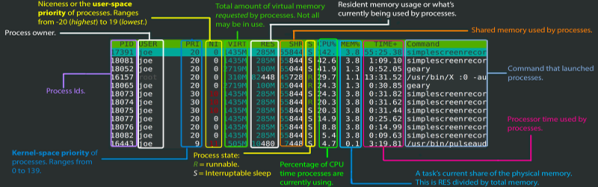
If you want to know exactly what’s going on in your Linux system, some of you might reach for top. For the connoisseur of system monitors, nothing less than htop will do. Not familiar with htop? [Umer Mansoor] did a beautiful job of explaining it graphically.

We’ve mentioned htop in a previous Linux Fu, but we’ve never gotten a chance to dig into it. And now, we don’t have to.  Like top, the htop program is still text-based, but it has a much nicer interface with colors, and easier way to send signals to processes, and support for tree displays. You can even use the mouse with it if you want to.

[Umer] did a lot of work to take screenshots of htop at work and annotate them. Sure, you could read the man page, but we think this is a lot better.

Of course, there are other improvements to top. Glances is pretty interesting, for example. For serious system administration help, you can try Webmin or Cockpit.