CNC Your Own PCB With This Tutorial

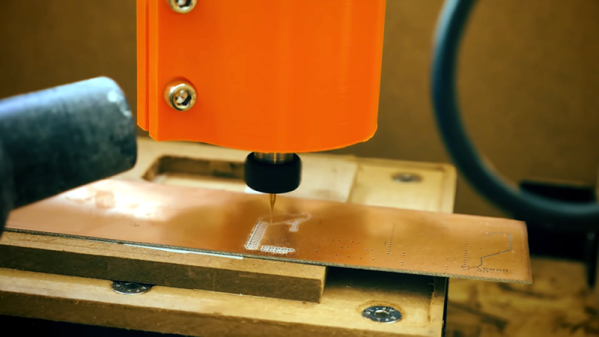
It is getting so easy to order a finished printed circuit board that it is tough to justify building your own. But sometimes you really need a board right now. Or maybe you need a lot of fast iterations so you can’t wait for the postal service. [Thomas Sanladerer] shows how he makes PCBs with a CNC machine and has a lot of good advice in the video below.

He starts with Eagle, although, you could use any creation package. He shows what parameters he changes to make sure the traces don’t get eaten away and how to do the CAM job to get the files required to make the boards. If you don’t use Eagle, you’ll need to infer how to do similar changes and get the same kind of output.

We’ve only heard a few people pronounce Gerber (as in Gerber file) with a soft G sound, but we still knew what he meant. We have the same problem with GIF files. However, once you have Gebers, you can join the video’s workflow about 5 minutes in.

At that point, he uses FlatCAM to convert the Gerbers to a single G-code file that integrates the paths and drill files. There were a few tricks he used to make sure all the tracks are picked up. Other tricks include leveling a spoil board by just milling it down and mounting different size bits. He also has ideas on aligning the Z axis.
Continue reading “CNC Your Own PCB With This Tutorial”

3D Printing Logic Gates

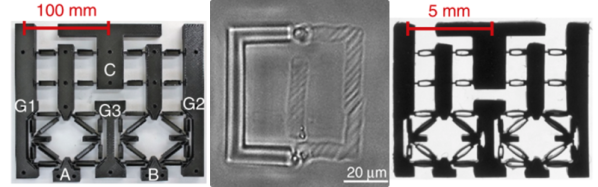
It may seem a paradox, but in the future tiny computers may dump electronics and return to their mechanical roots. At the macroscale, mechanical computers are fussy and slow, but when your area is down to a few molecules, electronics have trouble working but mechanical systems do just fine. In addition, these devices don’t use electricity directly, don’t generate electronic signatures, and may be less sensitive to things like radiation that damage electronics. A recent paper in Nature Communications discusses how to 3D print common logic gates using both macro-scale 3D printing techniques and a much smaller version with microstereolithography. You can see a video of gates in action below.

The gates use a bistable flexible mechanism. The larger gates use ABS plastic and measure about 250mm square. The smaller gate measures less than 25 mm square. They also use a special technique to make gates as small as 100 microns theoretically possible, although some of that is future work for the team.

Continue reading “3D Printing Logic Gates”

Grape Plasma Explained

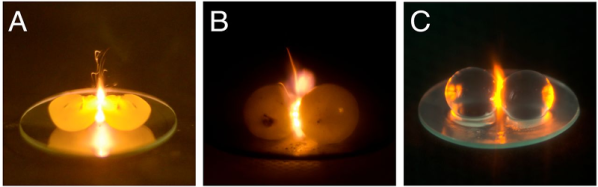
You’ve probably seen the videos of a grape — cut almost totally in half — in a microwave creates a plasma. A recent physics paper studies the phenomenon with a lot of high-tech gear and now the actual mechanism is known. [Veritasium] interviews the scientists and explains the grape plasma phenomenon in plain language. You can see the video below or read the paper directly.

Turns out the grape is about 1/10 of the microwave frequency and the refractive index of the grape at microwave frequencies might be as much as ten. A whole grape can get all the microwaves trapped inside, but two grapes — or two halves — that touch create fields strong enough to ionize the air.

Continue reading “Grape Plasma Explained”

Anodize Aluminum Easily

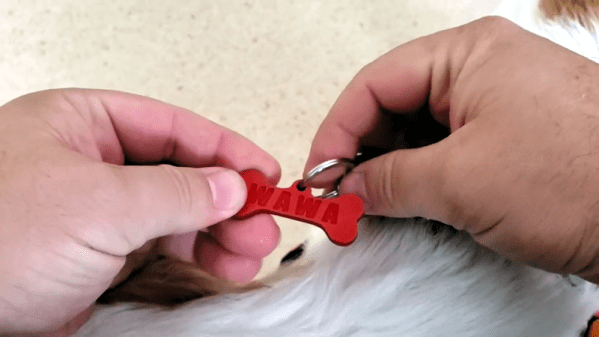
We’ve all seen brightly-colored pieces of aluminum and can identify them as anodized. But what does that mean, exactly? A recent video from [Ariel Yahni] starring [Wawa] — a four-legged assistant — shows how to create pieces like this yourself. You can see [Wawa’s] new dog tag, below.

[Ariel] found a lot of how to information on using sulphuric acid, but that’s dangerous stuff. One web page we covered years ago, though, discussed a safer chemistry. The process requires lye and a common pool chemical used to decrease pH. Sodium hydroxide isn’t super safe, but it is much less problem to buy, store, and use than battery acid.

Continue reading “Anodize Aluminum Easily”

Ceramic Aerogel Meets Stretch Goals

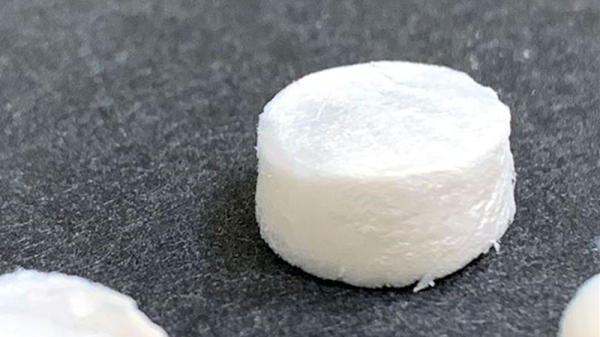
Aerogels have changed how a lot of high tech equipment is insulated. Resembling frozen smoke, the gel is lightweight and has extremely low thermal conductivity. However there’s always a downside, traditional aerogel material is brittle. Any attempt to compress it beyond 20% of its original size will change the material. Researchers at UCLA and eight other universities around the world have found a new form of ceramic aerogel that can compress down to 5% of its original size and still recover. It is also lighter and able to withstand extreme temperature cycles compared to conventional material. The full paper is behind a paywall, but you can view the abstract.

Traditional aerogel is more likely to fracture when exposed to high temperatures or repeated temperature swings, but the new material is more robust. Made from boron nitride, the atoms have a hexagonal pattern which makes it stronger.

Continue reading “Ceramic Aerogel Meets Stretch Goals”

Ludwig Promises Easy Machine Learning From Uber

Machine learning has brought an old idea — neural networks — to bear on a range of previously difficult problems such as handwriting and speech recognition. Better software and hardware has made it feasible to apply sophisticated machine learning algorithms that would have previously been only possible on giant supercomputers. However, there’s still a learning curve for developing both models and software to use these trained models. Uber — you know, the guys that drive you home when you’ve had a bit too much — have what they are calling a “code-free deep learning toolbox” named Ludwig. The promise is you can create, train, and use models to extract features from data without writing any code. You can find the project itself on GitHub.io.

The toolbox is built over TensorFlow and they claim:

Ludwig is unique in its ability to help make deep learning easier to understand for non-experts and enable faster model improvement iteration cycles for experienced machine learning developers and researchers alike. By using Ludwig, experts and researchers can simplify the prototyping process and streamline data processing so that they can focus on developing deep learning architectures rather than data wrangling.

Continue reading “Ludwig Promises Easy Machine Learning From Uber”

Pathio: New 3D Slicer From E3D

Having a great word processor won’t actually help you write the next bestselling novel. It might make it easier, but if you have a great novel in you, you could probably write it on paper towels with a crayon if you had to. A great 3D printer isn’t all you need to make great 3D prints. A lot depends on the model you start with and that software known as a slicer. You have several choices, and now you have one more: PathIO, a slicer sponsored by E3D, is out in beta. You can see a video about its features below.

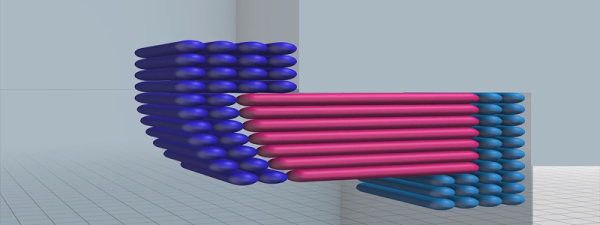
The software has a few rough edges as you might expect from a beta. The slicer doesn’t feed Gcode to a printer directly, although Octoprint integration is forthcoming. Developers say they are focusing on the slicing engine which is totally new. According to their website, conventional slicers immediately cut a model into 2D slices and then decide how to realize each slice with respect to the shell and infill. Pathio works in 3D space and claims this has benefits for producing correct wall thickness and an increase in self-supporting geometries.

Continue reading “Pathio: New 3D Slicer From E3D”