IR Rework Station

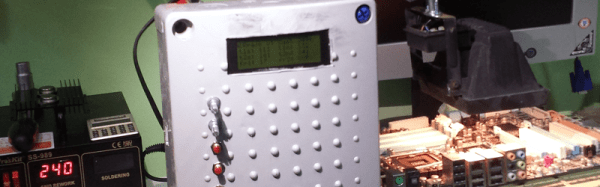
Modern surface mount components often need special tools for rework. However, those tools can be expensive. [Michael Skrepsky] wanted an infrared rework station, but didn’t like the price. So he built his own.

According to [Michael] he used a lot of scrap in the construction. . He used K-type thermocouples, optotriacs, triacs, a 20×4 display and, of course, an Arduino. An old bathroom heater, along with a 600W and 100W halogen bulb work as heaters.

Continue reading “IR Rework Station”

That’s Life…on A Hackaday Badge

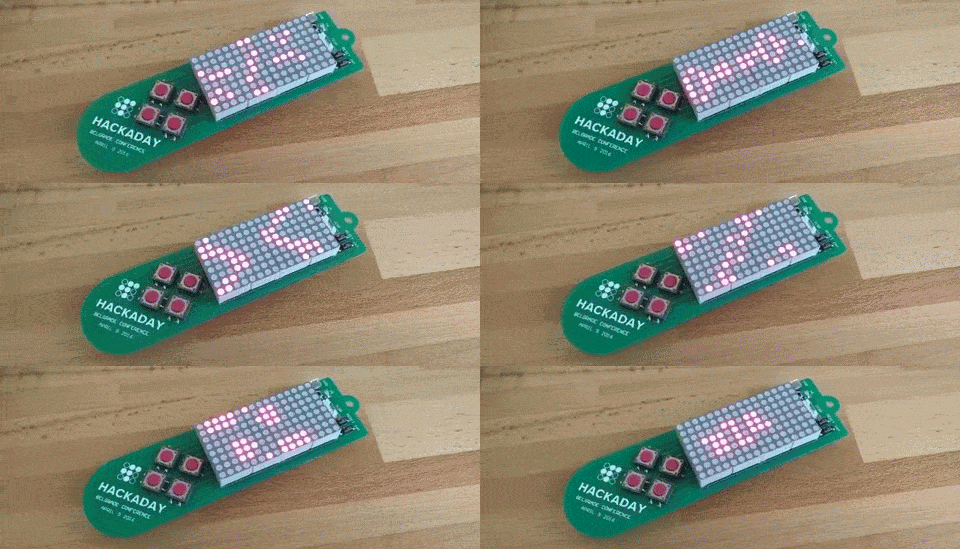
Our Hackaday Chief [Mike] sent me an e-mail the other day with a link to the Belgrade Hackaday Badge simulator. He clearly wanted me to enter something into the demo scene competition. The good news is that because of the simulator, you didn’t have to leave your desk to participate. The bad news is that I had very little time left at the end of the month, so I wanted to do something appealing but it had to be fairly easy to roll out. I wound up doing a very quick project but it had a few fine points that I thought I’d share. The end goal was to have an interesting display of Conway’s game of life on the badge.

By the way, there was a completely different project with the same goal by [Jeremias] on Hackaday.io. As far as I know, this was just the result of two people setting out to do the same thing. You’ll see the user interface is a good bit different, so you might see which you prefer.

If you haven’t seen it, the real badge is below. The emulator, of course, just runs as a window on your PC. For those that will be at the conference, or just want to program closer to the actual hardware, there is now a preconfigured MPLABX framework  for the PIC18LF25K50 and the bootloader/kernel running on this badge.

Continue reading “That’s Life…on A Hackaday Badge”

Cheap Air Pickup

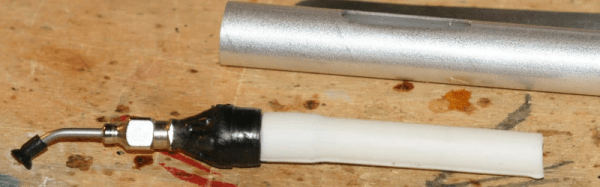
If you work with surface mount components, you might want an air pickup tool (sometimes called air or vacuum tweezers). You can find inexpensive ones that use a bulb or spring mechanism (like a solder sucker). While these are cheap, they don’t work very well. [Natsfr] had one of these cheap tools and decided to add a proper pump to make it work like a much more expensive tool.

Continue reading “Cheap Air Pickup”

A 2,200 Pound Personal Computer

[Connor Krukosky] wanted to buy another computer. Even though he is only 18, he had his first computer at 18 months old. He’s had plenty since then and his interest in computers led him to pursue a career in electrical engineering. A few years ago, [Conner] started collecting vintage computers.

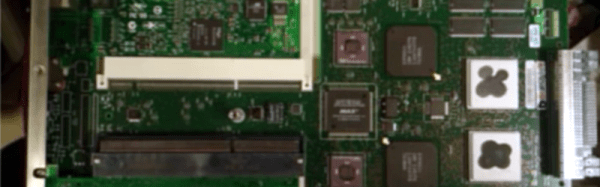
He’d bought up some Apple computers, terminals, and even a Data General minicomputer. Then he found a notice that Rutgers was auctioning off an IBM z890 mainframe computer. People warned [Conner] that this wasn’t a desktop workstation, it was a 2,200 pound case that probably wouldn’t fit through standard doors.

He was undeterred. He won the auction for under $240. The real expense, of course, would be moving it. He planned to make two trips: One to strip the machine to parts and bring some parts back and then a second trip to get the remaining parts.

You can see in the video below that he had a lot of adventure moving the beast. Things didn’t fit and even some excavation had to happen to get the computer in his basement.

Continue reading “A 2,200 Pound Personal Computer”

Lazy Bluetooth: Build With BLE, Don’t Reinvent It

It is a good bet that you have at least one Bluetooth device hanging around. Headsets, mice, keyboards, and speakers have become increasingly common. Bluetooth forms a short range wireless network and can also perform file transfers and create virtual serial ports.

If you have ever had to stop listening to music to recharge a Bluetooth headphone, you know Bluetooth won’t run long on batteries. In 2006, Nokia introduced Wibree, which would later become Bluetooth Low Energy (or BLE). These days it’s used in everything and it’s well worth your time to gather a basic understanding of this technology.

Continue reading “Lazy Bluetooth: Build With BLE, Don’t Reinvent It”

Remote Sensing Bombs Could Stem Terrorism

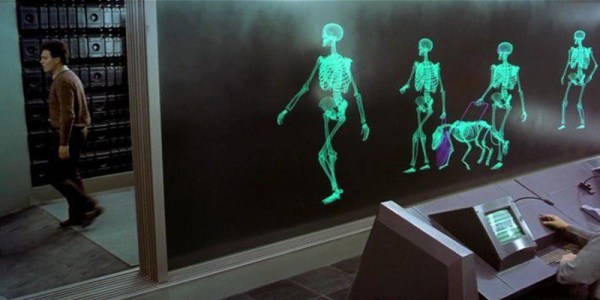
If you understand technology, there were a lot of things hard to explain on Star Trek. Transporters, doors that were smart enough to open unless you hit them during a fight, and the universal translator all defy easy explanation. But one of the hardest things to explain were Mr. Spock’s sensors. From the ship or with a tricorder, Spock could sense at a distance just about anything from chemical compositions, to energy, and even the presence of life (which, today, at least, is difficult to determine even what that means).

Remote sensing would have a very distinct use in today’s world: finding terrorist bombs earlier. A recent article published on New Scientist by [Debora MacKenzie] points out that stopping attacks like the recent one in Brussels is difficult without increasing congestion. For example, putting checkpoints at doors instead of inside transit stations is common in Asia, but causes lines and delays.
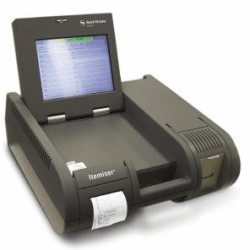
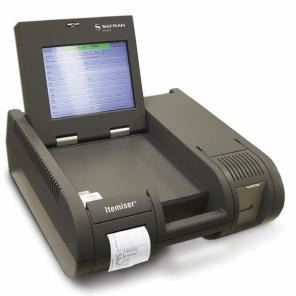
detecThe United States has used ion mobility spectrometry (IMS) to detect explosive traces on swabs (using machines like the one on the left). However in the early 2000’s they experimented with a version of the device that used puffs of air to determine if people had explosives while they passed by the machine. By 2010, officials decided the machines broke down too often and stopped using them.

Remote Sensing in Practice

According to an expert at Rand Corporation, remote sensing is likely to employ imaging or sniffers. However, imaging solutions are easy to fool since a bomb can take the shape of an ordinary object. Sniffers, including biological sniffers (known as dogs), are harder to fool. The problem is that deploying thousands of dogs to cover the world’s airports is difficult.

Continue reading “Remote Sensing Bombs Could Stem Terrorism”

Improving The RTL-SDR

The RTL-SDR dongle is a real workhorse for radio hacking. However, the 28.8 MHz oscillator onboard isn’t as stable as you might wish. It is fine for a lot of applications and, considering the price, you shouldn’t complain. However, there are some cases where you need a more stable reference frequency.

[Craig] wanted a stable solution and immediately thought of a TCXO (Temperature Compensated “Xtal” Oscillator). The problem is, finding these at 28.8 MHz is difficult and, if you can find them, they are relatively expensive. He decided to make an alternate oscillator using an easier-to-find 19.2 MHz crystal.

Continue reading “Improving The RTL-SDR”