Helping Gorilla Hands

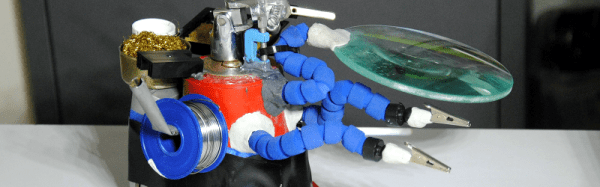
Helping hands are a common soldering aid. These inexpensive devices usually have a substantial base, a pair of alligator clips to hold a workpiece, and sometimes a magnifying glass. [Yonatan24] (who happens to be 13 years old) built his own set using a siren horn as a base. Lately, however, he decided to enhance it quite a bit to use Gorillapod arms and incorporate a solder cleaning and a variety of other features. Of course, there is a magnifier along with a solder waste collection bin.

The build is well-detailed, although since [Yonatan24] salvaged some of the parts, you might have to make adjustments to match the parts you use. The Gorillapod arms are from a cheap tripod, but a lot of the material was left over or stripped from junk (like the lead weight).

We’ve seen workbench PCB holders before (including a 3D printed one), of course, but you have to admire the look of this one, as well as the overboard set of features.

BabyBaby: A 1948 Computer On An FPGA

The Manchester Baby seems simple today. A 32-bit machine with 32 words of storage. It wasn’t meant to be a computer, though, but a test bed for the new Williams tube storage device. However, in 1948, it executed stored programs at about 1,100 instructions per second. The success of the machine led to a series of computers at Manchester University and finally to the first commercially available computer, the Ferranti Mark I.

[Dave] is lucky enough to volunteer to demonstrate the Baby replica at Machester’s Museum of Science Industry. He wanted his own Baby, so he used a Xilinx FPGA board to build a replica Baby named BabyBaby. Although it runs at the same speed as the original, it is–mercifully–much smaller than the real machine.

Continue reading “BabyBaby: A 1948 Computer On An FPGA”

Ten Mile Raspberry Pi WiFi (with A Catch)

How would you like to have a WiFi connection that covers 10 miles? Or how about an even wider network made up of a mesh of multiple nodes? It is possible, but there is a catch: you probably need a ham radio license to do it (at least, you do in the United States).

What makes it possible is the realization that conventional WiFi channels 1-6 are inside an existing US ham band. That means (if you are a ham) you can elect to use FCC part 97 rules instead of part 15 that governs WiFi routers. That means you can use more power and–even more importantly–better antennas to get greater range.

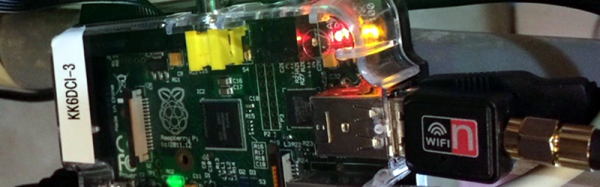
Traditionally, hams have used custom firmware for Netgear routers or Ubiquiti hardware. However, [WZ0W] recently posted his experience using Raspberry Pi boards as mesh nodes. The code (which also works with some other single board computers) is available on GitHub (with details on the project blog). [WZ0W] points out that, unlike using a consumer router, using a Pi provides a reasonably powerful computer for hosting services as well as hosting the network.

Continue reading “Ten Mile Raspberry Pi WiFi (with A Catch)”

DIY Hakko Soldering Station

[Julez] wanted another soldering station, so he decided to build one himself using a Hakko 907 soldering iron (or a clone). Of course, he could have bought a station, but anyone who reads Hackaday doesn’t require an explanation for why you would build something you could buy.

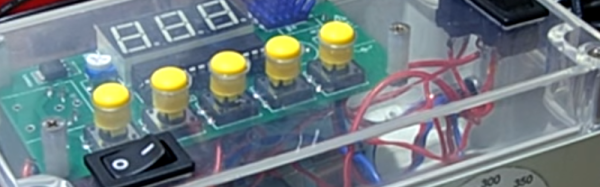
The station has two switchable outputs so you can use two different irons (perhaps with different tips) although you can only use one at a time. [Julez] bought a case with a transparent top from eBay and also got a digital temperature controller from eBay, which is the heart of the project. As for the actual iron, you can find clone versions of the 907 handpiece for well under $10.

Because the station uses a module, the actual wiring isn’t terribly difficult. There’s a pot to control the temperature and the controller directly connects to the iron’s heating element and temperature probe. There’s also a standby switch that reduces the temperature using a fixed resistor in series with the control pot.

Continue reading “DIY Hakko Soldering Station”

Raspberry Pi + Wolfram Data Drop

When you think of Mathematica and Wolfram, you probably think high-power number crunching. You might not think embedded systems. Wolfram runs on the Raspberry Pi, however, and there is a recent video (below) showing a Raspberry Pi, controlling I/O devices, and interacting with the Web using Wolfram data drop.

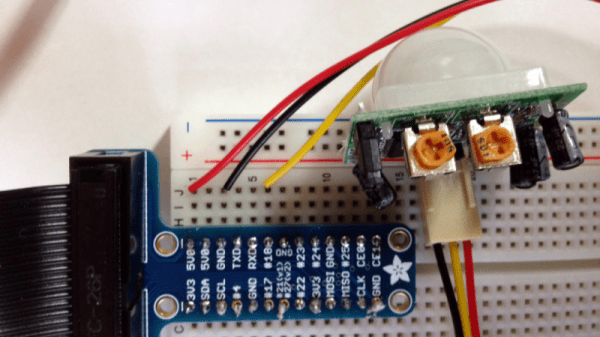
The second video, below, shows some older example projects including a simple home alarm with a PIR sensor. Not the kind of thing that Wolfram is known for, but fine as a “hello world” project. There is even a project that uses an Arduino for more I/O. Between the two videos, you can get a good idea of the sort of things you can accomplish using a Pi with the language.

Continue reading “Raspberry Pi + Wolfram Data Drop”

LiteBSD Brings 4.4BSD To PIC32

A few years ago [Serge Vakulenko] started the RetroBSD project–a 16-bit port of the old 2.11BSD operating system to the Microchip PIC32 microcontroller. This was impressive, but version 2 of BSD is, to most people, old news and somewhat difficult to use compared to modern BSD and Linux operating systems.

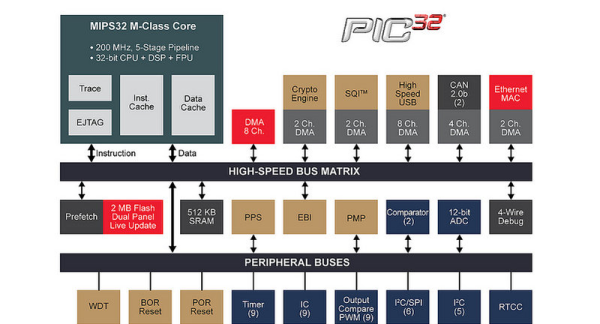
[Serge] has been at it again, however, and now has a port of 4.4BSD–LiteBSD–running on the PIC32MZ. According to [Alexandru Voica] there is about 200K of user space memory in the basic build, and by removing some OS features, you could double or triple that figure.

Continue reading “LiteBSD Brings 4.4BSD To PIC32”

BGA Hand Soldering Video

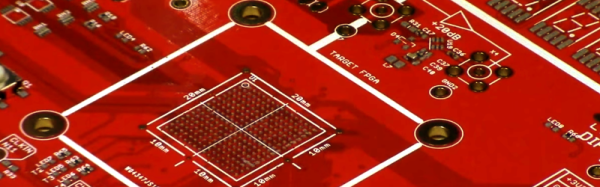
By 2016, most people have got the hang of doing SMD soldering in the garage–at least for standard packaging. Ball Grid Array or BGA, however, remains one of the more difficult packages to work with [Colin O’Flynn] has an excellent video (almost 30-minutes, including some parts that are sped up) that shows exactly how he does a board with BGA.

Continue reading “BGA Hand Soldering Video”