Hybrid Rocket Engine Combines Ceramic Aerospike With 3D Printed Fuel

[Integza] has worked hard over the last year, crafting a variety of types of rocket and jet engine, primarily using 3D printed parts. Due to the weaknesses of plastic, all of which conflict with the general material requirements for an engine that gets hot, he has had less thrust and more meltdowns than he would have liked. Undeterred, he presses on, now with a hybrid rocket aerospike design. The goal? Actually generating some thrust for once!

The latest project makes the most of what [Integza] has learned. The aerospike nozzle is 3D printed, but out of a special thick ceramic-loaded resin, using a Bison 1000 DLP printer. This allowed [Integza] to print thicker ceramic parts which shrunk less when placed in a kiln, thus negating the cracking experienced with his earlier work. The new nozzle is paired with a steel rocket casing to help contain combustion gases, and the rocket fuel is 3D printed ASA plastic. 3D printing the fuel is particularly cool, as it allows for easy experimentation with grain shape to tune thrust profiles.

With the oxygen pumping, the new design produces some thrust, though [Integza] is yet to instrument the test platform to actually measure results. While the nozzles are still failing over a short period of time, the test burns were far less explosive – and far more propulsive – than his previous efforts. We look forward to further development, and hope [Integza’s] designs one day soar high into the sky. Video after the break.

Continue reading “Hybrid Rocket Engine Combines Ceramic Aerospike With 3D Printed Fuel”

Testing 3D Printed Worm Gears

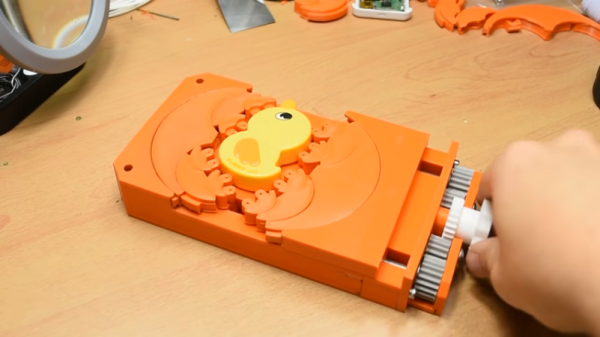
Worm gears are great if you have a low-speed, high-torque application in which you don’t need to backdrive. [Let’s Print] decided to see if they could print their own worm gear drives that would actually be usable in practice. The testing is enlightening for anyone looking to use 3D printed gearsets. (Video, embedded below.)

The testing involved printing worm gears on an FDM machine, in a variety of positions on the print bed in order to determine the impact of layer orientations on performance. Materials used were ABS, PLA and PETG. Testing conditions involved running a paired worm gear and worm wheel at various rotational speeds to determine if the plastic parts would heat up or otherwise fail when running.

The major upshot of the testing was that, unlubricated, gears in each material failed in under two minutes at 8,000 RPM. However, with adequate lubrication from a plastic-safe grease, each gearset was able to run for over ten minutes at 12,000 RPM. This makes sense, given the high friction typical in worm gear designs. However, it does bear noting that there was little to no load placed on the gear train. We’d love to see the testing done again with the drive doing some real work.

It also bears noting that worm drives typically don’t run at 12,000 RPM, but hey – it’s actually quite fun to watch. We’ve featured some 3D printed gearboxes before too, pulling off some impressive feats. Video after the break.

Continue reading “Testing 3D Printed Worm Gears”

Play Your Favorite Nokia Game On The Raspberry Pi Pico

In many people’s memories, Snake lived and breathed on Nokia handsets from the late 90s and early 2000s. However, the game has been around for much longer than that, and will continue to live on in the future. That’s at least in part thanks to people like [Hari Wiguna] keeping it alive by implementing it on new platforms.

[Hari] set about writing Snake in MicroPython for the Raspberry Pi Pico. The hardware side of things is simple enough – five buttons hooked up to the Pico, along with an 128×64 I2C OLED screen to display the game on. On the software side of things, [Hari] pushed the boat out, deciding that his version of Snake had to have the player character slither like the real thing. This took a little effort to get right, particularly when navigating corners in different directions. However, perseverance paid off and [Hari] got the job done.

Code is on GitHub for those that want to tinker at home. It’s a tidy piece of work, though not the weirdest place we’ve seen the game appear – we’ve actually seen it run within PCB routing software before thanks to some nifty scripting. Video after the break. Continue reading “Play Your Favorite Nokia Game On The Raspberry Pi Pico”

TrueTape64 Is A PC Interface For Your C64 Datasette

Back in the distant past of the 1980s, software was distributed on audio tape. Ones and zeroes were encoded as tones of different frequencies, and tapes were decoded by specialised hardware which could then spit out raw digital data to an attached computer. While software methods now exist to simply record audio from old tapes and turn them into data, [Francesco] wanted to do it the hardware way, and built a PC interface for his Commodore 64 Datasette.

The TrueTape64, as it has been named, is built around an Atmel ATTiny2313 microcontroller. This interfaces with the original Datasette hardware which takes care of reading the analog tape output and turning it into digital data. From there, the microcontroller communicates with an FTDI232 serial-to-USB adapter to get the data into a modern PC, where it’s compiled into a TAP image file via some Python magic.

It’s a barebones build, which goes so far as to run the Datasette’s motor off the USB power supply via a boost converter; those facing issues with the tape mechanism might do well to look there first. However, it does work, and a done job is a good job at the end of the day. We’ve seen similar hacks before, too – it’s great to see the community keeping cassette software alive!

South Australia Vs. Too Much Home Solar

Once upon a time, the consensus was that renewable energy was too expensive and in too sparse supply to be a viable power source to run our proud, electrified societies on. Since then, prices of solar panels have tanked, becoming more efficient along the way, and homeowners have been installing them on their rooftops in droves.

Where once it was thought we’d never have enough solar energy, in some cities, it’s becoming all too much. In South Australia, where solar output can be huge on a sunny day, electricity authorities are facing problems with grid stability, and are taking measures to limit solar output to the grid.

Isn’t More Usually Better?

The problem faced by South Australian utilities is one of how to properly control an electrical grid with many thousands of distributed power sources. Typically, in conventional modern power grids, voltage and frequency is controlled within set limits by carefully matching the supply from major power plants with the demand from users. Fast-response plants can be brought online to meet shortfalls, and switched off when demand drops, and everything hums along nicely.

Unfortunately, solar power isn’t so easy to throttle, and even less so when it’s coming from thousands of separate households each with their own rooftop install and an inverter to feed back into the grid. This has led to authorities contemplating measures such as charging homeowners to export energy to the grid in peak periods in an effort to slow the huge uptake of home solar systems. Export limits have also been proposed for suburbs with the highest concentration of home solar, as substations in certain residential areas struggle to cope under the huge inflows of energy. Continue reading “South Australia Vs. Too Much Home Solar”

PHP Gets A Demoscene Engine Of Its Very Own

When we think demoscene, our first thought is typically of 80s computers, particularly the Commodore 64 and Amiga 500 which were widely regarded as the awesomest of their time. However, you can write a demo on any platform you wish, and [OxABADCAFE] has done just that – in PHP.

Pretty, no?

Going by PDE, standing for Pointless, Portable, or PHP Demo Engine, the code is available on GitHub for the curious. The code is set up for RGB ASCII terminal output, for a beautifully old-school aesthetic. Demo sequences can be programmed in JSON files, with the code executing a default in-built demo if none is provided.

There’s no audio yet, so you’ll have to cool your thumping chiptune jets until that’s available in a later release. With that said, we look forward to more development expanding what can be done with the engine – after all, there’s nothing more demoscene than pushing the limits. Video after the break.

Continue reading “PHP Gets A Demoscene Engine Of Its Very Own”

How To Build A Turbo Car The Cheap, 90s Way

If you want to coax more power out of your car’s engine, a turbocharger is a great way to go about it. Taking waste energy from the exhaust and using it to cram more air into the engine, they’re one of the best value ways to make big gains in horsepower.

However, unlike simpler mods like a bigger exhaust or a mild cam swap, a turbocharger install on a naturally aspirated, fuel-injected engine often requires a complete replacement of the engine management system, particularly on older cars. This isn’t cheap, leaving many to stick to turbocharging cars with factory tuneable ECUs, or to give up altogether. In the 1990s, aftermarket ECUs were even more expensive, leading many to avoid them altogether. Instead, enthusiasts used creative hacks to make their turbo builds a reality on the cheap, and there’s little stopping you from doing the very same today.

Continue reading “How To Build A Turbo Car The Cheap, 90s Way”