Voltmeter Clock Looks Great On Display

Voltmeters are cheap, and have a great industrial aesthetic about them. This makes them prime candidates for hackers looking to do a clock build. [Brett Oliver] went down this very road, and built a very stylish timepiece along the way.

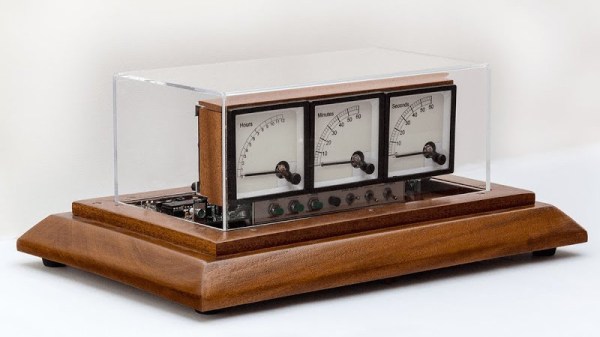
[Brett] initially wanted to go with 240-degree voltmeters, however the cost was prohibitive, so settled for the more common 90-degree models. New dials were produced by first sanding down the old dials, repainting in an old-fashioned off-white, and then applying the new graphics with inkjet transfer paper.

The attention to detail continues with the case. [Brett] aimed to build the clock with an old-school lab equipment aesthetic. A large piece of mahogany was crafted into the base.  A clear plastic cover was sourced from eBay, which really makes the piece. Large buttons and toggle switches were chosen to complete the look.

On the electronic side of things, it’s all run by a PIC16F628A, which controls the voltmeters via PWM. Running with a 20MHz crystal, the PIC is not a great timekeeper. Instead, the whole show is synchronized to [Brett]’s master clock we featured a few years back.

Building a clock is a rite of passage for a hacker, and [Brett]’s example goes to show how craftsmanship can really pay off in this pursuit. Video after the break.
Continue reading “Voltmeter Clock Looks Great On Display” →
Macro Photography With Industrial Lenses

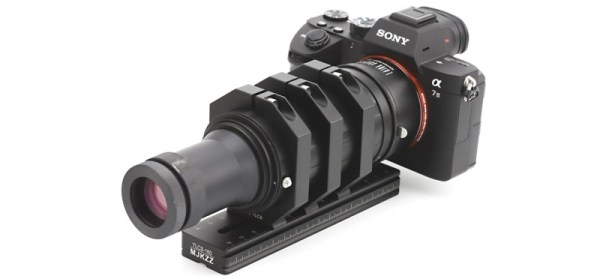
Line scan cameras are advanced devices used for process inspection tasks in industrial applications. Used to monitor the quality of silicon wafers and other high-accuracy tasks, they’re often outfitted with top-quality optics that are highly specialised. [Peter] was able to get his hands on a lens for a line-scan camera, and decided to put it to work on some macro photography instead.

Macro image taken with the hacked lens.

Judging by the specs found online, this is a fairly serious piece of kit. It easily competes with top-shelf commercial optics, which is what piqued [Peter]’s interest in the part. Being such a specialised piece of hardware, you can’t just cruise over to eBay for an off-the-shelf adapter. Instead, a long chain of parts were used to affix this lens to a Sony AIII DSLR, converting from threaded fittings to a Nikon mount and then finally to Sony NEX mount.

Further work involved fitting an aperture into the chain to get the lens as close as possible to telecentric. This improves the lens’s performance for certain tasks, and makes focus stacking macro shots more readily achievable – something we’ve seen [Peter] tinker with before.

You never know what you might find when sorting through surplus industrial gear, could could score some high-performance hardware if you know where to look. It’s always great to see a cheap find become a useful instrument in the hacker toolbox!

Focus Stacking For Tiny Subjects

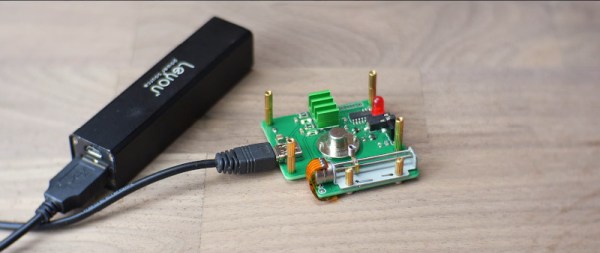
Focus stacking is a photographic technique in which multiple exposures are taken of a subject, with the focus distance set to different lengths. These images are then composited together to create a final image with a greater depth of field than is possible with a single exposure. [Peter Lin] built a rig for accurate focus stacking with very small subjects.

The heart of the rig is a motion platform consisting of a tiny stepper motor fitted with a linear slide screw. This is connected to an Arduino or PIC with a basic stepper driver board. While the motor does not respond well to microstepping or other advanced techniques, simply driving it properly can give a resolution of 15 μm per step.

The motor/slide combination is not particularly powerful, and thus cannot readily be used to move the camera or optics. Instead, the rig is designed for photography of very small objects, in which the rail will move the subject itself.

It’s a tidy build that would serve well for anyone regularly doing macro focus stack photography. If you’ve been trying to better photograph your insect collection, this one is for you. It’s a valuable technique and one that applies to microscopy too. Video after the break.

Continue reading “Focus Stacking For Tiny Subjects” →

Analog Meter Clock Uses Parts From A Simpler Time

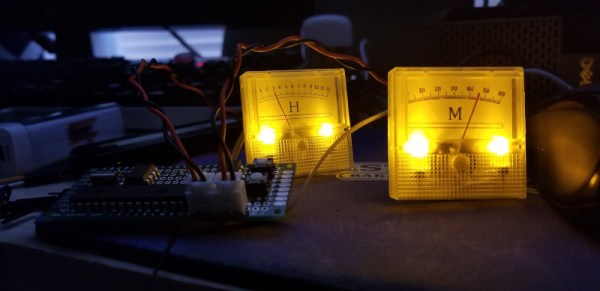
Clocks with hands that turn are all well and good for the common folk, but hacker types prefer something different. [Sjm4306] is one such person, and developed this analog dial clock with parts we’d almost consider retro by modern standards.

The microcontroller at the heart of the build is a PIC16F886. An 8-bit micro from the Microchip brand, it features no Arduino bootloader or USB interface, being flashed via a dedicated programmer. This is combined with a DS1302 real-time clock to keep accurate time, and a MCP4922 DAC which is responsible for generating the output to drive the dials. The dials themselves are sourced from eBay, being simple voltmeters. They’re given a new backing to display hours and minutes instead of volts, and backlit with LEDs for style.

In this day and age, we’re more used to seeing high-end micros used with integrated DACs and USB programming, but it’s nice to see the parts of yesteryear being used, too. It’s not the first clock we’ve seen from [sjm4306], either. Video after the break.

Continue reading “Analog Meter Clock Uses Parts From A Simpler Time” →

Building A Spinning Moiré Effect Lamp

A concise, comical explanation of Moiré patterns, via XKCD.

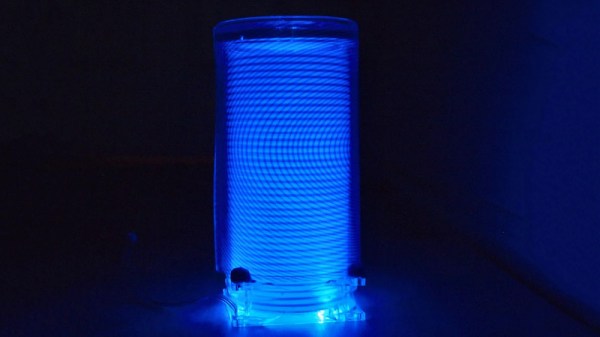
Moiré patterns are interference patterns created when grids of different size or alignment are placed over each other. You’ve probably seen these when photographing a TV screen or looking through a pair of windows screens at the same time. [ChrysN] put the effect to work with this spinning Moiré lamp build.

It’s a build that can be achieved with scrap-bin components. An LED-encrusted PC cooling fan is used as the base of the lamp, fitted with Sugru bumpers to hold a cheap glass vase. A line pattern is then printed on to paper, rolled into a cylinder, and slid on to the fan to spin with the blades, inside the vase. Another line pattern is then printed on to a transparency (a printable transparent sheet for those who don’t remember overhead projectors) and slid around the outside of the vase. When powered up, the LEDs glow, and the fan spins, creating a hypnotizing moving moiré pattern.

It’s a simple but visually captivating build, and one that should keep you up at night thanks to the blue LEDs. Moiré patterns can do so much more though – they’re even put to work guiding ships. Video after the break.

Continue reading “Building A Spinning Moiré Effect Lamp” →

Word Clock Does The Job With Laser-Etched Acrylic

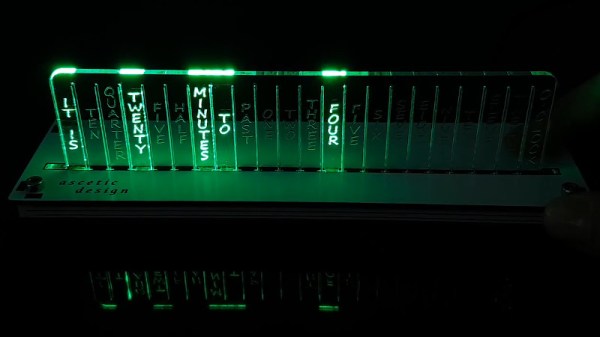
As far as telling the time, word clocks go out of their way to spell it out for you. As long as you know the language, they’re a stylish and effective way to get the message across. [Simon] built an elegant, stripped-back word clock of his own, with a laser cutter helping to get the job done.

The core of the build is an Arduino Nano, hooked up to a string of 22 WS2812B LEDs, driven via the FastLED library. An NXP PCF8563T serves as the real-time clock, to ensure stable and accurate timekeeping. The electronics are all housed inside an enclosure that appears to be constructed from PCBs, with instructions on operating the clock printed on the base.

The actual display is via laser-cut and laser-etched acrylic. The display piece slides into the top of the clock, with the LEDs edge lighting various segments to display the relevant words that make up the current time. The clock is designed in such a way that these display slides can be easily switched out to change the look of the clock, with different fonts and designs.

It’s a quick and clean take on the popular word clock design, and one any makerspace could whip up in a weekend. As far as word clocks go, however, the sky really is the limit when it comes to complexity. Video after the break.

Continue reading “Word Clock Does The Job With Laser-Etched Acrylic” →

Compact 3D Printed Hovercraft Is Loungeroom Floor Fun

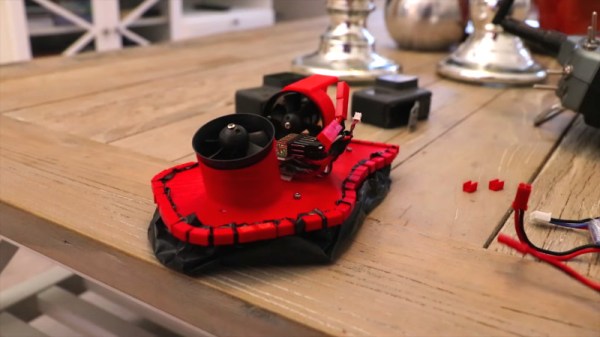
Hovercraft come in all shapes and sizes. and while they’ve largely disappeared as a major commercial transit option, they remain popular in the hearts and minds of makers everywhere. [RCLifeOn’s] latest project concerns a compact, indoor-sized hovercraft piloted via FPV, and it looks to be brilliant fun.

The build consists of a 3D printed chassis, with a skirt cut out of a garbage bag and held on with press-fit clamps. Twin ducted fans are employed, one for propulsion, the other for levitation. A 5GHz FPV camera is nestled on top of the rear fan housing to provide a video feed for the pilot.

The craft was somewhat uncontrollable in initial testing. Tweaks to the weight distribution and the addition of a bigger rudder helped tame the rig. [RCLifeOn] also demonstrates a unique way of balancing damaged fan assemblies in the field; it’s a technique we’ll keep in the back of our mind for future use.

The trick to a good hovercraft build is light weight, big control surfaces, and a good skirt. You can even go off-book and use the Coanda effect, if you’re so inclined. Video after the break.

Continue reading “Compact 3D Printed Hovercraft Is Loungeroom Floor Fun” →