Vertical Train Hauls Up The Wall

Trains are great for hauling massive amounts of cargo from point A to point B, and occasionally, point C on weekends. But they’re not really known for climbing hills well, and anything vertical is right out. Regardless, [Can Altineller] knows what he wants and set to work, creating the 3D Printed Wall Train.

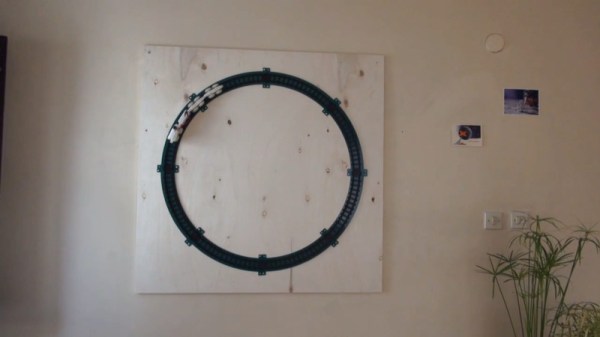
The first step was to get the train to stick to a vertical surface. This was achieved with the use of neodymium magnets in the train, which are attracted to laser-cut steel plates beneath the plastic tracks. The train itself consists of a custom 3D printed locomotive, outfitted with a motor and step-down gears that drive all four wheels. Said wheels are of a conical shape, and covered with rubber to provide enough grip to overcome gravity. The project is a progression from [Cal]’s earlier four-motor build.

The final result is a charming wall display, with the four-wheel drive train merrily tugging its carriages around the circular course ad infinitum. It’s a fun build, and we’d love to see similar techniques applied to a bigger layout. If this whets your appetite for model railroading, consider building your own turntable, or implementing some fancy sensors. Video after the break.


Continue reading “Vertical Train Hauls Up The Wall” →

The Young Engineers Guide To University Capstone Projects

Engineering degrees are as wide and varied as the potential careers on offer out in the real world. There’s plenty of maths to learn, and a cavalcade of tough topics, from thermodynamics to fluid mechanics. However, the real challenge is the capstone project. Generally taking place in the senior year of a four-year degree, it’s a chance for students to apply everything they’ve learned on a real-world engineering project.

Known for endless late nights and the gruelling effort required, it’s an challenge that is revered beforehand, and boasted about after the fact. During the project, everyone is usually far too busy to talk about it. My experience was very much along these lines, when I undertook the Submarine That Can Fly project back in 2012.  The project taught me a lot about engineering, in a way that solving problems out of textbooks never could. What follows are some of the lessons I picked up along the way. Continue reading “The Young Engineers Guide To University Capstone Projects” →

A Super Easy Laser Engraver

CNC comes in all shapes and sizes, from huge industrial lathes to homebuilt wire benders. [MJKZZ] has built their own compact rig, using optical drive parts to create a cute but effective laser engraver. (Video embedded below.)

The build aims to keep things simple by holding the laser stationary, and moving the bed instead. The laser in question is a 500 mW unit, driven by the Z axis on the Arduino CNC shield used to run the system. A DVD drive is taken apart, and the worm drive stepper motor assembly is used to slew the carriage back and forth, atop which is glued a bed. Upon this bed, a copy of the same assembly is then installed, offset 90 degrees, giving the X and Y axes.

The result of this setup is a lightweight moveable bed, controllable through Gcode with GRBL. With the laser situated above on some camera mounting gear, paper can be installed on the bed and engraved with ease. The resulting accuracy is admirable, and at full power, the laser is capable of cutting through the paper.

While it’s a lightweight rig, it could serve a purpose as a cheap and easy way to produce stencils from computerized artwork. Optical drives remain popular in the DIY CNC scene, as they’re a great way to source a moveable platform with all the mechanical considerations already worked out.

Continue reading “A Super Easy Laser Engraver” →

Microphone Isolation Shield Is A Great IKEA Hack; Definitely Not A Xenomorph Egg

As any content creator knows, good audio is the key to maintaining an audience. Having a high quality microphone is a start, but it’s also necessary to reduce echoes and other unwanted noise. An isolation shield is key here, and [phico] has the low down on making your own.

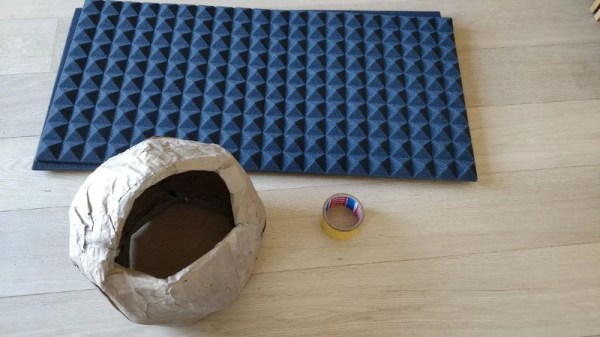
The build starts with an IKEA lampshade, so it’s a great excuse to head down to the flatpack store and grab yourself some Köttbullar for lunch while you’re at it (that’s meatballs for those less versed in IKEA’s cafeteria fare). This is really more of a powder-coated steel frame than a shade, perfect as the bones of an enclosure. [Phico] hacks it open with a Dremel to make room for the microphone. Cardboard soaked in wallpaper paste is then used to create a papier-mache-like shell, which is then stuffed with acoustic foam. A small opening is left to allow the narrator’s voice to reach the microphone, while blocking sound from other directions. Finally, a stocking is wrapped around the whole assembly to act as an integral anti-pop filter.

It’s a tidy build, and while it looks a bit like a boulder to some, if you encounter a room full of ovomorphs that look just like this, tiptoe right out of there. IKEA hacks are always popular, and this laser projector lamp is a great example. If you’ve got your own nifty Swedish-inspired build, make sure you let us know!

New Silicon Carbide Semiconductors Bring EV Efficiency Gains

After spending much of the 20th century languishing in development hell, electric cars have finally hit the roads in a big way. Automakers are working feverishly to improve range and recharge times to make vehicles more palatable to consumers.

With a strong base of sales and increased uncertainty about the future of fossil fuels, improvements are happening at a rapid pace. Oftentimes, change is gradual, but every so often, a brand new technology promises to bring a step change in performance. Silicon carbide (SiC) semiconductors are just such a technology, and have already begun to revolutionise the industry.

Mind The Bandgap

A graph showing the relationship between band gap and temperature for various phases of Silicon Carbide.

Traditionally, electric vehicles have relied on silicon power transistors in their construction. Having long been the most popular semiconductor material, new technological advances have opened it up to competition. Different semiconductor materials have varying properties that make them better suited for various applications, with silicon carbide being particularly attractive for high-power applications. It all comes down to the bandgap.

Electrons in a semiconductor can sit in one of two energy bands – the valence band, or the conducting band. To jump from the valence band to the conducting band, the electron needs to reach the energy level of the conducting band, jumping the band gap where no electrons can exist. In silicon, the bandgap is around 1-1.5 electron volts (eV), while in silicon carbide, the band gap of the material is on the order of 2.3-3.3 eV. This higher band gap makes the breakdown voltage of silicon carbide parts far higher, as a far stronger electric field is required to overcome the gap. Many contemporary electric cars operate with 400 V batteries, with Porsche equipping their Taycan with an 800 V system. The naturally high breakdown voltage of silicon carbide makes it highly suited to work in these applications.

Continue reading “New Silicon Carbide Semiconductors Bring EV Efficiency Gains” →

Object Tracking Camera Slider Gets The Nice Shots

In this day and age, where all leisure activities must be duly captured and monetized online, camera sliders are hot items. Many start with a simple manual build, before graduating to something motorized for more flexibility. [Saral Tayal] took things a step further, implementing a basic tracking mode for even sweeter shots. 

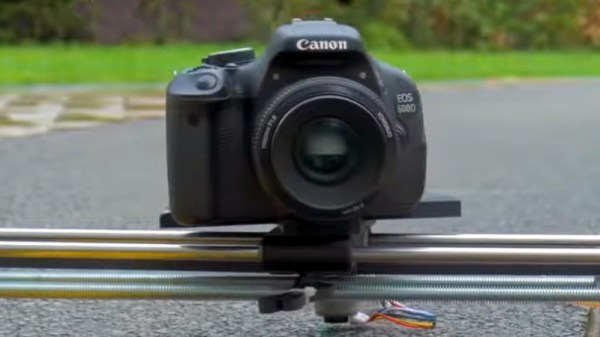
The build is mechanically simple, relying on 8mm steel rods and linear bearings more typically found in 3D printers. An Arduino Uno is pressed into service to run the show, outfitted with an OLED screen to run the interface. A RoboClaw motor controller is used to control the geared DC motors used, one controlling the linear motion, the other the rotation of the camera.

With encoders fitted to the motors, the RoboClaw controller enables the Arduino to track the position and rotation of the slider as it moves. The slider then can be given the position of an object relative to itself. With a little maths, it will rotate the camera to track the object as it moves along.

It’s a simple addition to the typical slider build that greatly increases the variety of shots that can be achieved. There are plenty of ways to go about building a slider, too, as we’ve seen before. Video after the break.

Continue reading “Object Tracking Camera Slider Gets The Nice Shots” →

Mimic Artfully Employs LEDs In Fashion

Any science fiction piece set in the near-future involves clothes that light up or otherwise have some form of electronics inside. This hasn’t happened in mainstream fashion just yet, but [Amped Atelier] are doing serious work in the field. Mimic was their entry for the 2016 MakeFashion Gala, serving as a great example of LEDs in fashion done right.

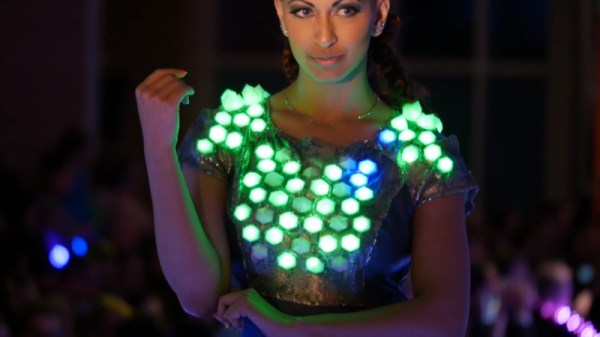
Mimic consists of two pieces, designed as cocktail dresses that mimic their surroundings, in much the same way as a chameleon. LEDs are controlled by an Arduino, fitted with a colour sensor. When activated, the Arduino can change the color of the LEDs to match whatever is presented to the sender. This technology could serve as a great way to avoid clashing with a friend’s outfit, or to send a surreptitious signal to your ride that you’re ready to leave.

The LEDs are hidden beneath attractive geometric diffusers, which are 3D printed directly on to the fabric of the outfit. This gives an attractive, finished look to the garment, and allows the diffusers to naturally flow with the lines of the piece.

These pieces show that it’s possible to create glowable night wear that is as stylish as it is high tech. If you’re looking for something a little edgier however, we’ve got that too. Video after the break.

Continue reading “Mimic Artfully Employs LEDs In Fashion” →