Can You Store Renewable Energy In A Big Pile Of Gravel?

As the world grapples with transitioning away from fossil fuels, engineers are hard at work to integrate new types of generation into the power grid. There’s plenty of challenges, particularly around the intermittent nature of many renewable energy sources. Energy storage projects are key to keeping the lights on round the clock, even when the wind isn’t blowing and the sun isn’t shining.

Conventional grid-level energy storage has long made use of pumped hydro installations where water is pumped uphill to a storage reservoir where it can later be used to run a generator. More recently, batteries are being used to do the job. When you consider the cost of these installations and their storage capacities, there is a gap between batteries and pumped hydro. A recently published whitepaper proposes Mountain Gravity Energy Storage — gravity-based energy storage using sand or gravel in mountainous areas — is the technology that can bridge the gap.

Continue reading “Can You Store Renewable Energy In A Big Pile Of Gravel?” →
Building A Mechanical Oscillator, Tesla Style

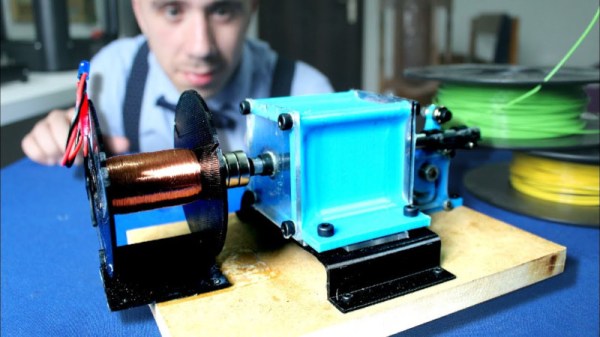
Before Tesla devised beautifully simple rotary machinery, he explored other methods of generating alternating current. One of those was the mechanical oscillator, and [Integza] had a go at replicating the device himself. (Video, embedded below the break.)

Initial attempts to reproduce the technology using 3D-printed parts were a failure. The round cylinder had issues sealing, and using O-ring seals introduced too much friction to allow the device to oscillate properly. A redesign that used external valving and a square cylinder proved more successful.

Once the oscillator was complete, the output shaft was fitted with magnets and a coil to generate electricity. After generating a disappointing 0.14 volts, [Integza] went back and had a look at the Maxwell-Faraday equations. Using this to guide the design, a new coil was produced with more turns, and the magnetic flux was maximised. With this done, the setup could generate seven volts, enough to light several LEDs.

While it’s not a particularly efficient generator, it’s a great proof-of-concept. Yes, Tesla’s invention worked, but it’s easy to see why he moved on to rotary designs when it came to real-world applications. We’ve seen [Integza] take on other builds too, like the ever-popular Tesla turbine.

Continue reading “Building A Mechanical Oscillator, Tesla Style” →

Cooking A Turkey With 880 AA Batteries

Cooking a turkey right is serious business this time of year. With major holidays on the line, there’s no room for error – any mistake can leave guests disgruntled and starving. [Stephen Farnsworth] took a risk, though, and attempted to cook a turkey using AA batteries.

The allure of the AA for such a task is precisely because it’s such a poor choice. Designed for portability rather than high power output, it was never designed to be the energy source for a major cooking job. To get things over the line, [Steve] busted out the math to figure out how many batteries would be required. This involved computing cooking efficiencies, battery thermal performance, and the specific heat of the bird itself. With the numbers coming together a 300W slow cooker was put on duty, in order to avoid over-draining the batteries.

With 880 AAs loaded into a custom carrier, [Steve] hooked up the power meter and the cooker and kept a close eye on the temperatures. After a couple of hours, the battery pack started to heat up, so additional cooling was brought in to avoid fire. At just before the six hour mark, the turkey was cooked through and ready to eat. Estimates are that the batteries still had plenty of capacity to keep going for a few hours yet, too.

It’s not a fast or effective way to cook a turkey, but it’s certainly achievable. We fully expect [Steve] to submit the coin-cell turkey cook-off next year, too. Remember, a little engineering always helps, especially in the kitchen. Video after the break.

Continue reading “Cooking A Turkey With 880 AA Batteries” →

John McMaster Explains Crypto Ignition Phone Keys And How To Reproduce Them

When you’re a nation state, secure communications are key to protecting your sovereignty and keeping your best laid plans under wraps. For the USA, this requirement led to the development of a series of secure telephony networks over the years. John McMaster found himself interested in investigating the workings of the STU-III secure telephone, and set out to replicate the secure keys used with this system.

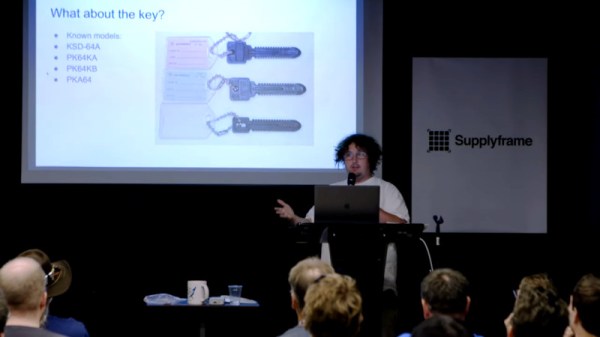
An encryption key in a very physical, real sense, the Crypto Igntion Key was used with the STU-III to secure phone calls across many US government operations. The key contains a 64KB EEPROM that holds the cryptographic data.

[John] had a particular affinity for the STU-III for its method of encrypting phone calls. A physical device known as a Crypto Ignition Key had to be inserted into the telephone, and turned with a satisfying clunk to enable encryption. This physical key contains digital encryption keys that, in combination with those in the telephone, are used to encrypt the call. The tactile interface gives very clear feedback to the user about securing the communication channel. Wishing to learn more, John began to research the system further and attempted to source some hardware to tinker with.

As John explains in his Hackaday Superconference talk embeded below, he was able to source a civilian-model STU-III handset but the keys proved difficult to find. As carriers of encryption keys, it’s likely that most were destroyed as per security protocol when reaching their expiry date. However, after laying his hands on a broken key, he was able to create a CAD model and produce a mechanically compatible prototype that would fit in the slot and turn correctly.

Continue reading “John McMaster Explains Crypto Ignition Phone Keys And How To Reproduce Them” →

How To Get Into Cars: Choosing Your First Project Car

The automobile is a wonderous invention, perhaps one of the most transformative of the 20th century. They’re machines that often inspire an all-consuming passion, capturing the heart with sights, sounds, and smells. However, for those who grew up isolated from car culture, it can be difficult to know how to approach cars as a hobby. If this sounds like you, fear not – this article is a crash course into getting your feet wet in the world of horsepower.

So You Like Cars, Eh?

Project cars let you do things that you’d never dare attempt in a daily.

The first step to becoming a true gearhead is identifying your specific passion. Car culture is a broad church, and what excites one enthusiast can be boring or even repulsive to another. Oftentimes, the interest can be spawned by a fond memory of a family member’s special ride, or a trip to a motor race during childhood.

Knowing what kind of cars you like is key to your journey. You might fall in love with classic American muscle and drag racing, or always fancied yourself in the seat of a tweaked-out tuner car a la The Fast And The Furious. Movies, posters, magazines, and your local car shows are a great way to figure out what excites you about cars. Once you’ve got an idea of what you like, it’s time to start thinking about picking out your first project car. Continue reading “How To Get Into Cars: Choosing Your First Project Car” →

Making Your Own Chain Sprockets, The Tidy Way

Chain sprockets are a key drivetrain component in a lot of builds. Unfortunately they can be difficult to source, particularly for those outside the reach of retailers like McMaster-Carr. In such situations, you might consider making your own.

The toothed profile on a chain sprocket can be produced in a simple manner by drawing a base circle, along with a series of circles spaced appropriately for the chain in question. This involves measuring the pitch and roller diameter of the chain. With these measurements in hand, a template can be created to produce the sprocket.

From there a series of holes are drilled to rough out the basic shape of the teeth, before the sprocket is then cut down to its appropriate outer diameter. The finishing work consists of chamfering the sprocket’s thickness, as well as the filing the sharp edges of the teeth for smooth engagement.

It’s a quick and easy method for producing sprockets with well-defined, accurate profiles. We’ve featured other rough and ready methods before, too. Video after the break.

Continue reading “Making Your Own Chain Sprockets, The Tidy Way” →

Dub Siren Synth Does It The Old School Way

There’s little that can compare to the sheer obnoxious thrill of mashing the DJ siren when its your turn behind the decks. We’ve certainly been guilty of abusing the privilege at local house parties, and unsurprisingly have not been invited back. If we ever get another shot, though, we’d be glad to have [lonesoulsurfer]’s dub siren at the ready.

This is a build for the old-school purists. There’s no microcontrollers or digital hardware here. The synth relies on two 555 timer ICs as the oscillators and an LM741 op-amp. These parts harken right back to the dawn of the integrated circuit era, and still do a great job in this application. There’s also a cheap reverb/echo module added in to fatten up the sound. It’s all laced up in an old CB radio enclosure, with the classic woodgrain applique doing much to add to the aesthetic.

It’s a build that’s simple enough for the electronics beginner, and would make a great tactile, analog addition to any DJ’s rig. If you need some wubwubs to go with your woowoos, then consider building a Ball of Dub, too.

Continue reading “Dub Siren Synth Does It The Old School Way” →