Fake: A Laser Display Board Of Your Very Own

Update 6/23/21: Many people have called this out as fake. When viewed at 1/4 speed, you can see the logos in the YouTube video are always full-off or full-on and never caught mid way through a scanned frame. The images may be projected from off-camera to the left, rather than by the diode behind the screen. It’s a neat idea, but on closer review the demo provided smells a bit fishy so we’ve added a “Real or Fake” tag and updated the title. Update #2: [Kanti Sharma] wrote into the tipsline apologizing for the faked video, saying that he tried to get it to work but couldn’t and then “used a phone and a lens to fake the laser”. Thanks for fessing up to this one.

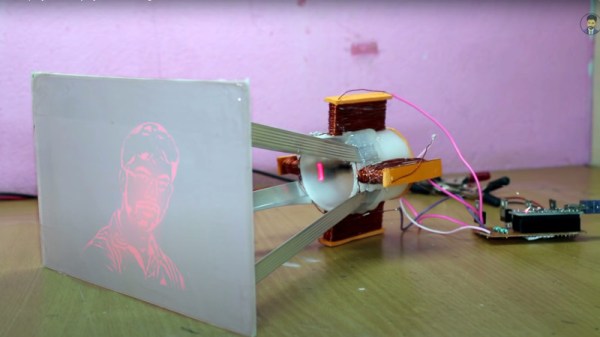
There are some times when an awesome project comes into your feed, but a language barrier intervenes as you try to follow its creator’s description. [Kanti Sharma]’s laser display appears to be a fantastic piece of work, but YouTube’s automatic translations in the video below make so little sense as to leave us Anglophones none the wiser as to what he’s saying. The principle comes across without need for translation though: he’s taken a laser diode module and is using it to create a vector scan by mounting it in the middle of a set of coils driven through beefy FETs by an Arduino. It’s an electromagnetic take on the same principle used in a CRT vector displays such as the famous Vectrex console, with the beam of electrons replaced with laser light.

It’s a technique not unlike what’s  been used for years in the lighting industry, in which much larger laser displays are created with mirrors mounted on galvanometers. There must be a physical limit at which the weight of the laser slows down the movement, but if the video is to be believed it’s certainly capable of displaying graphics on a screen.

People have done a lot of things with lasers on these pages, but there have been surprisingly few vector displays using them. Here’s one from nearly a decade ago.

Continue reading “Fake: A Laser Display Board Of Your Very Own”

Illustrated Kristina with an IBM Model M keyboard floating between her hands.

Keebin’ With Kristina: The One With The Chinese Typewriter

As much as I’d like to devote an article to each and every bit of keyboard-related what-have-you that I come across in my travels through the intertubes, there just aren’t enough hours. And after all, this isn’t Clack-a-Day. To that end, I gained editorial approval to bring you a periodic round-up of news and other tidbits on the keyboard and keyboard accessories front, and here we are. So let’s get to it!

Continue reading “Keebin’ With Kristina: The One With The Chinese Typewriter”

Microscopy Hack Chat With Zachary Tong

Join us on Wednesday, June 23 at noon Pacific for the Microscopy Hack Chat with Zachary Tong!

There was a time when electronics was very much a hobby that existed in the macroscopic world. Vacuum tubes, wire-wound resistors, and big capacitors were all mounted on terminal strips and mounted in a heavy chassis or enclosure, and interfacing with everything from components to tools was more an exercise in gross motor skills than fine. Even as we started to shrink components down to silicon chips, the packages we put them in were still large enough to handle and see easily. It’s only comparatively recently that everything has started to push the ludicrous end of the scale, with components and processes suitable only for microscopic manipulation, but that’s pretty much where we are now, and things are only likely to get smaller as time goes on.

The microscopic world is a fascinating one, and the tools and techniques to explore it are often complex. That doesn’t mean microscopy is out of the wheelhouse of the average hacker, though. Zachary Tong, proprietor of the delightfully eclectic Breaking Taps channel on YouTube, has been working in the microscopic realm a lot lately. We’ve featured his laser scanning confocal microscope recently, as well as his latest foray into atomic force microscopy. In the past he has also made DIY acrylic lenses, and he has even tried his hand at micromachining glass with lasers.

Zach is pretty comfortable working in and around the microscopic realm, and he’ll stop by the Hack Chat to share what he’s been up to down there. We’ll talk about all the cool stuff going on in Zach’s lab, and see what else he has in store for us.

join-hack-chatOur Hack Chats are live community events in the Hackaday.io Hack Chat group messaging. This week we’ll be sitting down on Wednesday, June 23 at 12:00 PM Pacific time. If time zones have you tied up, we have a handy time zone converter.
Click that speech bubble to the right, and you’ll be taken directly to the Hack Chat group on Hackaday.io. You don’t have to wait until Wednesday; join whenever you want and you can see what the community is talking about.

Raspberry Pi Floppy Driver Uncovers Fishy Secrets

A forum post by New Zealand electronics enthusiast [zl2wrw] about retreiving waypoints from a mysterious floppy disk caught our eye. The navigation system on his friend’s fishing boat had died and was replaced. But the old waypoints were stored on a 3-1/2 inch floppy disk that was unreadable on a normal PC. Not to be deterred, [zl2wrw] then looked for another solution — apparently a list of hot NZ fishing spots is worth quite the effort.

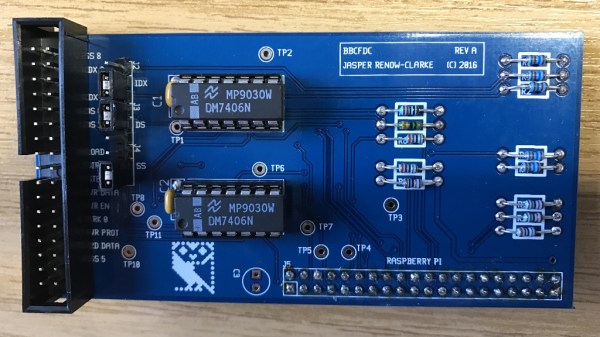
The tool he discovered, and the main point of this story, is the bbc-fdc by [Jasper Renow-Clarke] aka [picosonic]. [Jasper] made this project to read 5-1/4 inch Acorn DFS floppies from his BBC Micro. But bbc-fdc can be used to read a variety of floppy disk formats, such as DOS, C64, Apple II, and others It can also just capture raw magnetic flux transitions on the disk, blissfully unaware of any logical structure to the data. We recently wrote about another Raspberry Pi Floppy Drive Controller project by [Scott Baker]. What sets [picosonic]’s project apart is that he’s not using an FDC controller chip here. The only interface electronics is a couple of open-collector 7406 ICs. Data is read using the SPI peripheral. If you need to archive old floppy disks or do a forensic analysis of unknown disks like [zl2wrw], then one of these two projects will almost certainly do the trick.

Meanwhile back in New Zealand, [zl2wrw] discovered that the floppy format was standard (Modified Frequency Modulation, MFM) by examining the raw flux dump. However, the filesystem was a mystery — it didn’t quite match any of the usual suspects. So [zl2wrw] dug into the hex dump of the data and figured out enough of the structure to manually recover the waypoints. Subsequently, a user on the forum found a document describing the file system used by Furuno GPS units, which proved to be a close match albeit after the fact. Alas, [zl2wrw] hasn’t publish the coordinates of those good fishing spots.

Have you had any successes (or failures) when it comes to reading data from old disks? Or have you encountered peculiar disk formats and/or file systems, where having a tool like this could have been helpful? Let us know in the comments below.

Review: Inkplate 6PLUS

While the price of electronic paper has dropped considerably over the last few years, it’s still relatively expensive when compared to more traditional display technology. Accordingly, we’ve seen a lot of interest in recovering the e-paper displays used in electronic shelf labels and consumer e-readers from the likes of Amazon, Barnes & Noble, and Kobo. Unfortunately, while these devices can usually be purchased cheaply on the second hand market, liberating their displays is often too complex a task for the average tinkerer.

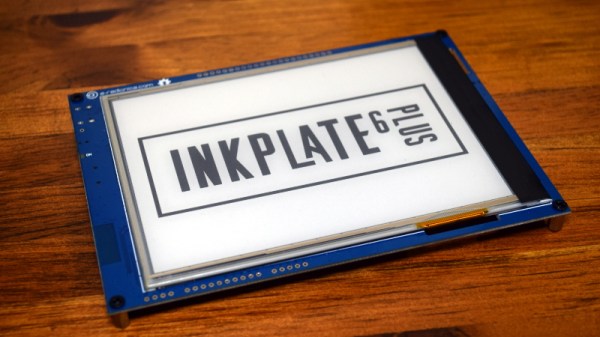
Enter the Inkplate. With their open hardware ESP32 development board that plugs into the e-paper displays salvaged from old e-readers, the team at e-radionica is able to turn what was essentially electronic waste into a WiFi-enabled multipurpose display that can be easily programmed using either the Arduino IDE or MicroPython. The $99 Inkplate 6 clearly struck a chord with the maker community, rocketing to 926% of its funding goal on Crowd Supply back in 2020. A year later e-radionica released the larger and more refined Inkplate 10, which managed to break 1,000% of its goal.

For 2021, the team is back with the Inkplate 6PLUS. This updated version of the original Inkplate incorporates the design additions from the Inkplate 10, such as the Real-Time-Clock, expanded GPIO, and USB-C port, and uses a display recycled from newer readers such as the Kindle Paperwhite. These e-paper panels are not only sharper and faster than their predecessors, but also feature touch support and LED front lighting; capabilities which e-radionica has taken full advantage of in the latest version of their software library.

With its Crowd Supply campaign recently crossing over the 100% mark, we got a chance to go hands-on with a prototype of the Inkplate 6PLUS to see how e-radionica’s latest hacker friendly e-paper development platform holds up.

Continue reading “Review: Inkplate 6PLUS”

RF Burns And Exploding PC Speakers: Sophos Looks At The Evidence

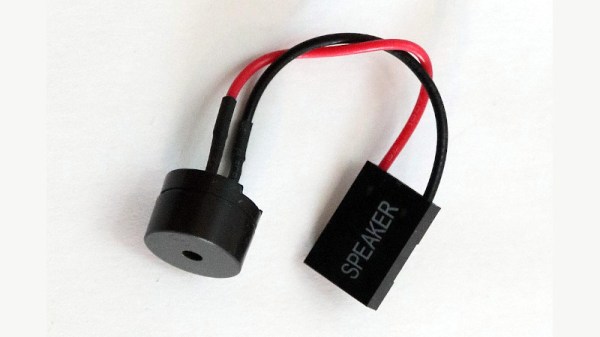
Every year in the month of June, someone by the unlikely name of [R.F. Burns] posts a question to the Linux Kernel Mailing List asking whether a Linux kernel module is possible that would blow the PC speaker. It’s fairly obviously a joke, which is why the UK-based anti-virus company Sophos have devoted a light-hearted blog post to it.

The post is an interesting diversion into early PC sounds, when the only hardware guaranteed to be present was a small speaker hooked up to a bit on an output port. The bit could be cycled for square wave beeps, or with a lot of clever manipulation could put out a low-bitrate PWM that delivered almost intelligible sounds including music and voice. They conclude that since the speaker would have been designed to be at the full amplitude of the 5-volt output bit all the time it should be impossible to blow it from software, and we’d be inclined to agree. There’s a remote possibility that some speakers might have a resonant frequency that could be found in software, but we’re not entirely convinced.

Your Hackaday scribe might have spent a while in a university computer lab back in the day trying and failing to write C code that would produce a usable PWM on an XT speaker, but those with long memories might recall the PC speaker driver for Windows 3.1. If you’re a fan of chiptune music there are even entire albums written for this most basic of instruments.

Header image: MKFI, Public domain.

Even With AC, Hazmat Suit Isn’t Really Cool

We’ll admit that the coolness factor of an air conditioned faux spacesuit made out of a hazmat suit will largely depend on where you wear it. At your next chess club meeting, maybe a hit. On a blind date, probably not. [Saveitforparts] apparently doesn’t mind and the combination of very warm weather and the donation of an expired hazmat suit, spurred his imagination as you can see in the video below.

A battery pack, a blower, and a box full of frozen water bottles completes the ensemble. Wireless temperature sensors show the outside temperature as well as temperature inside different parts of the suit. Does it work? We guess it must, but the roar of the fan is deafening and we have doubts about the frozen water cooling system. On the other hand, if you’re shooting a low budget science fiction thriller, this might be just the thing.

Even [Saveitforparts] admits this isn’t really practical and, as we suspected, he decided to get out of it as the condensing water started to run down his legs. Turns out astronauts and tank drivers use an undergarment made with small tubes of flowing water to stay cool.

This project reminded us of the positive pressure suit we saw a bit ago. Not to mention the one that went full body.

Continue reading “Even With AC, Hazmat Suit Isn’t Really Cool”