M&Ms And Skittles Sorting Machine Is Both Entertainment And Utility

If you have OCD, then the worst thing someone could do is give you a bowl of multi-coloured M&M’s or Skittles — or Gems if you’re in the part of the world where this was written. The candies just won’t taste good until you’ve managed to sort them in to separate coloured heaps. And if you’re a hacker, you’ll obviously build a sorting machine to do the job for you.

Use our search box and you’ll find a long list of coverage describing all manner and kinds of sorting machines. And while all of them do their designated job, 19 year old [Willem Pennings]’s m&m and Skittle Sorting Machine is the bees knees. It’s one of the best builds we’ve seen to date, looking more like a Scandinavian Appliance than a DIY hack. He’s ratcheted up a 100k views on Youtube, 900k views on imgur and almost 2.5k comments on reddit, all within a day of posting the build details on his blog.

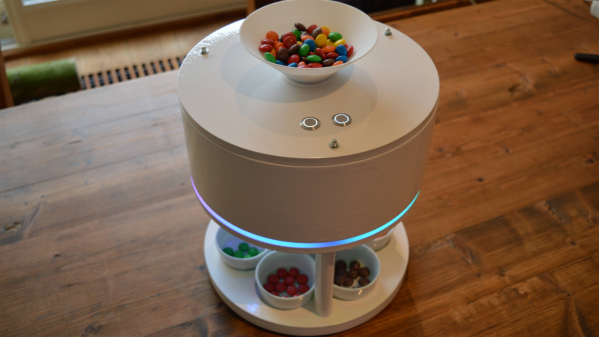
As quite often happens, his work is based on an earlier design, but he ends up adding lots of improvements to his version. It’s got a hopper at the top for loading either m&m’s or Skittles and six bowls at the bottom to receive the color sorted candies. The user interface is just two buttons — one to select between the two candy types and another to start the sorting. The hardware is all 3D printed and laser cut. But he’s put in extra effort to clean the laser cut pieces and paint them white to give it that neat, appliance look. The white, 3D printed parts add to the appeal.

Rotating the input funnel to prevent the candies from clogging the feed pipes is an ace idea. A WS2812 LED is placed above each bowl, lighting up the bowl where the next candy will be ejected and at the same time, a WS2812 strip around the periphery of the main body lights up with the color of the detected candy, making it a treat, literally, to watch this thing in action. His blog post has more details about the build, and the video after the break shows the awesome machine in action.

And if you’re interested in checking out how this sorter compares with some of the others, check out these builds — Skittles sorting machine sorts Skittles and keeps the band happy, Anti-Entropy Machine Satiates M&M OCD, Only Eat Red Skittles? We’ve Got You Covered, and Hate Blue M&M’s? Sort Them Using the Power of an iPhone!  As we mentioned earlier, candy sorting machines are top priority for hackers.

Continue reading “M&Ms And Skittles Sorting Machine Is Both Entertainment And Utility”
Skittles Sorter

Only Eat Red Skittles? We’ve Got You Covered.

Are you a bit obsessive compulsive with lots of certain things? We are too. Like Skittles! If you’re the kind of person who likes to sort their Skittles, you should seriously look into making your own 3D printed Skittles Sorter.

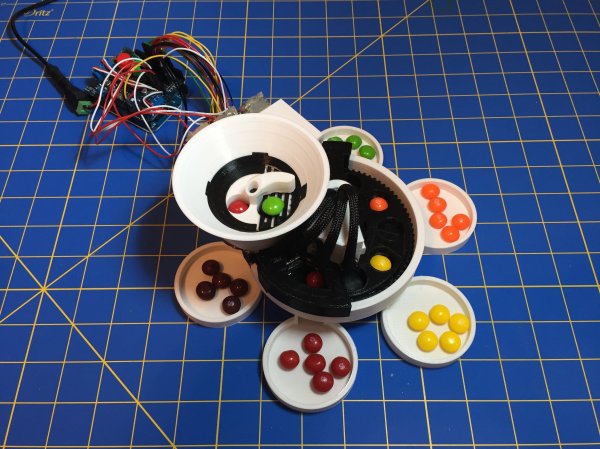
Built more to challenge his new 3D printer, [MrPrezident] was looking for a project to combine mechanical design with a bit of image recognition prowess — so he came up with this clever, and compact, Skittle sorting machine.

It uses an Arduino Uno with a ZITRADES color sensor module to identify the color of each candy. A small LED helps illuminate the Skittles to ensure an accurate color reading. Then, depending on the color, a series of gears rotate the Skittles piece to its designated color repository.

Theoretically it should also work with M&M’s (which are a bit smaller) but unfortunately, there are 6 colors of M&M’s and only 5 colors of Skittles. What would the machine do then!? We don’t see a reject bin!

Continue reading “Only Eat Red Skittles? We’ve Got You Covered.”

Webcam Eye-tracking Moves Robot-powered Skittles Candy

robot-powered-skittles

This is a great hack, and it’s an advertisement. We wish this were the norm when it comes to advertising because they’ve really got our number. Skittles enlisted a few engineers to build a web interface that moves robot-powered candies.

When we started looking into this we figured that a few robots were covered with over-sized cases that looked like Skittles. But that’s not it at all. What you see above is actually upside down. The top side of the white surface has one tiny wheeled robot for each candy. A magnet was embedded in each Skittle which holds it to the underside of the surface. The user interface was rolled out on a Facebook page. It uses a common webcam for eye tracking. When you move your eyes, the robot controlling your assigned candy moves in that direction. See for yourself in the cllip after the break.

So we say bravo Mars Inc. We love it that you decided to show off what’s behind to curtain. As with the Hyundai pixel wall, there’s a whole subset of people who might ignore the ad, but will spend a lot of time to find out how it was done.

Continue reading “Webcam Eye-tracking Moves Robot-powered Skittles Candy”

Skittles Sorting Machine Sorts Skittles, Keeps The Band Happy

In 1982, Van Halen had the biggest stage show around. Their rider – a document going over the requirements for the show – reflects this. In the middle of the requirements for the lighting and sound rigs, Van Halen placed a rather odd request; one (1) bowl of M&M, (ABSOLUTELY NO BROWN ONES). The theory being if the request for no brown M&Ms wasn’t followed, the lighting and sound rigs probably weren’t up to spec either.

It’s not M&Ms this time (they wouldn’t fit in the machine), but [egenriether] came up with a seriously clever solution for sorting Skittles by color. Why? We have no idea, other than, ‘just because.’

The build details are a little scant, but we know [egenriether] used a BASIC Stamp 2 for the electronics portion of the build. To sort the Skittles by color, a TAOS RGB color sensor reads the red, green, and blue values for each Skittle and actuates a servo that guides each piece of candy into its respective bowl.

It’s a very, very cool, if completely useless build. Still, we’re thinking it could be put to use if [egenriether] is ever backstage setting up before the band arrives.

Videos after the break. Thanks [Andrew] for sending this one in.

Continue reading “Skittles Sorting Machine Sorts Skittles, Keeps The Band Happy”

Skittles, The Robotic Blimp

Blimp 4_0

Funky Shiitake Mushrooms, a high school design team from Fremont, CA, have created a low cost airship they call Skittles the Second. Skittles is a remote control robotic blimp, complete with 4 reversible propellers, wireless video, and 2.4 a GHz remote control. Somewhere between a regular RC  blimp and a Predator Drone, Skittles and FSM have managed to gain a large number of awards including winning the Digital Open grand prize. The ship performs amazingly, and can perform a full 360 in just over one second. There is a video after the break.

For the future, the group plans to give the ship autonomous capabilities, in order to avoid losing another drone in strong wind. Fortunately, after that happened to Skittles the first, they were able to hunt it down after it had floated 3 miles down the road. Since they are all high school students under 17, we would say they have a lot of potential. I, for one, welcome our new robotic blimp overlords.

Continue reading “Skittles, The Robotic Blimp”

Tangible Sequencer Interface With Skittles


Using a webcam, some cardboard, and a bag of Skittles, [Kyle McDonald] created this tangible interface for a beat sequencer. The Skittles are dropped onto the rows which correspond to a drum channel and each Skittle represents an 1/8th note. For such cheap components, the system seems to recognize the sequences pretty quick. This is probably due to some clever programming with the processing back-end. He claims his inspiration was the BallBearing sequencer, which uses the ball bearings as contact switches to determine the sequence rather than having a webcam analyze the surface.

It would be really nice to see this project expanded into a full blown instrument. the webcam could allow for dynamic surfaces and he could certainly add more control to the system with some knobs and/or sliders. He claims these features, and the source, will soon arrive.

Tech In Plain Sight: Pneumatic Tubes

Today, if you can find a pneumatic tube system at all, it is likely at a bank drive-through. A conversation in the Hackaday bunker revealed something a bit surprising. Apparently, in some parts of the United States, these have totally disappeared. In other areas, they are not as prevalent as they once were, but are still hanging in there. If you haven’t seen one, the idea is simple: you put things like money or documents into a capsule, put the capsule in a tube, and push a button. Compressed air shoots the capsule to the other end of the tube, where someone can reverse the process to send you something back.

These used to be a common sight in large offices and department stores that needed to send original documents around, and you still see them in some other odd places, like hospitals or pharmacy drive-throughs, where they may move drugs or lab samples, as well as documents. In Munich, for example, a hospital has a system with 200 stations and 1,300 capsules,  also known as carriers. Another medical center in Rotterdam moves 400 carriers an hour through a 16-kilometer network of tubes. However, most systems are much smaller, but they still work on the same principle.

Continue reading “Tech In Plain Sight: Pneumatic Tubes”