3D Scanning Trouble? This Guide Has You Covered

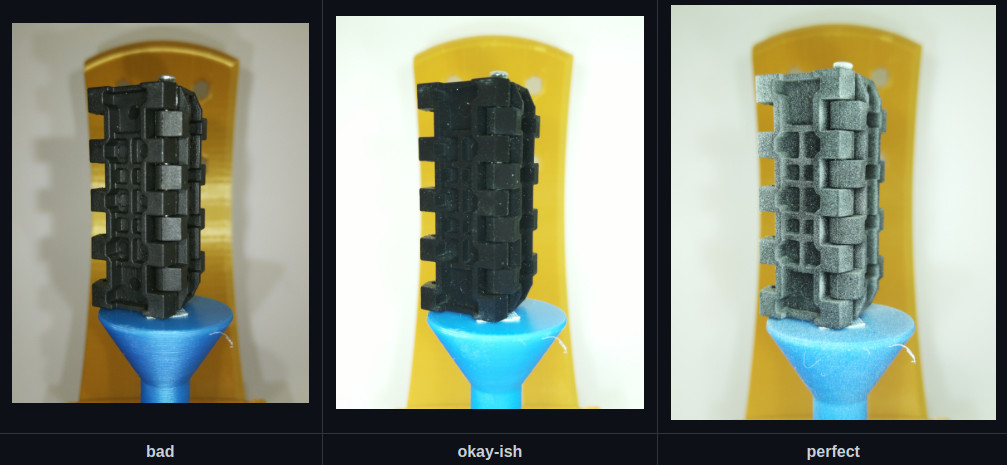
When it comes to 3D scanning, a perfect surface looks a lot like the image above: thousands of distinct and random features, high contrast, no blurry areas, and no shiny spots. While most objects don’t look quite that good, it’s possible to get usable results anyway, and that’s what [Thomas] aims to help people do with his tips on how to create a perfect, accurate 3D scan with photogrammetry.

3D scanning in general is pretty far from being as simple as “point box, press button”, but there are tools available to make things easier. Good lighting is critical, polarizers can help, and products like chalk spray can temporarily add matte features to otherwise troublesome, shiny, or featureless objects. [Thomas] provides visuals of each of these, so one can get an idea of exactly what each of those elements brings to the table. There’s even a handy flowchart table to help troubleshoot and improve tricky scan situations.
[Thomas] knows his stuff when it comes to 3D scanning, seeing as he’s behind the OpenScan project. The last time we featured OpenScan was back in 2020, and things have clearly moved forward since then with a new design, the OpenScan Mini. Interesting in an open-sourced scanning solution? Be sure to give it a look.
Go-Kart Reverse Without The Pain

Go-karts are a huge amount of fun, but often lack the most basic of mechanical conveniences such as a reverse gear. You can’t start a small four-stroke engine in reverse, so their simple chain drive transmissions lack the extra cogs to make it happen. Enter [HowToLou], who has given his go-kart a reversing option by the addition of an electric motor.

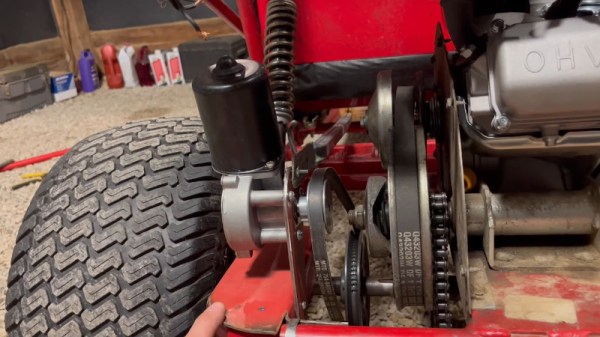
It’s an extremely simple arrangement, the motor is a geared 12 V item which drives a V-belt to the axle. The motor is mounted on a pivot with a lever, such that normally the belt isn’t engaged, thus reverse can be selected by pulling the lever. A simple button switch applies power to the motor, meaning that the machine can travel sedately backwards on electric power.

We’re not entirely convinced by the integrity of some of his fixings and it would be interesting to see how much the V-belt wears under the influence of the pulley when not engaged, but as an alternative to a full gearbox we can see the point. But then again as regular readers may know, we’re more used to full electric traction.

Continue reading “Go-Kart Reverse Without The Pain”

Quantum Circuit Uses Just A Few Atoms

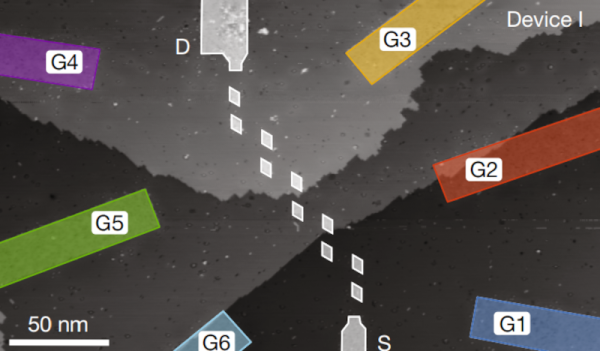
Researchers at the University of New South Wales and a startup company, Silicon Quantum Computing, published results of their quantum dot experiments. The circuits use up to 10 carbon-based quantum dots on a silicon substrate. Metal gates control the flow of electrons.  The paper appears in Nature and you can download the full paper from there.

What’s new about this is that the dots are precisely arranged to simulate an organic compound, polyacetylene. This allowed researchers to model the actual molecule. Simulating molecules is important in the study of exotic matter phases, such as superconductivity. The interaction of particles inside, for example, a crystalline structure is difficult to simulate using conventional methods. By building a model using quantum techniques on the same scale and with the same topology as the molecule in question, simulation is simplified.

The SSH (Su-Schreffer-Heeger) model describes a single electron moving along a one-dimensional lattice with staggered tunnel couplings. At least, that’s what the paper says and we have to believe it. Creating such a model for simple systems has been feasible, but for a “many body” problem, conventional computing just isn’t up to the task. Currently, the 10 dot model is right at the limit of what a conventional computer can simulate reasonably. The team plans to build a 20 dot circuit that would allow for unique simulations not feasible with classic computing tech.

The dots are made with a scanning tunneling microscope and there is a Goldilocks effect regarding the size of the dots. If they are too small, the energy levels are overwhelmed by phosphorous donors. Too large, and capacitive coupling between dots makes the system unstable.

We’ll admit, the science in the paper is pretty dense. But the Methods section outlines what it takes to create something like this. You’ll need silicon, high-temperature ovens, and the ability to handle exotic gasses and perform lithography. Pretty much an IC fab in your basement. However, we did wonder if anyone homebrewing chips had ever tried STM lithography like this as an alternative to optical lithography. Seems like it might be possible.

We can’t help with some of the more exotic gear, but if you want to build an STM, it has been done. While you can make quantum dots in your kitchen, we don’t think they are going to work the same.

The Prints Don’t Stop With This Prusa I3 MK3 Mod

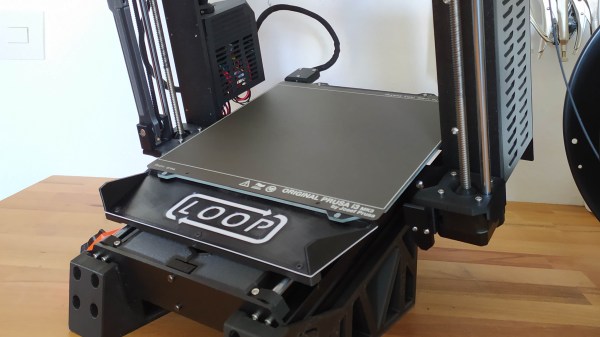
One of the issues with 3D printing is that when a print is done, you need to go back and pull the print off the bed to reset it for the next one. What if you needed to print 600 little parts for whatever reason? Most people might say get lots of printers and queue them up. Not [Pierre Trappe], as he decided that his Prusa i3 MK3S+ would print continuously.

The setup was dubbed Loop and consisted of a few parts. First, there’s an arm that sweeps the build plate to clear the printed pieces, a slide for the pieces to descend on, and a stand for the printer to sit on that puts it at an angle. The next step is to modify OctoPrint to allow a continuous print queue. The slicer needs to change as [Pierre] provides some G-code to reset the printer and clear the print.

We were especially impressed with the attention to detail in the documentation for this one. There’s extensive guidance on getting the bed adhesion just right, as you can’t have it come off mid-print, but you need it to detach cleanly and easily when the arm sweeps across the bed. Calibrating that first layer is essential, and he provides handy instructions to dial it in. Additionally, temperature and material play a crucial role, and [Pierre] documented the different materials and temperatures he used while developing Loop.

While continuous belt printers are arguably the “correct” answer to the question of printing 600 little parts, they come with their own baggage. Being able to pull off something similar on a printer as reliable and well supported as the Prusa i3 makes for a compelling alternative.

Continue reading “The Prints Don’t Stop With This Prusa I3 MK3 Mod”

picture of a brambling (a small bird), with "BirdNET-Pi" written above it

Neural Network Identifies Bird Calls, Even On Your Pi

Recently, we’ve stumbled upon the extensive effort that is the BirdNET research platform. BirdNET uses a neural network to identify birds by the sounds they make, and is a joint project between the Cornell Lab of Ornithology and the Chemnitz University of Technology. What strikes us is – this project is impressively featureful and accessible for a variety of applications. No doubt, BirdNET is aiming to become a one-stop shop for identifying birds as they sing.

There’s plenty of ways BirdNET can help you. Starting with likely the most popular option among us, there are iOS and Android apps – giving the microphone-enabled “smart” devices in our pockets a feature even the most app-averse hackers can respect. However, the BirdNET team also talks about bringing sound recognition to our browsers, Raspberry Pi and other SBCs, and even microcontrollers. We can’t wait for someone to bring BirdNET to a RP2040! The code’s open-source, the models are freely available – there’s hardly a use case one couldn’t cover with these.

Screenshot of the BirdNET-Pi interface, showing a chart of bird chirp occurences, and a spectrogram below itAbout that Raspberry Pi version! There’s a sister project called BirdNET-Pi – it’s an easy-to-install software package intended for the Raspberry Pi OS. Having equipped your Pi with a USB sound card, you can make it do 24/7 recording and analysis using a “lite” version of BirdNET. Then, you get a web interface you can log into and see bird sounds identified in real-time. Not just that – BirdNET-Pi also processes the sounds and creates spectrograms, keeps the sound in a database, and can even send you notifications.
The BirdNET-Pi project is open, too, of course. Not just that – the BirdNET-Pi team emphasizes everything being fully local, unless you choose otherwise, and perhaps decide to share it with others. Many do make their BirdNET-Pi instances public, and there’s a lovely interactive map that shows bird sounds all across the world!

BirdNET is, undoubtedly, a high-effort project – and a shining example of what a dedicated research team can do with a neural network and an admirable goal in mind. For many of us who feel joy when we hear birds outside, it’s endearing to know that we can plug a USB sound card into our Pi and learn more about them – even if we can’t spot them or recognize them by sight just yet. We’ve covered bird sound recognition on microcontrollers before – also using machine learning.

A Passive Automatic CNC Tool Changer

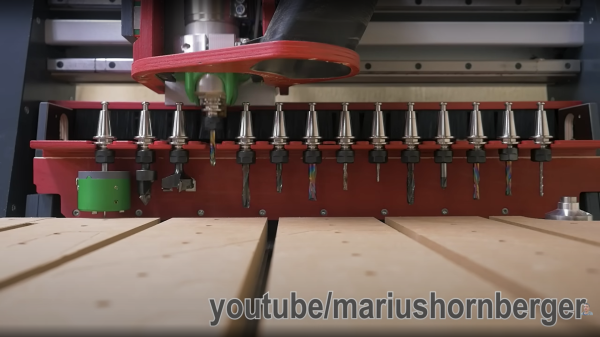
[Marius Hornberger] has been busy hacking his “Hammer” CNC router again, and now it sports a much desired feature — an automatic tool-changer. Having wanted one for a while, [Marius] was unhappy sacrificing a big chunk of useable bed area just to park the tool-changer magazine. An obvious solution would be to have the magazine retract away from the bed, outside of the working area. Sadly, the CNC controller had only enough spare outputs to drive the pneumatic tool changer (mounted on the spindle) leaving none spare to control the magazine assembly. So, there was only one obvious route to take, use some simple spring-loaded mechanics to move the magazine into tool-picking range with the Y axis motion instead.

Obviously, the whole thing is CNC machined on the machine itself, taking only a couple of iterations and smidge of table-saw action to get everything to fit well and operate smoothly without binding or colliding with the moving gantry. A cunning pair of levers on each end of the magazine allow it to move much further than the advancing gantry, swinging it quickly into position when the Y axis is at the extreme of its travel, and retracting away when the gantry moves back. Another nice addition to the build was a tool depth sensor (AKA: a switch) mounted off to one side, which allows the machine to find the bottom of each tool, if it is not known, so the Z axis can compensate. When combined with the automatically retracting dust shoe, this is a definitely a CNC build we’d love to see in a shop near us!

We’ve had a fair few CNC hacks over the years, including tool changers, like this one, but 3D printers can use some tool changer love too!

Continue reading “A Passive Automatic CNC Tool Changer”

Giant Xbox Series X Works Like A Real One

Like most home consoles, the Xbox Series X was specifically designed to fit neatly in the average home theater unit. [Michael Pick] thought that wasn’t quite big enough, and set out to build the world’s largest working Xbox Series X himself.

The build was in part inspired by a Microsoft creation: a large fridge in the shape of an Xbox Series X. However, [Michael] wanted to go further, maintaining the gaming functionality and more faithfully recreating details like the divot on the top of the console.

Carefully positioned servos press the Xbox’s buttons

The first step was to build a big wooden frame, with wooden panels screwed on to create the basic form of the console. Creating the lovely curved and perforated top was done by 3D printing a series of pieces that were all glued together to emulate the feature on the real console itself. The back was also given fake giant ports that look just like the real thing.

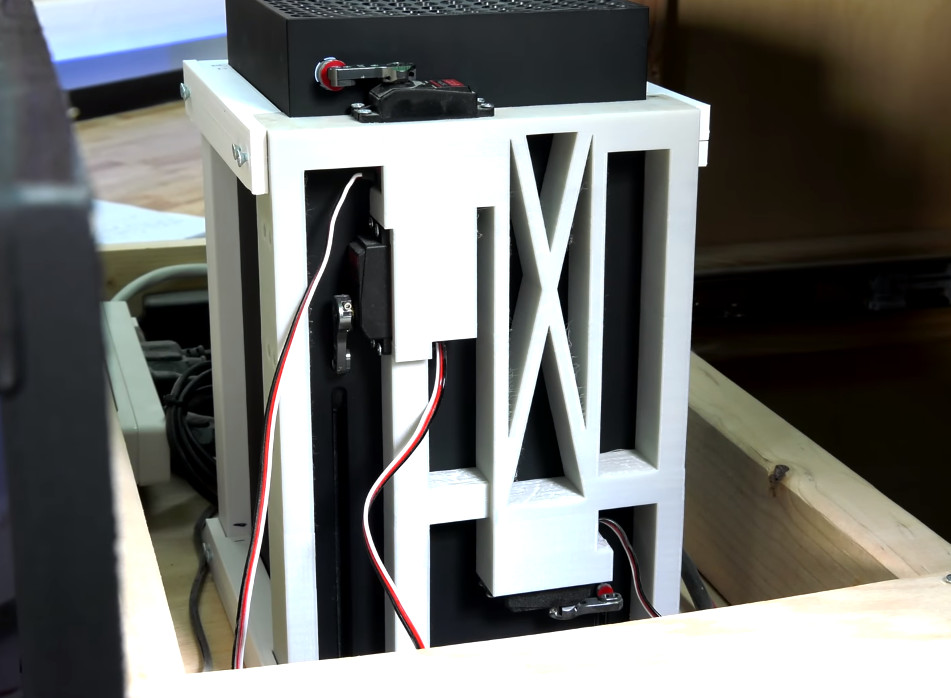
The real hack is inside, though. The Xbox hardware itself just sits inside the frame on a little shelf. There’s a handful of servo motors set up to press the real console’s buttons when the corresponding buttons are pressed on the giant Xbox itself. It goes a long way to making the build feel “real” to the user.

The final build measures over 2 meters (6.5 feet) tall and 1 meter wide, weighing in at a total of 113 kg (250 lbs). It was good enough to win [Michael] a Guinness World Record for his trouble. The build was later donated to a local youth center in Georgia.

We’ve seen [Michael]’s giant builds before, too; his 300%-sized Nerf Gun was a particular highlight. Video after the break.

Continue reading “Giant Xbox Series X Works Like A Real One”