Bungee-Corded Bass Zither Really Slaps

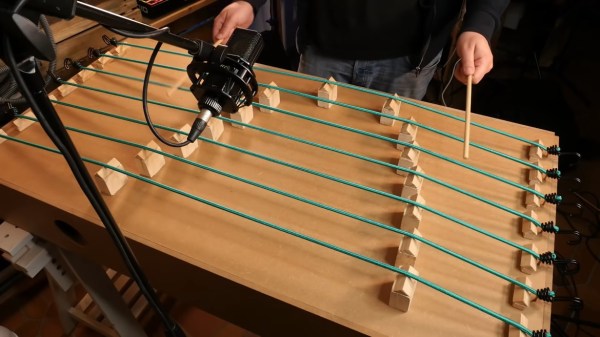
Surely we’ve all played some bass riffs on a stretched-out rubber band before, right? [Nicolas Bras] found that the ultimate musical rubber bands are bungee cords, and used seven of them to build a double-bass zither that can be plucked or struck with drumsticks. Be sure to check it out in the build/demo video after the break.
[Nicolas] is what you might call a hardware store hacker. This is not his first instrumental rodeo by far; in fact, he has spent the last 15 years building instruments from stuff like PVC and other commonly-available items.

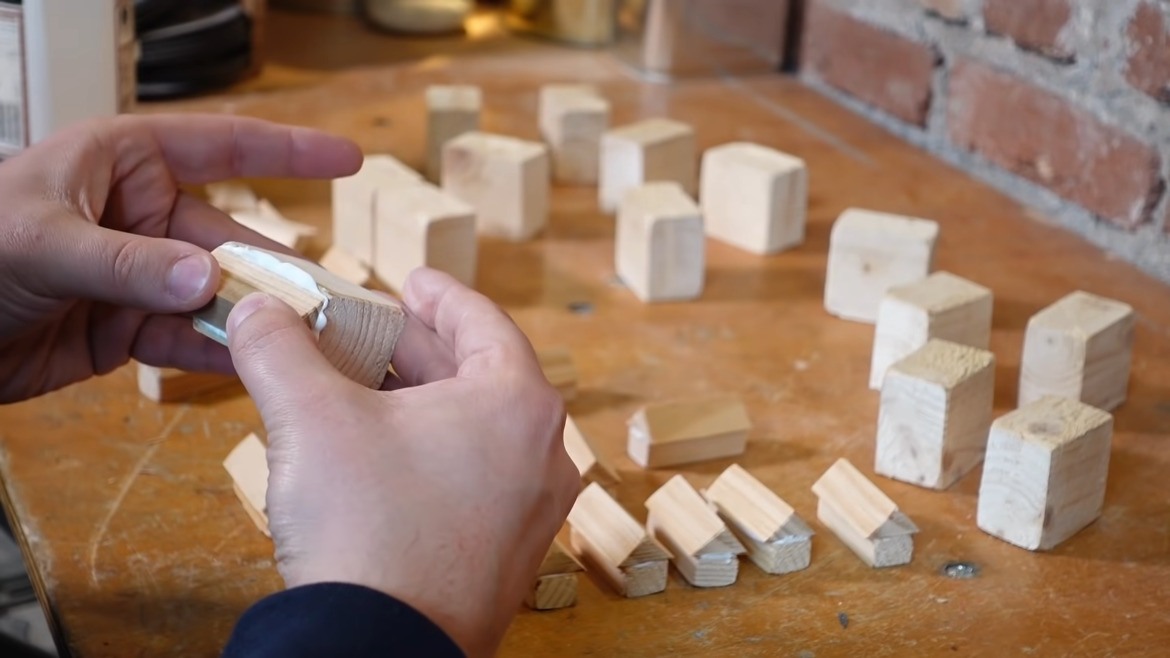
One thing in this build that’s not so commonly available is the large sound box [Nicolas] built to strap the bungee cords across. He also made custom bridges for the bungees that are topped with triangular wood, which makes them look like little row houses.

In order to actually play the thing, [Nicolas] arranged the row houses in a 2-point bridge system for dual-note strings, which sound good between the bridges and the bungee hooks, but not so much between the bridges themselves. Overall, the zither has a great, mellow sound no matter how he plays it, and we just might have to string one of these up ourselves.

Not a strings person? Then you might be sated by [Nicolas]’ PVC pipes, which play “Popcorn” perfectly.
Continue reading “Bungee-Corded Bass Zither Really Slaps”

Hall Effect Module Knows Where Your Motor Is

If you have a motor and you’d like to know where the shaft position is, you are likely to turn to an optical encoder scheme. However, as [lingib] points out, you can also use a magnet and a magnetometer. You can see how it works in the video below.

The MLX90393 is a 3-axis hall effect device and, with a magnet on the shaft, the X and Y outputs of the spinning magnet will form a quadrature output that you can easily read.

Continue reading “Hall Effect Module Knows Where Your Motor Is”

Skip The Shipping, Print Your Own Cable Chains

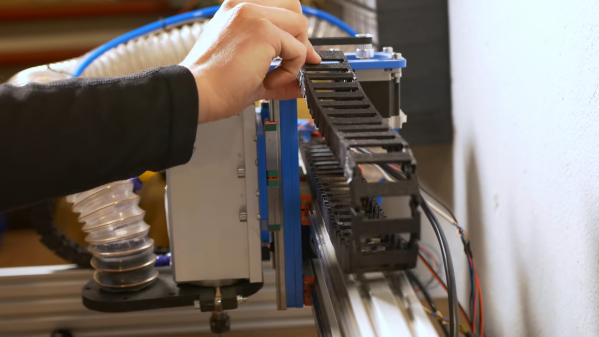
CNC machines and 3D printers tend to have plenty of cabling which must be neatly managed while the machine moves. If not properly taken care of, wires can easily end up tangled in the moving bits leading to a dead machine at best, and some kind of raucous fire at worst. [Nikodem Bartnik] decided to create his own cable chains for his CNC build to keep everything in check.

The benefit of cable chains is that they stop cables splaying everywhere while still allowing them to move as needed with the axes of the machine. [Nikodem] created 20mm and 40mm chains for his build, affixed into the aluminium extrusion with bolts and T-nuts for easy assembly. The chains are assembled by hand, with 3D printed clips that hammer in place to hold the cables inside once inserted.

Of course, there’s nothing stopping you from buying cable chains off the shelf. But if you don’t want to wait for shipping in this era of cursed supply chains, or you want a cable chain you can customize to perfectly suit your machine, making your own could be the way to go. 

Continue reading “Skip The Shipping, Print Your Own Cable Chains”

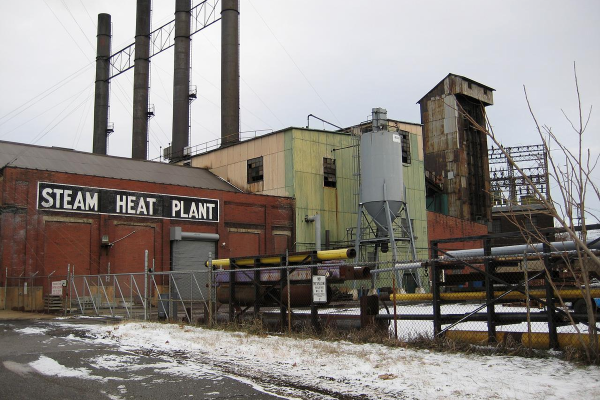
Ask Hackaday: Is It Time For Waste Heat And Cold Area Heating To Shine?

It’s difficult to escape the topic of energy supply at the moment, with the geopolitical situation surrounding the invasion of Ukraine leaving the natural gas supply to an entire continent in jeopardy. Fortunately we’re watching the green shoots of an early spring here in the Northern hemisphere so the worst of the winter weather is behind us, but industrial customers can take no such solace from the season and will have to weather whatever price hikes are to come. Every alternative idea for energy supply is on the table, and with the parallel imperative of decarbonising the economy this goes beyond the short term into a future without so much need to rely on gas.

The Future is Cloudy

A district heating plant in Vienna, Austria.
A district heating plant in Vienna, Austria. Joadl, CC BY-SA 3.0 AT

A collaboration between a Finnish district heating network and Microsoft caught our eye because the location of a new data centre for the tech giant was chosen specifically to supply waste heat to the network, rather than releasing it to the environment. It’s not uncommon at all for European cities to use district heating networks but they are normally supplied by waste incinerators, boilers, or combined heat and power stations. The use of data centre waste heat is a novelty, as is in particular the siting of the data centre being dictated by the network.
Continue reading “Ask Hackaday: Is It Time For Waste Heat And Cold Area Heating To Shine?”

Mindblowing Graphics From An ATtiny85

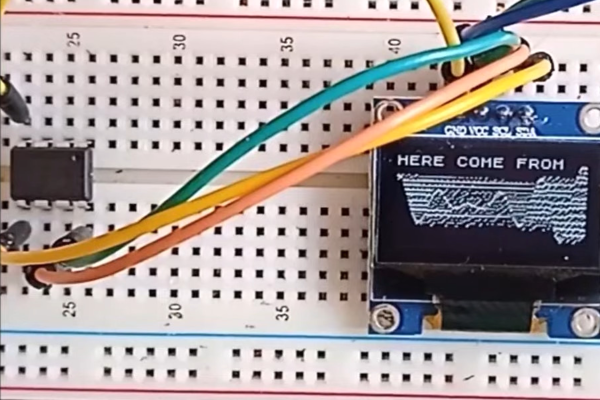
[Görg Pflug] wrote in with his really nice graphics library. It’s got multiple layers, two text consoles, greyscale, internal halftoning, and sprites. It can pull off a number of classic graphics tricks and demos. Oh yeah, and did we mention it runs on a freaking ATtiny85 and an I2C OLED screen?!

This is an amazing piece of work — if you’d asked us if this was possible, we would have probably said “no”. And now it’s yours to use in your own projects. The GitHub repo is full of demos showing off everything from switching between multiple layers, extremely rapid text scrolls, animations, boing balls, and even a Wolfenstein-style raycaster. On an ATtiny85.

There’s a demo video, embedded below, that shows it all off, but honestly you have to think about what’s going to to be suitably wowed. The first demo just seems to have a graphic wave over static text, for instance. No big deal? It’s blending the greyscale layers together and dithering them out to black and white for the OLED in real time! On an ATtiny85.

While the library is written in straight C++, there are even a couple examples of how you’d integrate this with Arduino’s Wire library if you so wished. We don’t know about you, but this makes us want to whip together an ATtiny85 and SSD1306 OLED demo board just to start playing around. This isn’t just an amazing hack, but it would also be a useful way to add graphics and a nice console to any project you’re working on.

Did we mention it’s all done on an ATtiny85?  Over I2C? Kudos!

Continue reading “Mindblowing Graphics From An ATtiny85”

Scientists Are Now Declaring New Species Via Photos And Video

Identifying new species is key to the work of zoologists around the world. It’s an exciting part of research into the natural world, and being the first to discover a new species often grants a scientists naming rights that can create a legacy of one’s work that lasts long into the future.

Traditionally, the work of taxonomy involved capturing and preserving an example of the new species. This is such that it could be classified properly and studied in detail by scientists working now and in the future. However, times are changing, and scientists are beginning to identify new species on the basis of videos and photos instead.

Continue reading “Scientists Are Now Declaring New Species Via Photos And Video”

Warm Up Your Extruders, RepRap Festivals Are Back

Like pretty much every other large gathering, the Midwest and East Coast RepRap Festivals had to be put on hold during the height of the COVID-19 pandemic. But now that the United States is cautiously returning to something that looks a lot like normal, both Festivals have now confirmed they will be back to full-scale live events for 2022.

After experimenting with a virtual event and a scaled-down show in 2021, the Midwest RepRap Festival (MRRF) will be returning to the Elkhart County 4H Fairgrounds in Goshen, Indiana from June 24th to the 26th. No tickets will be required for attendees or exhibitors, everyone is welcome to just show up and have a good time. There will however be sponsorship opportunities for anyone who wants to support this long-running event.

Summer already booked up? In that case, the East Coast RepRap Festival (ERRF) will be taking place from October 8th to the 9th at the APG Federal Credit Union Arena in Bel Air, Maryland. Tickets cost $10 for both exhibitors and attendees, though anyone under 17 gets in for free. Even though ERRF only confirmed their 2022 plans recently, it looks like there are only a few sponsor spots still left open.

Hackaday has attended both events in the past, and we’ve always come back blown away by the incredible variety of printers, projects, and products on display. It seems like there wouldn’t be that many different ways to show off melted plastic, but trust us, these folks always manage to surprise you. Given the amount of time that’s passed since either event was able to operate at normal capacity, we predict these 2022 Festivals are going to be smash hits that you won’t want to miss if you’re even remotely interested in 3D printing.