Hackaday Links Column Banner

Hackaday Links: May 4, 2025

By now, you’ve probably heard about Kosmos 482, a Soviet probe destined for Venus in 1972 that fell a bit short of the mark and stayed in Earth orbit for the last 53 years. Soon enough, though, the lander will make its fiery return; exactly where and when remain a mystery, but it should be sometime in the coming week. We talked about the return of Kosmos briefly on this week’s podcast and even joked a bit about how cool it would be if the parachute that would have been used for the descent to Venus had somehow deployed over its half-century in space. We might have been onto something, as astrophotographer Ralf Vanderburgh has taken some pictures of the spacecraft that seem to show a structure connected to and trailing behind it. The chute is probably in pretty bad shape after 50 years of UV torture, but how cool is that?

Parachute or not, chances are good that the 495-kilogram spacecraft, built to not only land on Venus but to survive the heat, pressure, and corrosive effects of the hellish planet’s atmosphere, will at least partially survive reentry into Earth’s more welcoming environs. That’s a good news, bad news thing: good news that we might be able to recover a priceless artifact of late-Cold War space technology, bad news to anyone on the surface near where this thing lands. If Kosmos 482 does manage to do some damage, it won’t be the first time. Shortly after launch, pieces of titanium rained down on New Zealand after the probe’s booster failed to send it on its way to Venus, damaging crops and starting some fires. The Soviets, ever secretive about their space exploits until they could claim complete success, disavowed the debris and denied responsibility for it. That made the farmers whose fields they fell in the rightful owners, which is also pretty cool. We doubt that the long-lost Kosmos lander will get the same treatment, but it would be nice if it did.

Continue reading “Hackaday Links: May 4, 2025”

Is This The Truck We’ve Been Waiting For?

Imagine a bare-bones electric pickup: it’s the size of an old Hilux, it seats two, and the bed fits a full sheet of plywood. Too good to be true? Wait until you hear that the Slate Pickup is being designed for DIY repairability and modification, and will sell for only $20,000 USD, after American federal tax incentives.

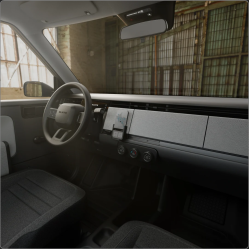
Using the cellphone for infotainment makes for a less expensive product and a very clean dash. (Image: Slate Motors)

There are a few things missing: no infotainment system, for one. Why bother, when almost everyone has a phone and Bluetooth speakers are so cheap? No touch screen in the middle of the dash also means the return of physical controls for the heat and air conditioning.

There is no choice in colors, either. To paraphrase Henry Ford, the Slate comes in any color you want, as long as it’s grey. It’s not something we’d given much though to previously, but apparently painting is a huge added expense for automakers. Instead, the truck’s bodywork is going to be injection molded plastic panels, like an old Saturn coupe. We remember how resilient those body panels were, and think that sounds like a great idea. Injection molding is also a less capital-intensive process to set up than traditional automotive sheet metal stamping, reducing costs further.

That being said, customization is still a big part of the Slate. The company intends to sell DIY vinyl wrap kits, as well as a bolt-on SUV conversion kit which customers could install themselves. The plan is to have a “Slate University” app that would walk owners through maintaining their own automobile, a delightfully novel choice for a modern carmaker.

Continue reading “Is This The Truck We’ve Been Waiting For?”

This Week In Security: No More CVEs, 4chan, And Recall Returns

The sky is falling. Or more specifically, it was about to fall, according to the security community this week. The MITRE Corporation came within a hair’s breadth of running out of its contract to maintain the CVE database. And admittedly, it would be a bad thing if we suddenly lost updates to the central CVE database. What’s particularly interesting is how we knew about this possibility at all. An April 15 letter sent to the CVE board warned that the specific contract that funds MITRE’s CVE and CWE work was due to expire on the 16th. This was not an official release, and it’s not clear exactly how this document was leaked.

Many people made political hay out of the apparent imminent carnage. And while there’s always an element of political maneuvering when it comes to contract renewal, it’s worth noting that it’s not unheard of for MITRE’s CVE funding to go down to the wire like this. We don’t know how many times we’ve been in this position in years past. Regardless, MITRE has spun out another non-profit, The CVE Foundation, specifically to see to the continuation of the CVE database. And at the last possible moment, CISA has announced that it has invoked an option in the existing contract, funding MITRE’s CVE work for another 11 months.

Continue reading “This Week In Security: No More CVEs, 4chan, And Recall Returns”

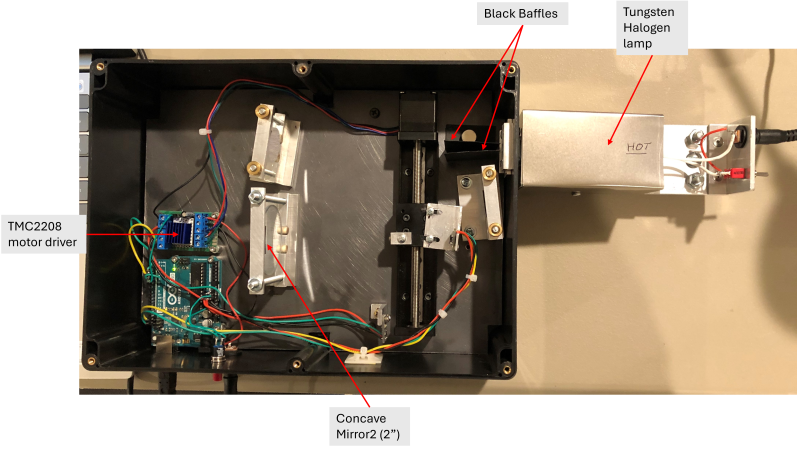
A photograph with labels showing the parts of a DIY scanning spectrometer.

DIY Scanning Spectrometer Is A Bright Idea

Spectroscopy seems simple: split a beam of light into its constituent wavelengths with a prism or diffraction grating, and measure the intensity of each wavelength. The devil is in the details, though, and what looks simple is often much harder to pull of in practice. You’ll find lots of details in [Gary Boyd]’s write-up of his optical scanning spectrometer project, but no devils.

Schematic diagram of [Gary Boyd]'s spectrometer, showing optical elements and rays of light as well as major physical elements like the motor and linear stage.
Schematic diagram of [Gary Boyd]’s Czerny-Turner type scanning spectrometer.
A scanning spectrometer is opposed to the more usual camera-type spectrometer we see on these pages in that it uses a single-pixel sensor that sweeps across the spectrum, rather than spreading the spectrum across an imaging sensor.

Specifically, [Gary] has implemented a Czerny-Turner type spectrometer, which is a two-mirror design. The first concave mirror collimates the light coming into the spectrometer from its entrance slit, focusing it on a reflective diffraction grating. The second concave mirror focuses the various rays of light split by the diffraction grating onto the detector.

In this case [Gary] uses a cheap VEML 7700 ambient light sensor mounted to a small linear stage from amazon to achieve a very respectable 1 nm resolution in the range from 360 nm to 980 nm. That’s better than the human eye, so nothing to sneeze at — but [Gary] includes some ideas in his blog post to extend that even further. The whole device is controlled via an Arduino Uno that streams data to [Gary]’s PC.

[Gary] documents everything very well, from his optical mounts to the Arduino code used to drive the stepper motor and take measurements from the VEML 7700 sensor. The LED and laser “turrets” used in calibration are great designs as well. He also shares the spectra this device is capable of capturing– everything from the blackbody of a tungsten lamp used in calibration, to a cuvette of tea, to the sun itself as you can see here. If you have a couple minutes, [Gary]’s full writeup is absolutely worth a read.

This isn’t the first spectrometer we’ve highlighted– you might say we’ve shown a whole spectrum of them.

Hackaday Links Column Banner

Hackaday Links: April 13, 2025

It’s been a while since we’ve dunked on an autonomous taxi foul-up, mainly because it seemed for a while there that most of the companies field testing driverless ride-sharing services had either ceased operation or curtailed them significantly. But that appears not to be the case after a Waymo robotaxi got stuck in a Chick-fil-A drive-through. The incident occurred at the chicken giant’s Santa Monica, California location at about 9:30 at night, when the autonomous Jaguar got stuck after dropping off a passenger in the parking lot. The car apparently tried to use the drive-through lane to execute a multi-point turn but ended up across the entrance, blocking other vehicles seeking their late-evening chicken fix. The drive-through-only restaurant ended up closing for a short time while Waymo figured out how to get the vehicle moving again.

Continue reading “Hackaday Links: April 13, 2025”

This Week In Security: AI Spam, SAP, And Ivanti

AI continues to be used in new and exciting ways… like generating spam messages. Yes, it was inevitable, but we now have spammers using LLM to generate unique messages that don’t register as spam. AkiraBot is a Python-powered tool, designed to evade CAPTCHAs, and post sketchy SEO advertisements to web forms and chat boxes around the Internet.

AkiraBot uses a bunch of techniques to look like a legitimate browser, trying to avoid triggering CAPTCHAs. It also runs traffic through a SmartProxy service to spread the apparent source IP around. Some captured logs indicate that of over 400,000 attempted victim sites, 80,000 have successfully been spammed.

Continue reading “This Week In Security: AI Spam, SAP, And Ivanti”

Fiber Laser Gives DIY PCBs A Professional Finish

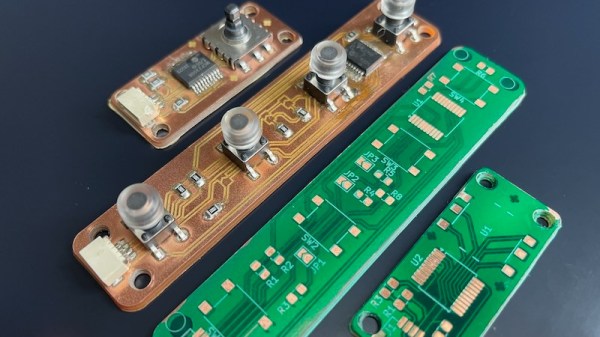
While low-cost professional PCB fabrication has largely supplanted making circuit boards at home, there’s still something to be said for being able to go from design to prototype in an afternoon. Luckily we aren’t limited to the old toner transfer trick for DIY boards these days, as CNC routers and powerful lasers can be used to etch boards quickly and accurately.

But there’s still a problem — those methods leave you with a board that has exposed traces. That might work in a pinch for a one-off, but such boards are prone to shorts, and frankly just don’t look very good. Which is why [Mikey Sklar] has been experimenting with applying both a soldermask and silkscreen to his homemade boards.

The process he describes starts after the board has already been etched. First he rolls on the soldermask, and then sandwiches the board between layers of transparency film and clear acrylic before curing it under a UV light. After two coats of the soldermask, the board goes into a fiber laser and the silkscreen and mask layers are loaded into the software and the machine is set to a relatively low power (here, 40%). The trick is that the mask layer is set to run four times versus the single run of the silkscreen, which ensures that the copper is fully exposed.

Since the board doesn’t need to be moved between operations, you don’t have to worry about the registration being off. The end result really does look quite nice, with the silkscreen especially popping visually a lot more than we would have assumed.

We’ve previously covered how [Mikey] uses his CNC router and fiber laser to cut out and etch the boards, so this latest installment brings the whole thing full circle. The equipment you’ll need to follow along at home isn’t cheap, but we can’t argue with the final results.

Continue reading “Fiber Laser Gives DIY PCBs A Professional Finish”