An Open-Source Microfluidic Pump For Your Science Needs

When it comes to research in fields such as chemistry or biology, historically these are things that have taken place in well-financed labs in commercial settings or academic institutions. However, with the wealth of technology available to the average person today, a movement has sprung up of those that run advanced experiments in the comfort of their own home laboratory. For those needing to work with very tiny amounts of liquid, [Josh’s] microfluidics pump may be just the ticket.

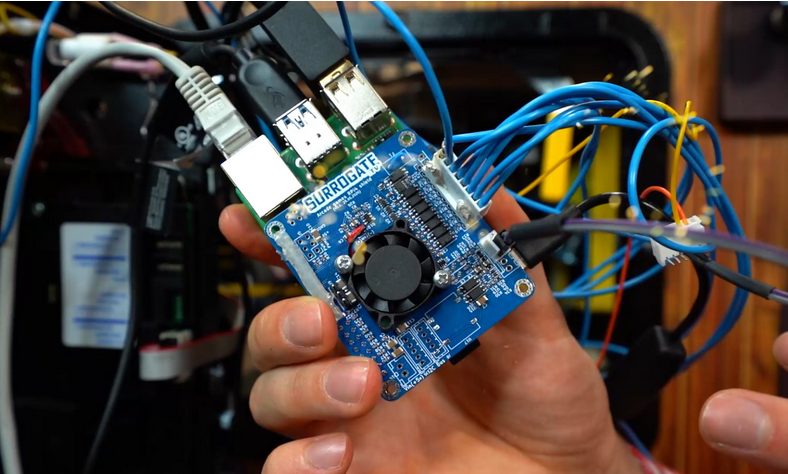
Consisting of a series of stepper-motor driven pumps, the hardware is inspired by modern 3D printer designs. The motors used are all common NEMA items, and the whole system is driven by the popular Marlin firmware. The reported performance is impressive, delivering up to 15 mL/min with accuracy to 0.1uL/min. That’s a truly tiny amount of fluid, and the device could prove highly useful to those exploring genetics or biology at home.

The great thing about this build is that it’s open source. [Josh] took the time to ensure that it was easily moddable to work with different tubing and materials, such that others could spin up a copy using whatever was readily available in their area. Performance will naturally vary, but if you’re experienced enough to build a microfluidic pump, you’re experienced enough to calibrate it, too. Design files are on Github for those keen to build their own.

We’ve seen other builds in this area before, too. We look forward to seeing some fun science done with [Josh]’s build, and look forward to seeing more DIY science gear in the future!

Breakaway Keyboard PCB Makes Customization A Snap

Once upon a time, keyboards were something that you took with you from computer to computer, because most of them were built quite nicely. After a few dark decades of membrane keyboards being the norm, the rise of the mechanical keyboard community has shined a light on what is possible with open source designs. Anyone can join in, because quality clackers now exist on every level, whether you want to design the perfect split ortho with OLEDs, rotary encoders, and rear view mirrors, or just want to fork over some money and get to punching switches.

Break me off a piece of that candy bar keeb.

Building your own keyboard doesn’t have to be daunting. It can be as easy or as involved as you want. There’s still a fair amount of soldering simply because it’s a keyboard. But there are plenty of options if you don’t want to do a whole lot beyond soldering switches (or hot swap sockets!) and putting a case together.

Take for instance the JNAO (Just Need An Ortho) build that [Jared] just finished. It starts with a PCB and on-board controller, and the idea is to customize it from there. You’re left to 3D print, laser cut, or otherwise carve your own case and a plate to stabilize the key switches, and then get down to business deciding on switches and keycaps.

The interesting thing about the JNAO is the breakaway row of keys on the bottom. The standard grid is 12×5, but if you don’t need the dedicated number row along the top like [Jared], you’re not stuck with it. And you’re not stuck with the default layout, either. Flashing to a standard Planck layout didn’t go as easily as [Jared] might have liked, but we think he was wise to get the firmware squared away before ever turning on the soldering iron.

Don’t know what to do with such a small keyboard? They’re pretty much perfect for cyberdeck builds.

Smashing The Atom: A Brief History Of Particle Accelerators

When it comes to building particle accelerators the credo has always been “bigger, badder, better”. While the Large Hadron Collider (LHC) with its 27 km circumference and €7.5 billion budget is still the largest and most expensive scientific instrument ever built, it’s physics program is slowly coming to an end. In 2027, it will receive the last major upgrade, dubbed the High-Luminosity LHC, which is expected to complete operations in 2038. This may seem like a long time ahead but the scientific community is already thinking about what comes next.
Recently, CERN released an update of the future European strategy for particle physics which includes the feasibility study for a 100 km large Future Circular Collider (FCC). Let’s take a short break and look back into the history of “atom smashers” and the scientific progress they brought along. Continue reading “Smashing The Atom: A Brief History Of Particle Accelerators”

A Mobile Phone For The Pulse Dial Generation

One of the useful side effects of the ubiquitous availability of cellular network data modules is that they can be used to create custom mobile phones. It’s surprising in a way that we don’t see as many of these projects as we’d expect, but by way of redressing that deficiency we’re pleased to see the work of [Proton Gamer], who has taken a vintage rotary dial phone and upgraded it with an Arduino and GSM shield to make a very unexpected mobile phone project.

It’s not entirely certain from the write-up which manufacturer produced the donor phone or for which country’s network it was produced, but it seems typical of the type you might have found the world over in the 1960s. We’re given a breakdown of the various components and how to interface to them, the ringer for example is run using a motor driver board. There are comprehensive instructions for the conversion, though sadly they involve gutting the phone and removing the original hardware. The result can be seen in the video below the break, and the finished project makes a mobile phone call from the unlikeliest of hardware.

This certainly isn’t the first rotary dial mobile phone we’ve featured, including one based on a conference badge.

Continue reading “A Mobile Phone For The Pulse Dial Generation”

Ask Hackaday: Why Did GitHub Ship All Our Software Off To The Arctic?

If you’ve logged onto GitHub recently and you’re an active user, you might have noticed a new badge on your profile: “Arctic Code Vault Contributor”. Sounds pretty awesome right? But whose code got archived in this vault, how is it being stored, and what’s the point?

Continue reading “Ask Hackaday: Why Did GitHub Ship All Our Software Off To The Arctic?”

Panic Button Is An Audio-Visual Parachute Out Of Zoom Calls

Everyone has been learning how to stream this year whether they want to or not. This has given rise to the embarrassment paradox, which states that the more urgently you need to kill your camera and microphone feeds in a videoconference call, the more difficult and time-consuming it will be. Zoom in particular will toggle the mic and camera with keyboard shortcuts, but when your toddler waddles into the room swinging a used diaper around in the air, keyboard shortcuts will seem woefully under-powered.

What you need is a single sturdy button that sends both of these toggle commands as quickly as possible. [Simon Prickett]’s panic switch does exactly that. It’s a delightfully tactile arcade button connected to a Trinket M0, which can emulate a keyboard quite easily as an Arduino or CircuitPython device.

This little keyboard doesn’t send these macros directly, because that would be way too risky. What if you were reading Hackaday instead of staring into the tiled faces of your coworkers? Then it wouldn’t work, because Zoom is out of focus.

Instead, it sends an obscure four-key macro to the computer that triggers an AppleScript. [Simon]’s AppleScript checks to see if Zoom is running. If not, it has the system announce the fact. If it is running, then the script sends cmd+shift+a and cmd+shift+v to Zoom directly to toggle the audio and video. Check out the demo after the break.

As you might expect, we’ve seen a couple of videoconference survival hacks over the past few months. Need to show something or work with your hands, but only have one camera? All you need is a mirror, a clothespin, and a length of wire for a simple split-screen setup.

Continue reading “Panic Button Is An Audio-Visual Parachute Out Of Zoom Calls”

Ultracapacitors Might Have Bad Fruity Smell

You might think the smell of an electrolytic capacitor boiling out is bad, but if scientists from the University of Sydney have their way, that might be nothing. They’ve devised an ultracapacitor — that uses biomass from the stinky durian fruit along with jackfruit. We assume the capacitors don’t stink in normal use, but we wouldn’t want to overload one and let the smoke out.

One of the things we found interesting about this is that the process seemed like something you might be able to reproduce in a garage. Sure, there were a few exotic steps like using a vacuum oven and a furnace with nitrogen, and you’d need some ability to handle chemicals like vinylidene fluoride. However, the hacker community has found ways to create lots of things with common tools, and we would imagine creating aerogels from some fruit ought not be out of reach.

Continue reading “Ultracapacitors Might Have Bad Fruity Smell”