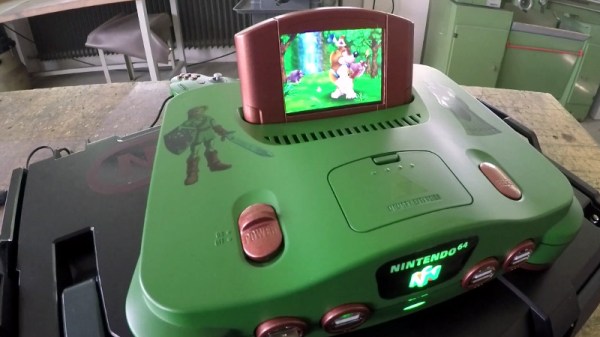
Fire Breathing N64 Puts Blast Processing In The Shade

Consoles over the years have innovated, bringing new features and experiences with each subsequent generation. Rumble, motion controls and more recently VR have all come to the fore as companies vie for supremacy in the marketplace. Nobody’s really had the guts to tackle fire, though. Until now.

The case and spinning logo alone would have made the front page; the fire is simply next level. Our parents were always telling us to sit further from the TV… and now we know why.

The build is based on the Nintendo 64. The motherboard is removed from the original case, and fitted to a sheet metal enclosure of impressive craftsmanship. This allows the fitment of the machine’s party piece — twin jets of flame, triggered by an extra button on the controller. There’s also a spinning N64 logo built into the front of the case, backlit in a foreboding red — hinting to the player that this is no regular console.

The console is capable of shooting flames up to 4 feet long, and if you have to ask why, you’re likely on the wrong website. We’d love to see the jets triggered by rumble, ideally on a per player basis — making bouts of Mario Kart and Smash Brothers more perilous than ever.

As it turns out, fire’s also a great way to visualise sound waves. Video after the break.

Continue reading “Fire Breathing N64 Puts Blast Processing In The Shade”

“Yell To Press B” Mod Makes N64 Controller Worse

There’s probably no reason anyone would actually desire a mod like this. Well, no good reason. But [William Osman] had been pondering what it would be like to play some classic games with inputs other than buttons, and decided to make an audio sensor responsible for pressing the B button on an old N64 controller. This “Yell To Press B” mod was also something unique to show his hosts when he visited the YouTube video game aficionados, [Game Grumps].

[William] acknowledges that the build is a bit of a hack job, but the project page does a good job of documenting his build process and covering the kinds of decisions involved in interfacing to a separate piece of hardware. After all, most budding hackers have sooner or later asked themselves “how do I make my gadget press a button on this other thing?” [William] ends up using a small relay to close the connection between the traces for the B button when triggered by a microphone module, but he points out that it should be possible to do a non-destructive version of the mod. Examples exist of reading the N64 controller’s state with an Arduino, which could form the basis of a man-in-the-middle approach of “Yell To Press B” (or anything else) instead of soldering to the button contacts. A video is embedded below, in which you can watch people struggle to cope with the bizarre mod.

Continue reading ““Yell To Press B” Mod Makes N64 Controller Worse”

A New Take On Building A Portable N64

When home consoles go mobile, whether in the form of modded original hardware or emulation, they usually take a pretty standard shape. A screen in the middle, with buttons either on the sides or below it. Basically the same layout Nintendo popularized with born-handheld systems such as the Game & Watch series and original Game Boy. Like the saying goes, if it ain’t broke…
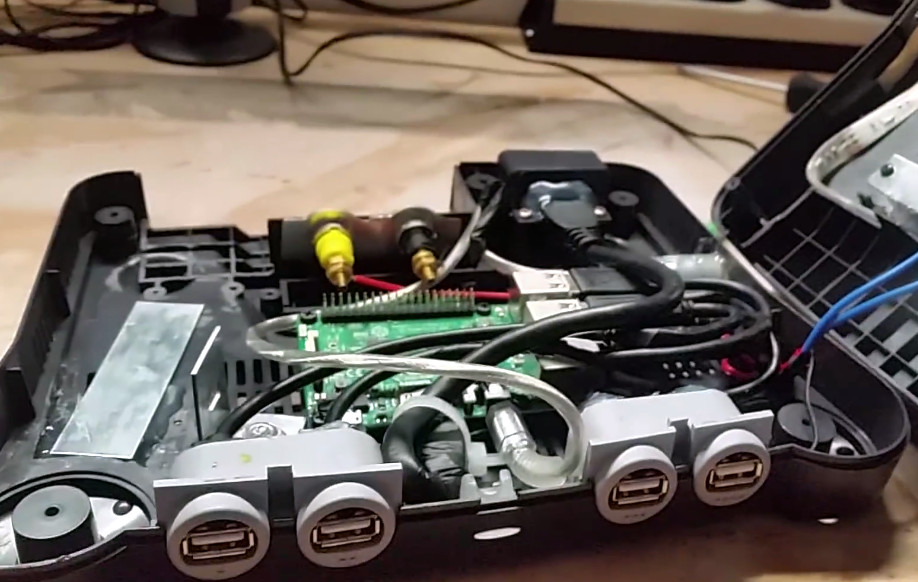
But [Le Nerdarto] had a different idea. He came across a broken N64 and wanted to turn it into a portable console, but not necessarily a handheld one. Noticing the cartridge was about the perfect size to contain a small LCD and in an ideal position, he set out to make what is arguably the most literal interpretation of “portable N64” we’ve ever seen. It might not be the most practical iteration of this concept, but it definitely gets extra points for style.

After he stripped the N64 of its original hardware, he installed a Raspberry Pi 3 and an RC battery eliminator circuit (BEC) to get 5V out of the internal 6200 mAh 7.4V battery. [Le Nerdarto] says this provides power for the Pi, the LCD, and the various lighting systems for up to 10 hours. He’s also added USB ports in the front of the system for controllers, and an HDMI port on the back so he can still connect the system up to a TV when not on the move.

The 3.5 inch LCD in the cartridge is arguably the centerpiece of the build, and while it might be on the small side, we can’t deny it’s a clever idea. [Le Nerdarto] had the good sense to tilt the it back a few degrees to put the display at a more comfortable angle, but otherwise it looks stock since he was able to fit everything in without cutting the back of his donor cartridge out. For those who might be wondering, the “cartridge” can’t be removed, but we’ll admit that would have been a killer feature to add especially with the HDMI port on the back.

Of course, since it’s running emulators on a Raspberry Pi, this isn’t only a portable N64. The front mounted USB ports allow him to plug in all sorts of controllers and emulate classics from pretty much any console that’s older than the N64 itself. Ironically the Raspberry Pi 3 isn’t exactly an ideal choice for N64 emulation, but a good chunk of titles are at least playable.

If you’re more of a purist and want a true portable N64, we’ve covered plenty of those over the years to get you inspired.
Continue reading “A New Take On Building A Portable N64”

The N64 Controller Gets Brass Gears Through 3D Printing

The controller for the Nintendo 64 is a masterpiece of design, and despite being more than two decades old, people are still using this controller competitively. Smash Bros, you know. Those competitive gaming enthusiasts are hard on their controllers, and after decades and tournaments, the analog stick will wear out. Previously, this required a rebuild or simply replacing the entire controller. Now there’s another option: a completely re-engineered analog stick, all made possible thanks to 3D printing.

[Nam Le] is a student at Cal Poly, and as would be expected for a very specific subset engineering students, had to track down new N64 controller every few months. The stick on these controllers wear out, so [Nam] decided to make the most durable joystick that has ever fit inside an N64 controller.

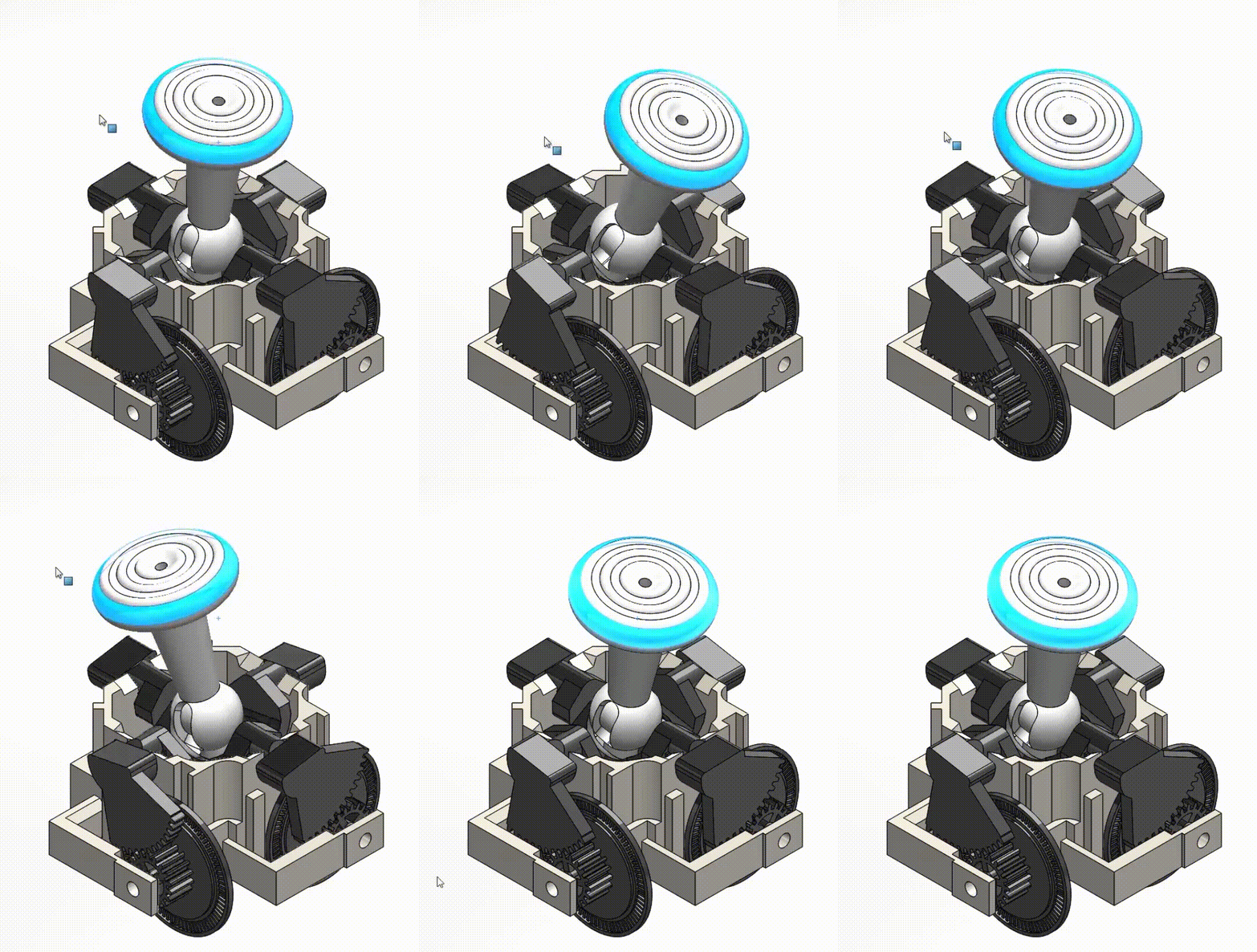
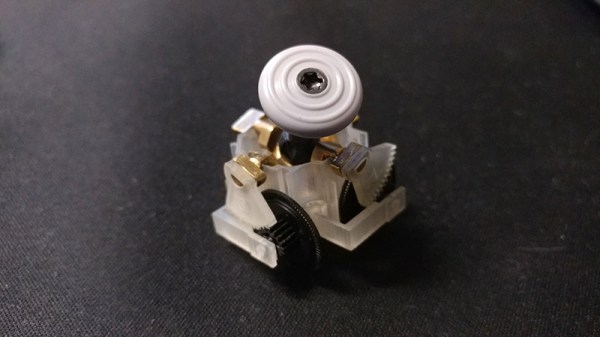
The design of the N64 stick is pretty simple, and exactly what you would expect if you’ve ever opened up an analog joystick. There’s the stick itself, which is connected to gears on the X and Y axes, which are in turn connected to encoders. This entire assembly sits in a bowl. After twenty years, the mating surface between the stick and the gears wear down, and the bowl becomes deformed. The solution here is obviously to engineer something sturdier, and despite what most of the 3D printing community will tell you, ABS and PLA just won’t cut it.

[Nam] re-designed the gears and bowl out of brass using lost-wax casting using 3D printed parts. These brass parts were mated with 3D printed gears and an enclosure for the bowl. The stick is nylon, an important design choice because this is the first part to wear down anyway, and it’s also the easiest part to replicate. Yes, this is designing an analog stick for the strength of materials and Real Engineering™ for those of you keeping track at home.

Right now, the joystick works as intended, and lasts much longer than the stock version. The goal now is to get this stick tournament-legal for some serious Smash time, in the hopes of not replacing controllers every few months.

Add-On Board Brings Xbox 360 Controllers To N64

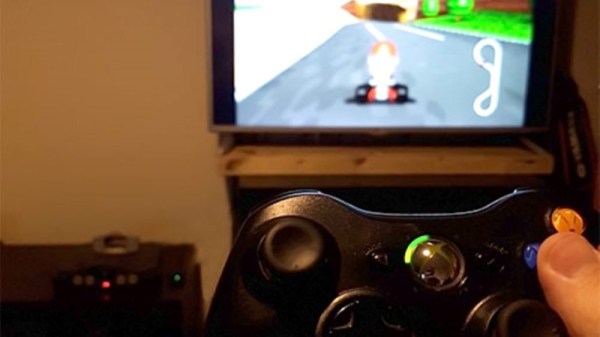
Many of the games released on the Nintendo 64 have aged remarkably well, in fact a number of them are still considered must-play experiences to this day. But the years have not been so kind to the system’s signature controller. While the N64 arguably defined the console first person shooter (FPS) genre with games like “Goldeneye” and “Perfect Dark”, a modern gamer trying to play these classics with the preposterous combination of analog and digital inputs offered by the N64 controller is unlikely to get very far.

Of course, you could play N64 games in an emulator and use whatever controller you wish. But where’s the challenge in taking the easy way out? [Ryzee119] would much rather take the insanely complex route, and has recently completed work on an add-on board that let’s you use Xbox 360 wireless controllers on Nintendo’s 1996 console. He’s currently prepping schematics and firmware for public release, with the hope that support for additional USB controllers can be added by the community.

Nintendo historians may recall that the N64’s controllers had an expansion port on the bottom where you would connect such accessories as the “Rumble Pak” and “Controller Pak”. The former being an optional force feedback device, and the latter a rather oddly named memory card for early N64 games which didn’t feature cartridge saves. Only “90’s Kids” will recall the struggle of using the “Rumble Pak” when a game required the “Controller Pak” to save progress.

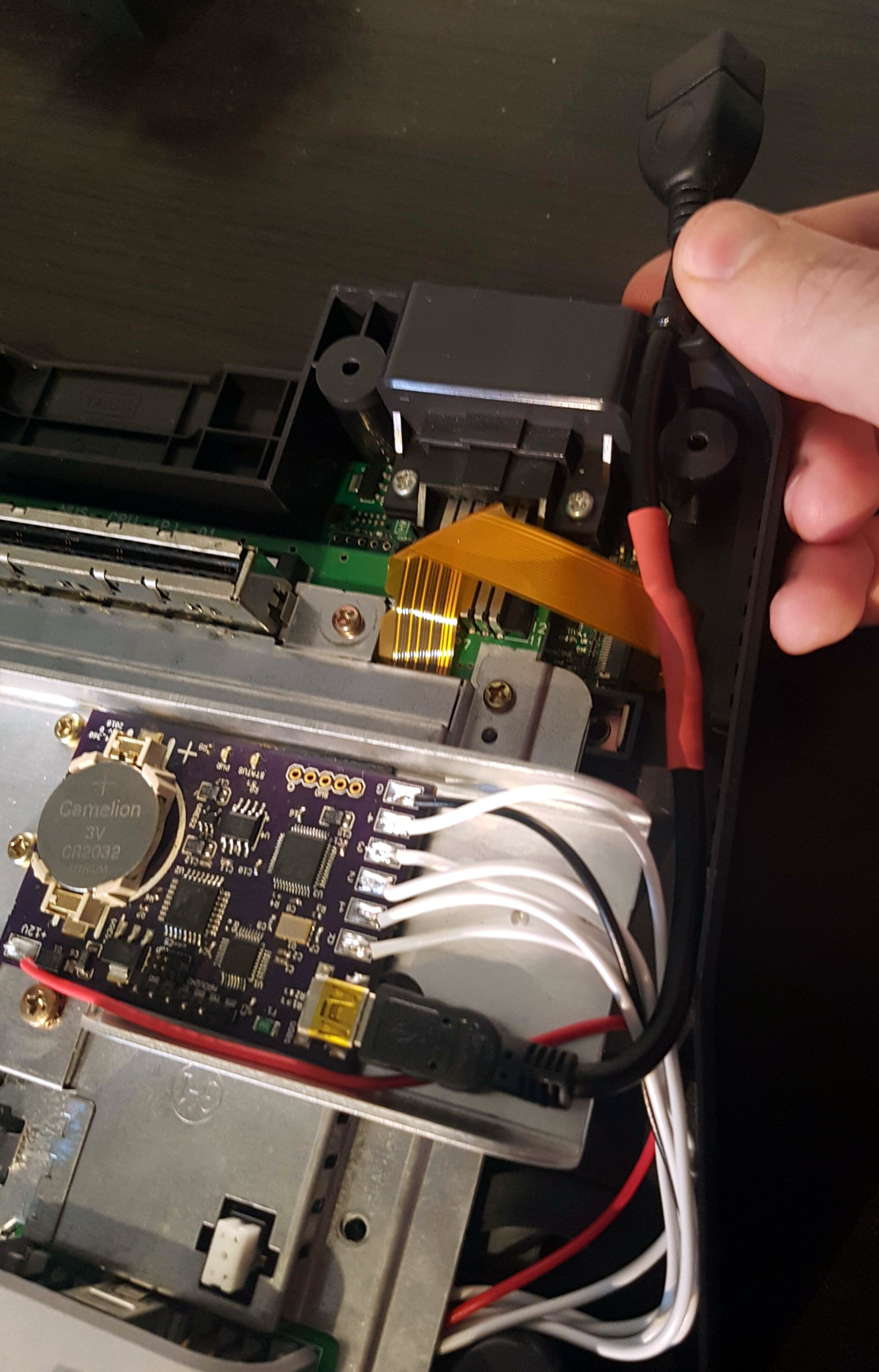
Thankfully [Ryzee119] has solved that problem by adding battery backed storage to his adapter along with some clever code which emulates the “Controller Pak”. Similarly, the “Rumble Pak” is emulated by the Xbox 360 controller’s built-in force feedback and a bit of software trickery. Specific button combinations allow for enabling and disabling the various virtual accessories on the fly.

But the best part of this modification might be how unobtrusive the whole thing is. Not only does it allow you to still use the original controllers and accessories if you wish, but it only requires soldering a handful of wires to the console’s motherboard. Thanks to the surprising amount of dead space inside the system’s case, it’s not even a challenge to fit the board inside. You do need to use the official USB Xbox 360 controller receiver, but even here [Ryzee119] opted to put a USB port on the board so you could just plug the thing in rather than having to cut the connector off and trying to solder it to the board yourself.

It probably won’t come as a surprise that this isn’t the first time [Ryzee119] has fiddled with the internals of a classic Nintendo system. We’ve previously covered his fantastic custom PCB to fit a Raspberry Pi Zero into a GameBoy Advance.

[Thanks to Gartral for the tip.]

N64 Emulated In VR Makes Hyrule Go 3D

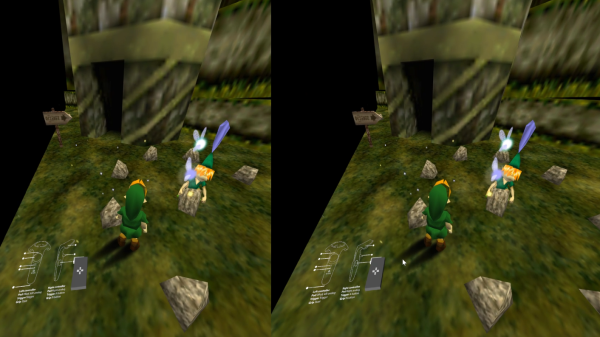
The Nintendo 64 had some groundbreaking and popular 3D games, and [Avaer Kazmer] felt it was only right to tamper with things just enough to trick an emulator into playing Ocarina of Time in VR, complete with stereoscopic 3D. The result is more than just running an emulator on a simulated screen in virtual reality; the software correctly renders a slightly different perspective of the world of Hyrule to each eye in order to really make the 3D pop in a way the original never could, and make it playable with VR controllers in the process. The VR emulator solution is called Emukit and works best with Exokit, a JavaScript web browser for AR and VR environments for which [Avaer] is a developer.

It turns out that there were a few challenges to work around and a few new problems to solve, not least of which was mapping VR controllers to control an N64 game in a sensible way. One thing that wasn’t avoidable is that the N64’s rendered world may now pop in 3D, but it still springs forth from a rectangular stage. The N64, after all, is still only rendering a world in a TV-screen-sized portion; anything outside that rectangular window doesn’t really exist, and there’s no way around it as long an emulated N64 is running the show. Still, the result is impressive, and a video demo is embedded below where you can see the effect for yourself.

Continue reading “N64 Emulated In VR Makes Hyrule Go 3D”

A Beautifully Crafted N64 Portable

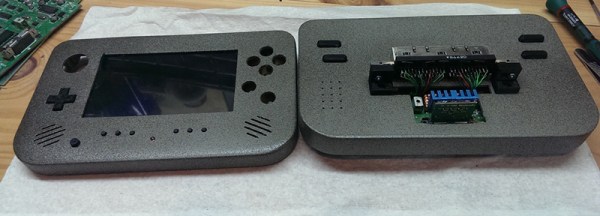
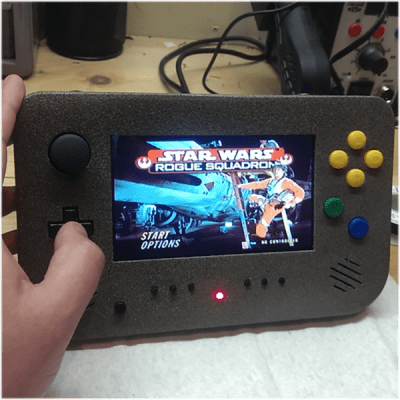
With dozens of powerful single board Linux computers available, you would think the time-tested practice of turning vintage video game consoles would be a lost art. Emulators are available for everything, and these tiny Linux boxes are smaller than the original circuitry found in these old consoles. [Chris], one of the best console modders out there, is still pumping out projects. His latest is a portable N64, and it’s exactly what we’ve come to expect from one of the trade’s masters.

We’ve seen dozens of Nintendo 64s modded into battery-powered handhelds over the years, and [Chris]’ latest project follows the familiar format: remove the PCB from the console, add a screen, some buttons, and a battery, and wrap everything up in a nice case. It’s the last part of the build – the case – that is interesting here. The case was fabricated using a combination of 3D printing CNC machining.

rogueThe enclosure for this project was initially printed in PLA, the parts glued together and finally filled for a nice, smooth finish. [Chris] says PLA was a bad choice – the low melting point means the heat from milling the face plate gums up the piece. In the future, he’ll still be using printed parts for enclosures, but for precision work he’ll move over to milling polystyrene sheets.

With the case completed, a few heat sinks were added to the biggest chips on the board, new button breakout board milled, and a custom audio amp laid out. The result is a beautifully crafted portable N64 that is far classier and more substantial than any emulator could ever pull off.

[Chris] put together a video walkthrough of his build. You can check that out below.

Continue reading “A Beautifully Crafted N64 Portable”