Protocol Snooping Digital Audio

More and more clubs are going digital. When you go out to hear a band, they’re plugging into an ADC (analog-to-digital converter) box on stage, and the digitized audio data is transmitted to the mixing console over Ethernet. This saves the venue having to run many audio cables over long distances, but it’s a lot harder to hack on. So [Michael] trained popular network analysis tools on his ProCo Momentum gear to see just what the data looks like.

[Michael]’s writeup of the process is a little sparse, but he name-drops all the components you’d need to get the job done. First, he simply looks at the raw data using Wireshark. Once he figured out how the eight channels were split up, he used the command-line version (tshark) and a standard Unix command-line tool (cut) to pull the data apart. Now he’s got a text representation for eight channels of audio data.

Using xxd to convert the data from text to binary, he then played it using sox to see what it sounded like. No dice, yet. After a bit more trial and error, he realized that the data was unsigned, big-endian integers.  He tried again, and everything sounded good. Success!

While this is not a complete reverse-engineering tutorial like this one, we think that it hits the high points: using a bunch of the right tools and some good hunches to figure out an obscure protocol.
Nothing’s As Vain As A Phone Taking A Selfie Of Itself… With Itself

The selfie: pop culture’s most frivolous form of self-expression is also probably one of the most human acts you could find yourself doing in a day. Everyone is guilty of snapping a quick pic from time to time with the expectation that it will leave an impression on those who see it. All of the implications surrounding why we do this support our deep-seated need to sculpt an identity for ourselves using others as the hammer and chisel. So, consider how upside-down the world would feel if you caught a robot posing for a shot in the mirror? What about one whose sole function was to take selfies and post them? If this breaks your mind a little, that was the intention. This #selfie robot by artists [Radamés Ajna] and [Thiago Hersan] is the first development in a larger body of work called “memememe”, which is meant to comment on our culture’s obsession with the trending, selfing nature of social media. This specific project explores the relationship between conversation and identity in a situation where there is no second party.

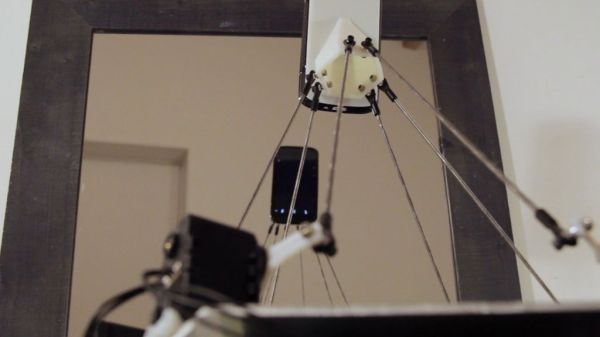
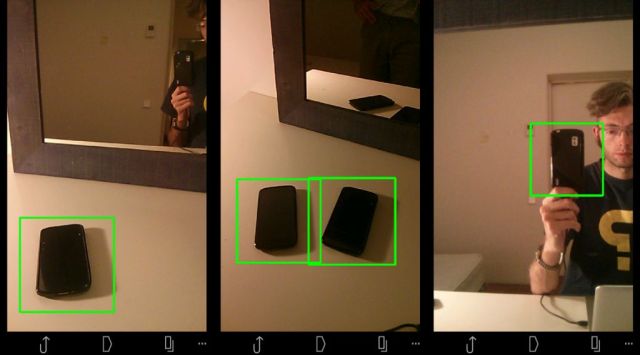
selfieBOT2Hardware-wise, the #selfie bot is a Stewart platform made from six servo motors and a few pieces of carefully measured pushrod connected with swivel-ball-links. An android phone is mounted on the end effector which acts functionally as the robot’s face and eyes. To make it self-aware in a sense, [Ajna] and [Hersan] created their own recognition software with Open CV using a collection of sample images of various phones as reference points. As soon as the robot recognizes itself in the mirror as indicated by specific words flashing on its screen, it takes a picture, immediately uploading it to its own tumblr account. [Ajna] and [Hersan] have a nice description of their process on the project’s Instructable’s page which you can check out to see how they used Haar Cascades to create their custom object recognition. Additionally, if you’d fancy building your own robot to covertly place in your living room to snap pictures of other phones, you could check out their code on github.

Watch it selfie :

Continue reading “Nothing’s As Vain As A Phone Taking A Selfie Of Itself… With Itself”

Hackaday Prize Judge Elecia White Writes Tell-All Blog Post

The awarding of The Hackaday Prize is nearly upon us!  With just over a day left to go, Launch Judge Elecia White has decided to spill the beans and write a blog post about which of the five finalists she thinks should win. We don’t want to spoil the surprise… but what the heck, she wants them ALL to win.

ChipWhisperer because it brings high-end hardware security tools to the masses.

SatNOGS because it brings space to your back yard,

PortableSDR because of its great waterfall display,

ramanPi because come on, it’s a freaking spectrometer!

Open Source Science Tricorder because it uses sensors to help us see the science in the world around us.

Elecia knows how much time, effort, and passion went into these projects, and how each one embodies the open and connected spirit of The Hackaday Prize. Only one day remains before the big event in Munich, and the announcement of the winner.

Transmitting Data Long-Distance With Morse Code

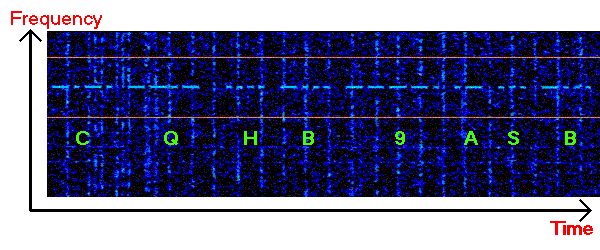
[Konstantinos] wrote in to tell us about his CDW project: a digital encoding scheme for ham radio that uses CW (continuous wave) Morse code for digital data transfer. [Link updated 1/5/16] CW operation with Morse code is great for narrow-bandwidth low-speed communication over long distances. To take advantage of this, [Konstantinos] developed a program that takes binary or text files, compresses them, and translates them to a series of letters and numbers that can be represented with Morse code.

The software translates the characters into sequences of Morse code pulses, and plays an audio stream of the result. His software doesn’t support decoding Morse from an audio stream, so [Konstantinos] recommends using one of many existing programs to get the job done. Alternatively those with a good ear and working knowledge of Morse can transcribe the characters by hand.

After receiving a broadcast, the user pastes received characters back in the software. The software re-assembles the binary file from the Morse characters and decompresses the result. [Konstantinos] also added a simple XOR encryption feature, but keep in mind that using encryption on ham radio bands is technically illegal.

2.5kW Of Beverage-Cooling Awesomeness

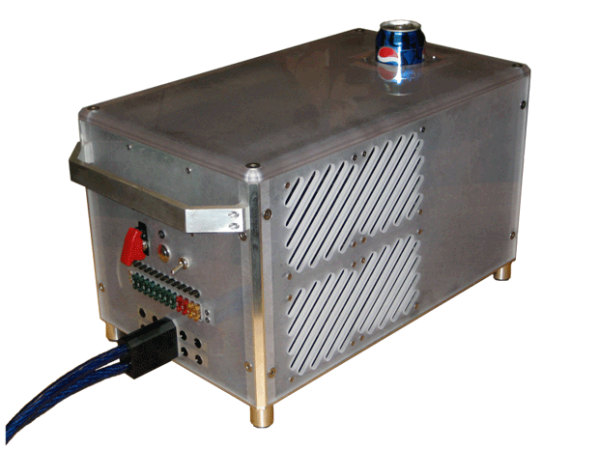
We’ve covered many thermoelectric beverage coolers in the past, but none come close to the insane power of the AbsolutZero. [Ilan Moyer] set out to design a beverage cooler that chills a drink from room temperature to 5 degrees Celsius as quickly as possible, and it looks like he succeeded. The AbsolutZero consumes around 2.5kW of power and runs 8 water-cooled thermoelectric modules to quickly chill a drink.

[Ilan] put his machinist skills to work and fabricated many custom parts for this build. He machined water blocks for each thermoelectric cooler out of solid copper which draw heat away from each thermoelectric cooler. He also fabricated his own bus bars to handle the 200A+ of current the system draws. To transfer heat from the beverage to the thermoelectric modules, he turned and milled a heat spreader that perfectly fits a can of any beverage.

[Ilan]’s design uses a closed-loop water cooling system and 4 radiators to dissipate all of the heat the system produces, which is quite a lot: thermoelectric modules are typically only 10-15% efficient. The whole design is buttoned up in a custom polycarbonate enclosure with a carrying handle so you can conveniently lug the massive setup wherever quickly chilled beverages are needed. Be sure to check out [Ilan]’s build photos to see his excellent machining work.

Thanks for the tip, [Stefan].

"Stomach Shot" lets you see through your zombie corpse.

“Stomach Shot” Halloween Costume

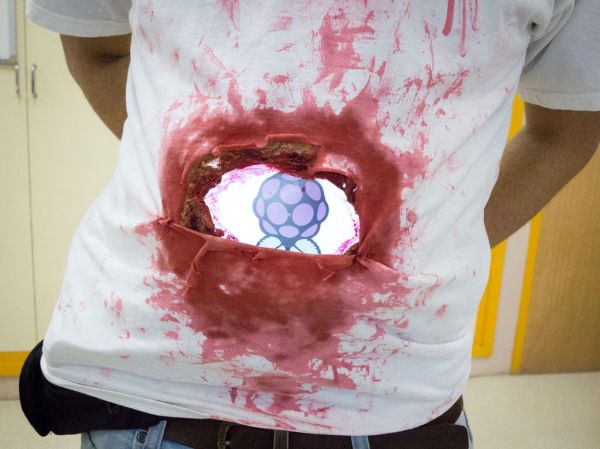
Halloween may have come and gone, but [Luis] sent us this build that you’ll want to check out. An avid Walking Dead fan, he put in some serious effort to an otherwise simple bloody t-shirt and created this see-through “stomach shot” gunshot wound.

The project uses a Raspi running the Pi Camera script to feed video from a webcam on the back of his costume to a 7″ screen on the front. [Luis] attached the screen to a GoPro chest harness—they look a bit like suspenders—to keep it centered, then built up a layer of latex around the display to hide the hard edges and make it more wound-like. Power comes from a 7.4V hobby Lipo battery plugged into a 5V voltage converter.

After ripping a small hole in the back of his t-shirt for the webcam and a large hole in the front for the screen, [Luis] applied the necessary liberal amount of fake blood to finish this clever shotgun blast effect.

IP camera hack

How To Backup And Restore Your IP Camera Firmware

[Filipe] has been playing around with custom firmware for inexpensive IP cameras. Specifically, he has been using cameras based on a common HI3815 chip. When you are playing around with firmware like this, a major concern is that you may end up bricking the device and rendering it useless. [Filipe] has documented a relatively simple way to backup and restore the firmware on these cameras so you can hack to your heart’s content.

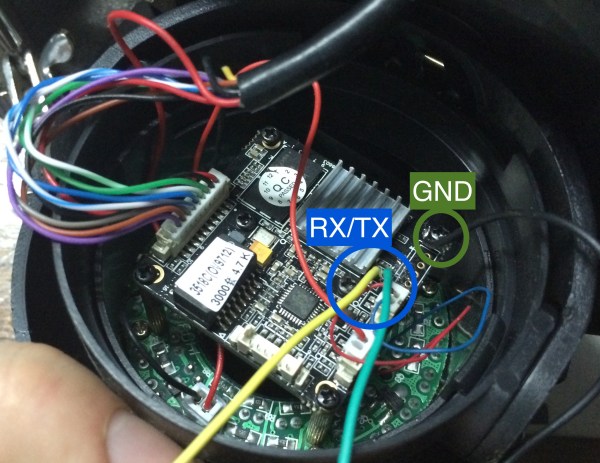
The first part of this hack is hardware oriented. [Filipe] cracked open the camera to reveal the PCB. The board has labeled serial TX and RX pads. After soldering a couple of wires to these pads, [Filipe] used a USB to serial dongle to hook his computer up to the camera’s serial port.

Any terminal program should now be able to connect to the camera at 115200 baud while the camera is booting up. The trick is to press “enter” during the boot phase. This allows you to log in as root with no password. Next you can reset the root password and reboot the camera. From now on you can simply connect to the phone via telnet and log in as root.

From here, [Filipe] copies all of the camera’s partitions over to an NFS share using the dd command. He mentions that you can also use FTP for this if you prefer. At this point, the firmware backup is completed.

Knowing how to restore the backup is just as important as knowing how to create it. [Filipe] built a simple TFTP server and copied the firmware image to it in two chunks, each less than 5MB. The final step is to tell the camera how to find the image. First you need to use the serial port to get the camera back to the U-Boot prompt. Then you configure the camera’s IP address and the TFTP server’s IP address. Finally, you copy each partition into RAM via TFTP and then copy that into flash memory. Once all five partitions are copied, your backup is safely restored and your camera can live to be hacked another day.