Ask Hackaday: Floating To Space

floating into space book cover

On a cool September morning just west of Sturbridge, Massachusetts, a group of MIT students launched a low-budget high altitude project that would go on to gain global attention. They revealed to the world that with a small weather balloon, a hacked camera, cheap GPS phone and a little luck, you could get pictures that rival those from the Space Shuttle. Their project set forth a torrent of hackers, students, kids and parents the world over trying to copy their success. Many succeeded. Others did not.

At 100,000 feet or about 20 miles up, it’s a brisk 60 degrees below zero. The atmosphere at this height is but a fraction of its density at sea level. Solar radiation rains down like a summer squall, and the view is just short of breathtaking. It seems so agonizingly close to space that you could just reach out and touch it. That one could almost float right on up into orbit.

Sound impossible? Think again. A little known volunteer based company operating out of California is trying to do just this.
Continue reading “Ask Hackaday: Floating To Space”

Launching A Glider From Space

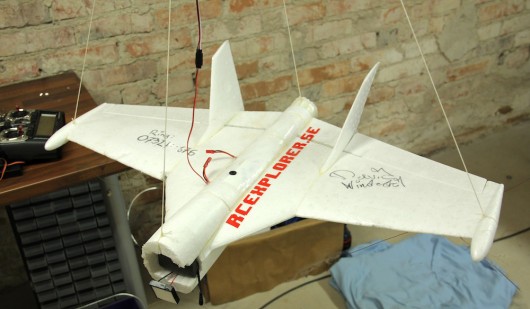
We get a ton of tips about weather balloon launches taking hobby electronics into space. But every once in a while one of them stands out from the rest. This project does send an electronic payload into space, but it also lets [David] fly his hardware back from near-space using an RC airplane.

The return vehicle is unpowered, but that shouldn’t be a problem as launching from a weather balloon will provide plenty of altitude for the flight. Because the temperature experienced in that part of the atmosphere is so cold [David] had to take several things into account. Obviously you want your batteries and control electronics to be insulated from the cold. But something that doesn’t usually pop into mind are issues with the servo motors which run the glider’s flaps. They usually have some white grease on the gears. At temps as low as -50C that grease will harden and make the servo stop working so he made sure to clean the gears thoroughly before the flight.

Unfortunately [David] had several problems capturing images and recorded video from the ground station. But his write up is still a fun read and the clip after the break gives a general overview of the entire project from the nose camera of the glider.

Continue reading “Launching A Glider From Space”

Great Antenna For Software Defined Radio Is Really Easy To Make

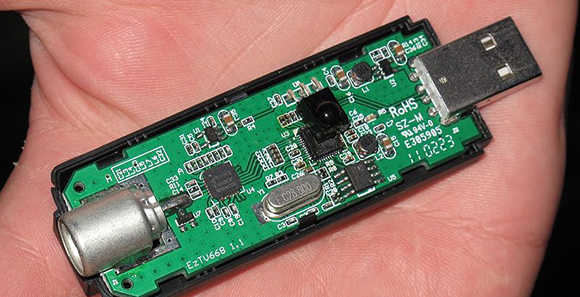
The University of Kent’s hackerspace, TinkerSoc, recently had a talk on software-defined radio using an incredibly inexpensive USB TV tuner. Of course this is nothing new to Hackaday readers, but they did manage to build one of the best antennas for their TV dongle. It’s a discone antenna, and is perfectly suited for tuning into a whole bunch of really cool things such as weather balloons and aircraft transponders.

The idea discone antenna looks exactly like its namesake; a metal disk attached to a metal cone. Of course with the frequencies the RTL software-defined radio deals with, it’s rarely necessary to build antennas out of sheet metal. The team at TinkerSoc built their discone out of galvanized garden wire and attached it to the input of their TV tuner.

All the dimensions for their discone antenna were gleaned from [ve3sqb]’s antenna design programs. Since TinkerSoc designed their antenna for 110 MHz, it ended up being pretty large. For higher frequencies, though, a discone antenna become fairly small and more than portable enough for a mobile rig.

Can A Kickstarter Project Actually Build A Space Elevator?

It’s the stuff that Science Fiction is made of: an elevator that climbs its way into space rather than needing a rocket to get there. Can it be done? No. But this Kickstarter project aims to fund research that will eventually make a space elevator possible. They’re already way over their goal, and plan to use the extra funds to extend the reach of the experiments.

A complete success would be a tether that reaches into space, held taught by a weight which is pulled away from earth by centrifugal force. That’s not really on the radar yet (last we heard humans weren’t capable of producing a substance strong enough to keep the tether from snapping). What is in the works is a weather balloon supporting a ribbon which a robot can climb. The team isn’t new to this, having built and tested several models at University and then in a start-up company that closed its doors a few years ago. Now they’re hoping to get a 3-5 kilometer ribbon in the air and to build a new robot to climb it.

For now we’ll have to be satisfied with the 1000 ft. climb video after the break. But we hope to see an Earth-Moon freight system like the one shown in the diagram above before the end of our lifetimes.

Continue reading “Can A Kickstarter Project Actually Build A Space Elevator?”

Communicating From Anywhere With A SPOT Connect

[Nate] over at Sparkfun put up a great tutorial for using the SPOT personal satellite communicator with just about any microcontroller. These personal satellite transmitters were originally intended to pair with the bluetooth module of a smart phone, allowing you to send a short 41-character message from anywhere in the world. Now, you can use these neat little boxes for getting data from remote sensors, or even telemetry from a weather balloon.

[Nate]’s teardown expands on [natrium42/a>] and [Travis Goodspeed]’s efforts in reverse-engineering the SPOT satellite communicator. The hardware works with the Globalstar satellite constellation only for uplink use. That is, you can’t send stuff to a remote device with a SPOT. After poking around the circuitry of the original, first-edition SPOT, [Nate] pulled out a much cheaper SPOT Connect from his bag of tricks. Like the previous hacks, tying into the bluetooth TX/RX lines granted [Nate] full access to broadcast anything he wants to a satellite sitting in orbit.

We’ve seen the SPOT satellite messaging service put to use in a high altitude balloon over the wilds of northern California where it proved to be a very reliable, if expensive, means of data collection. Sometimes, though, XBees and terrestrial radio just aren’t good enough, and you need a satellite solution.

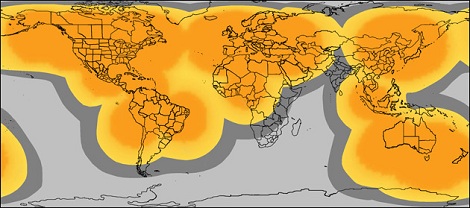
The SPOT satellite service has an enormous coverage area, seen in the title pic of this post. The only major landmasses not covered are eastern and southern Africa, India, and the southern tip of South America. If anyone out there wants to build a transatlantic UAV, SPOT, and [Nate]’s awesome tutorial, are the tools to use.

Tip ‘o the hat to [MS3FGX] for sending this one in.

Pictures From Space For $150

prelaunch

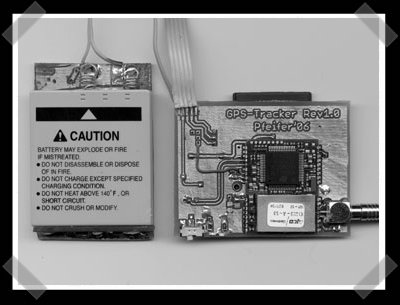
Ever wanted to be able to launch a balloon into space, track its location via GPS, take some photographs of the curvature of the earth, and recover the balloon, all for the low low cost of $150? [Oliver Yeh] sent in his teams project, Icarus, which does just that. The group of MIT students found that they could use a weather balloon filled with helium to reach heights of around 20 miles above the earth;  their particular balloon achieved 93,000 feet (17.5 miles). Then, utilizing only off the shelf components with no soldering, conjured up a GPS tracker using a Motorola i290 Prepaid Cellphone. They then used a Canon A470 loaded with the chdk open source firmware to take pictures. After seeing the results of their launch, the team hopes that this could rejuvenate interests in science and the arts.