Atari Combo Controller Has What You Need For Any Cartridge

atari-combo-controller

Retro gaming enthusiasts take note: this joystick is what you need to play any Atari game on the original console. It plugs right into the original console hardware and removes the need to choose the joystick, paddle, or keypad controller separately. You just leave this puppy hooked up and move your hands to the set of controls used on each game.

[x2Jiggy] built the thing from scratch. The enclosure is a wooden box from the craft store. He holds it closed with a couple of magnetic latches like you might find on old fashioned kitchen cabinets. The buttons of the keypad are mounted on a chunk of protoboard but he did take the time to give it a coat of matching paint so that it doesn’t look out of place. Inside you’ll find some more protoboard and point-to-point soldering to complete the rest of the connections.

You can see a fast motion video of the build process after the break. This reminds us of the universal controller built for Project Unity.

Continue reading “Atari Combo Controller Has What You Need For Any Cartridge”
Microsoft IllumiRoom Breaks Your Video Game Out Of Its Television Prison

microsoft-illumiroom

We see a lot of video game tech coming out of the three console giants (Microsoft, Sony, and Nintendo). With one look we can usually predict what is going to be a flop. Case and point is the Wii U whose sales have been less than extraordinary and Sony Move which is motion control directed as hardcore games who we believe are perfectly happy with the current evolution of their dual shock controllers. But this time around we think Microsoft has it nailed. They’re showing off technology they call IllumiRoom which uses a projector to bring your entire gaming room into the experience.

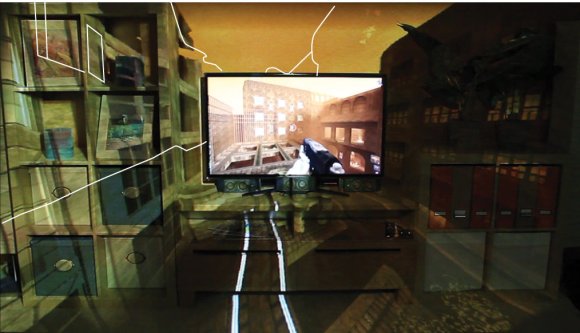
The image above is not doctored. This is a picture of IllumiRoom in action. A projector on the coffee table automatically calibrates to the room (using Kinect 3D data for mapping) in order to show realistic graphic rendering on the non-flat projection surfaces. In our mind, this comes straight out of Kinect hacking projects like the Hadouken projector. With this in place, the game designers are given free rein to come up with all kinds of different ways to use the feature. Stick with us after the break to see what they’ve developed.

Continue reading “Microsoft IllumiRoom Breaks Your Video Game Out Of Its Television Prison”

Pebble Watch Hack Makes It A Home Automation Controller

[Enrico] loves his Pebble watch, and recently had a chance to explore the code package used to customize its function. It turned out to be really easy to work with so he set out to make the Pebble watch into a home automation controller (dead link; Internet Archive).

So far the two bits of hardware used in his experiments are shown in the image above. The watch itself serves as the controller, interacting with the Ethernet relay board seen in the background. The watch communicates via Bluetooth but you don’t have to know much about that thanks to the example files available from the repository. With communications taken care of he needed a menu system to access commands on the watch. Instead of coding his own he hacked a playlist into the built-in music menu. This allows him to switch the relays on and off again as if he were playing or pausing audio tracks. See it in action after the break.

Continue reading “Pebble Watch Hack Makes It A Home Automation Controller”

Using A Screwdriver To Start Your Car

screwdriver-key

[Hahabird] uses this screwdriver to start his car. Despite what it may look like, only this particular screwdriver will start the ignition because it still uses the key lock. What he’s done is alter the screwdriver to act as an extension for the key. It’s purely aesthetic, but you have to admit it looks pretty gnarly hanging off of the steering column.

The hack merely involved cutting off the unneeded parts of the key and screwdriver. With the shaft of the tool cut down to size he clamped it in a vice and cut a slot into it using a hack saw. From there he headed over to the grinding wheel and smoothed out the sharp edges.

The key itself had the handle portion cut off and was thinned on the grinding wheel to fit snugly in the screwdriver slot. To permanently mate the two pieces he used a torch and some silver solder.

[via Reddit]

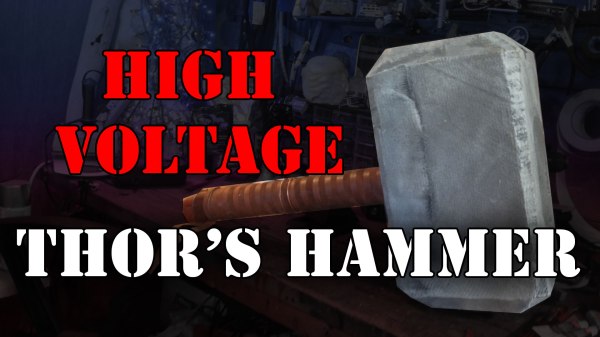
High Voltage Thor’s Hammer: Mjolnir At 80,000 Volts

[Thor’s] hammer, Mjolnir, is pretty freaking awesome. It can only be picked up by [Thor], he can use it to fly, and probably the coolest part, it can summon lightning. After watching the first movie, and goofing around with the guys at ArcAttack, I had this idea that I could stuff a tiny tesla coil into a mjolnir and end up with a really cool prop.

At this point, I had to make a decision. I was either going to go portable and live with small arcs, or make this a stationary piece and hide a giant tesla coil in a base. It would have bigger arcs, but I couldn’t carry it around.  While I may re-visit the stationary version at some point, I ultimately decided I wanted to be able to wander around and play with this thing.

I had seen some videos of [Staci Elaan] showing off her battery-powered coils and I really liked her results. I figured, with her experience, she could probably do a better job than I could on getting the most bang out of a small package.  She was happy to be involved and delivered a small 12v powered coil for me to work with. I should also point out that the coils [Staci] makes are usually donated to educational groups. This woman is awesome.

Continue reading “High Voltage Thor’s Hammer: Mjolnir At 80,000 Volts”

AM Tube Radio Restored And Given MP3 Playback Too

mp3-antique-radio

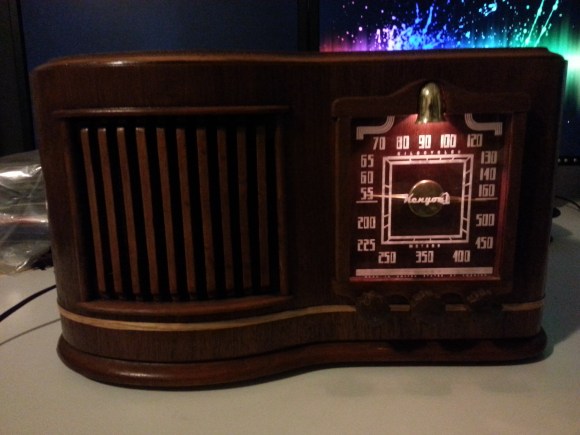
This AM radio looks a bit like it did coming out of the factory. But there are a lot of changes under the hood and that faceplate is a completely new addition. The project really is a restoration with some augmentation and [Michael Ross] did a great job of documenting the project.

The Kenyon radio was built in 1946 and uses vacuum tubes for the amplifier. Considering its age this was in relatively good shape and the first thing that [Michael] set out to do was to get the electronics working again. It involved replacing the messy collection of capacitors inside. He then cleaned up the tubes, checking for any problems, and put the electronics back together to find they work great!

He cleaned up the chassis and gave it a new coat of finish. The original dial plate was missing so he built a wood frame to match a dial scale he ordered. The bell-shaped brass cover hides the light that illuminates the dial.

He could have stopped there but how much do people really listen to AM radio these days? To make sure he would actually use the thing he added an Arduino with an MP3 shield. It patches into the antenna port via a relay, injecting modern tunes into the old amplifier circuit. Catch a glimpse of the final project in the video after the break.

Continue reading “AM Tube Radio Restored And Given MP3 Playback Too”

DIY Laser Cutter Built To Make Stencils

It was time for some new T-shirts so [Andreas Hölldorfer] built a laser cutter. Wait, what? That’s the excuse he’s going with, and in the end this scratch built laser cutter did come in handy by cutting stencils to use when decorating his garments.

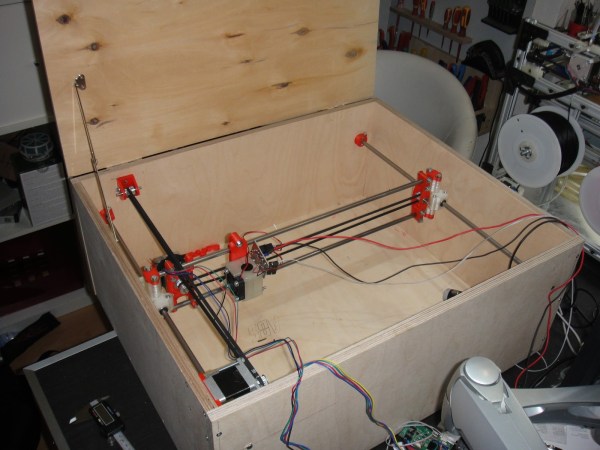
The first thing we thought when looking at the cutter is where’s the tube? [Andreas] didn’t use a CO2 laser, so this ends up being rather low-powered. The cutting head is a 1W blue laser diode which manages to slice the three-ring binder separator pages he’s using for the stencils. The two-axis machine is mounted inside a wooden box to protect his eyes while it’s cutting. He plans to add a drawer later on so that the cutting bed will slide in and out to swap out material for the next project. He already does a lot of 3D printing work and had an old RepRap driver board on hand to use for this projects. He designed and printed the red mounting brackets which make all of the junk-bin components work together. Not bad!

If you’d like to try this out on a smaller scale try using optical drive parts for the axes.