Another Take On The Rear-window LED Marquee

re-window-led-display

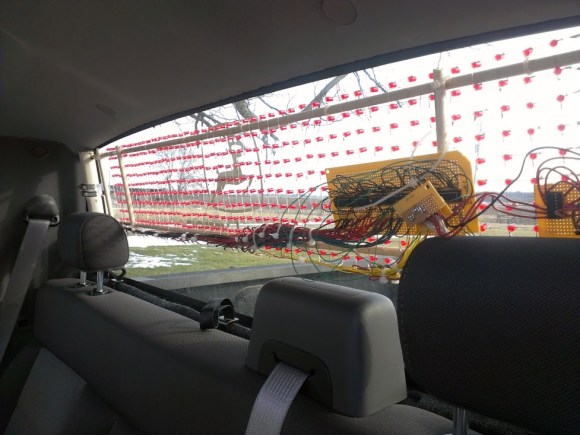
This rear-window LED marquee will help let the driver behind you know when you’re planing to change lanes or make a turn. But it also includes the ability to send a message like “Back Off!”. [Robert Dunn] was inspired to undertake the project after seeing the one we featured back in October. We’d say his has a better chance of being street legal since it uses all red LEDs.

The marquee is a matrix of 480 LEDs, all hand soldered to form the nearly transparent 48×10 grid shown above. This is important to preserve visibility out the back window of his truck. It makes us wonder about the feasibility of using SMD instead of through hole components. That would certainly make it even less visible when not illuminated, but the assembly process would be much more difficult. That’s because the 5mm LED packages fit nicely in the grid of holes he drilled in some plywood which served as the jig during soldering. The presence of leads also made the soldering process manageable.

Power to an Arduino board is provided from the cigarette lighter adapter. A set of six shift registers drive the columns while the rows are controlled by a 4017 decade counter and some transistors. Check out the blinker test video after the break to get a look at what this can do while on the road.

Continue reading “Another Take On The Rear-window LED Marquee”
Garage Parking Monitor Guides You In Every Time

THEPARKINGSPOTTER2

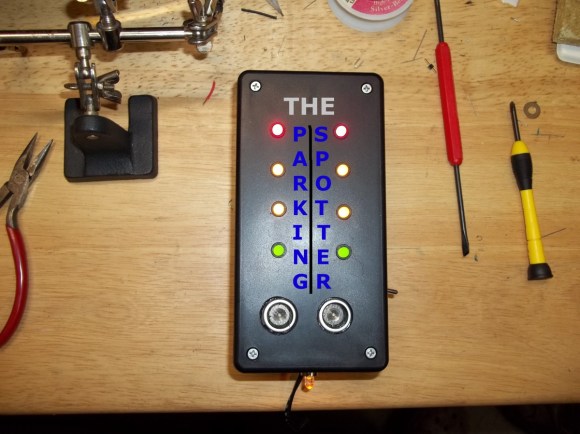
The live Adafruit Show and Tell stream from last weekend featured this project put together by [Silent Jeff]. He’s called “Silent” because when it came time to present his project on the show his microphone wasn’t working. As you can see in the video after the break, [PT] and [Ladyada] worked together to explain the project (of which they had no prior knowledge) using a game of charades. This is one of the follow-up images he sent them which details his parking spotter project.

[Ladyada] compliments [Jeff] on the finished look of the device and we agree. Not only does this do a great job of letting a driver know if they have pulled far enough into the garage, but it’s finished appearance ensures it won’t ever look out-of-place. The two silver discs near the lower end of the box are the sensors of an ultrasonic rangefinder. You mount this box so that the sensor is measuring distance between itself and the bumper of your vehicle. As the distance decreases the LEDs change to let you know when to stop. Inside the case you’ll find a voltage regulator and single-chip running the Arduino bootloader. [Jeff] says this is just his second Arduino project and we hope that at this rate we’ll be looking for big things from him in the not too distant future!

This is basically the same idea as cars that use parking assist sensors in the bumper. It’s just attached to the building instead of to the vehicle itself.

Continue reading “Garage Parking Monitor Guides You In Every Time”

New Year’s Eve Countdown Clock Included SMS Interactivity

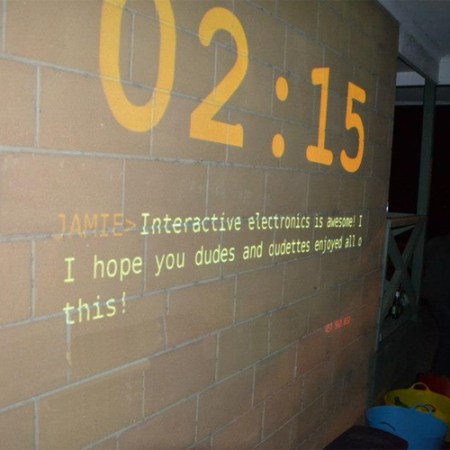
We remember several years back, when text messaging was first becoming popular, we went to a bar which had a huge television that would display text messages sent to a particular number. This sounds like a novelty, but in a large group of folks who know one another it’s the sandbox of social games. Wanting to tap in on that fun for his New Year’s Eve party, [James] built this countdown timer that includes an element of SMS interactivity (link dead, try the Internet Archive version).

The rig is projector based. A computer using Processing does the majority of the work but [James] needed a way to accepts text messages (the locale of the party had no Internet connection so this was the best bet). He grabbed a GSM shield and his Arduino Leonardo. The bulk of the evening the display showed the last few messages received, with a small countdown timer in the lower corner. As the countdown approached zero the time was given prominence as in the image above. We guess he was lucky to find a prepaid SIM card that allowed free incoming text messages. Our cell provider charges us 20¢ for each.

You might give this one a whirl next year. If it’s not quite your thing take a look around. We’ve seen a lot of fun setups like this mini ball drop.

Glass Delay Line Slide Used In An RGB Lamp

glass-delay-lines-lamp

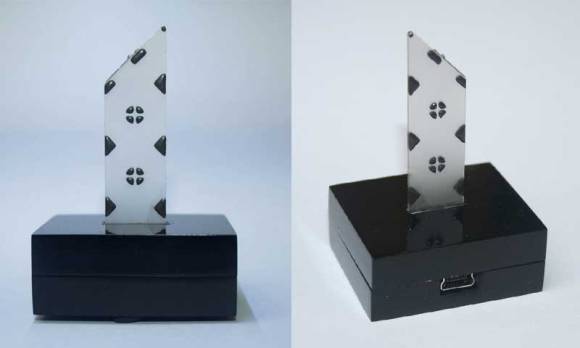
The spire used in this lamp is a part from an old television. It’s a glass delay line slide which pipes the light up from the Bluetooth controlled RGB lamp (translated) in the base.

We have looked at delay lines previously when [Dave Jones] tore down a camcorder to get at one. But we must have missed the EEVblog follow-up episode which explains how the glass slides work. The device uses physical distance to form a delay. Waves directed into the edge of the glass slide bounce around at an angle before being sensed at the collection point. [Lukas] liked the visual appearance of the part and decided to use it to add visual interest to his lamp project. The nature of the glass makes it perfect for directing the light up and away from the PCB.

The lamp consists of one RGB LED module controlled by an ATtiny2313 microcontroller. Also on board is a HC-05 Bluetooth module. This along with an app he wrote lets the user change lamp color and behavior wirelessly. You can see the lamp in action in the video after the break, but we think the camera shot probably doesn’t do it the justice it deserves.

Continue reading “Glass Delay Line Slide Used In An RGB Lamp”

LED Ice Cubes Prevent Alcohol Induced Blackouts

cube

On November 23rd last year, [Dhairya] attended a little shindig at MIT. Three drinks into the night, he blacked out and woke up in the hospital the next day. It was an alcohol-induced blackout, and like all parties at MIT, there’s an ingenious solution to [Dhairya]’s problem.

[Dhairya] came up with an alcohol-aware ice cube made of a coin cell battery, an ATtiny microcontroller, and an IR transceiver are molded into an edible gelatin ice cube. The microcontroller counts the number of sips per drink, and after one glass of adult beverage changes the color of the flashing LED from green to yellow. After two drinks the LED changes from yellow to red, signaling [Dhairya] to slow down.

If [Dhairya] feels the night is too young and keeps on drinking, the IR transmitter signals to his cell phone to send a text to a friend telling them to go take [Dhairya] home.

Less than three weeks after waking up in the hospital, [Dhairya] tested out his glowing ice cubes at another party. Everything performed wonderfully, even if he admits his creation is a little crude. A neat piece of work, and we can’t wait to see an update to this project.

Continue reading “LED Ice Cubes Prevent Alcohol Induced Blackouts”

Turning A Game Boy Into An Android Gamepad

gameboy

[Chad] has been messing around with emulators on his phone, but as anyone with a smart phone knows, even the most advanced touchscreen controls are terrible. Wanting something that pays tribute to the classic systems he was emulating, he decided to turn a classic old school brick Game Boy into an Android gamepad.

After gutting an old DMG-01, [Chad] set to work turning the D-pad and buttons in the Game Boy into something his Galaxy Nexus could understand. He chose a Bluetooth connection to provide input for his emulators, with the hardware generously donated from a Nintendo Wiimote.

The Game Boy PCB was cut up and a few leads attached to the Wiimote PCB. After modifying the case to include space for the Wiimote and a cell phone mount, [Chad] had a functional game pad, perfect for his adventures in emulation.

You can see [Chad]’s demo of his game pad after the break,

Continue reading “Turning A Game Boy Into An Android Gamepad”

[Ben Krasnow] Builds A CT Scanner

gif

After building a homebrew x-ray backscatter imager, [Ben Krasnow] realized he had nearly all the components to build his own CT scanner, able to make a 3D model of the inside of a frozen chicken.

Basically, a CT scanner takes dozens of x-rays of an object and reassembles them with the help of fancy algorithms to allow doctors to peer inside a human body. The CT scanners you’ll find at your local hospital are monstrous devices, rotating an x-ray tube and sensor around a patient with the help of some very heavy duty electromechanical engineering. [Ben] wanted to keep his build rather small, so instead of rotating the x-ray tube and screen around an object, he simply made a stepper motor-driven lazy suzan to rotate his frozen bird.

[Ben] set a digital camera off to the side of his build and captured 45 images of a rotating chicken. After correcting for the perspective distortion, the images were thrown into 3D Slicer to create a true 3D representation of a x-rayed chicken.

Continue reading “[Ben Krasnow] Builds A CT Scanner”