Open Source Android Thermostat

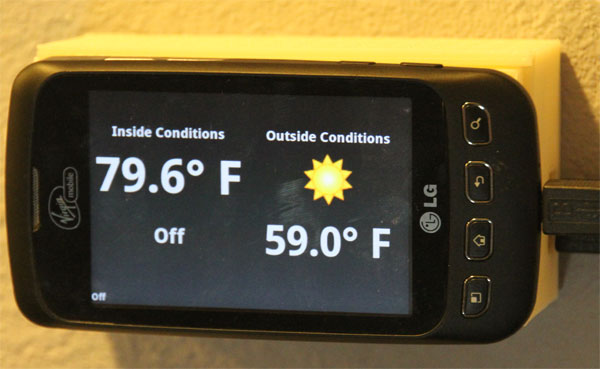
Put that old Android phone to good use by mounting it on the wall as a smart thermostat. This open source hardware and software project lets you replace your home’s thermostat with an Android device which adds Internet connectivity and all that comes with the increase in computing power.

The brunt of the hardware work is taken care of by using an IOIO board which makes it easy to interface any Android device with the simple hardware which switches your HVAC equipment. We’ve been waiting for the launch of the new IOIO design and if it comes in at a lower price as has been rumored that makes this project in the price range of the least expensive of programmable thermostats (assuming you already have an Android device to devote to it). Simply etch your own board to host the relays and voltage rectifier and you’re in business.

There is a client and server app, both free in the Play Store. The server runs on the wall-mounted device with the client offering control via a network connection. The features of the system are shown off quite well in the video after the break.

This sounds like a perfect use for that phone you ripped out of the pages of a magazine.
Continue reading “Open Source Android Thermostat”

Cellular Vehicle Information And Control

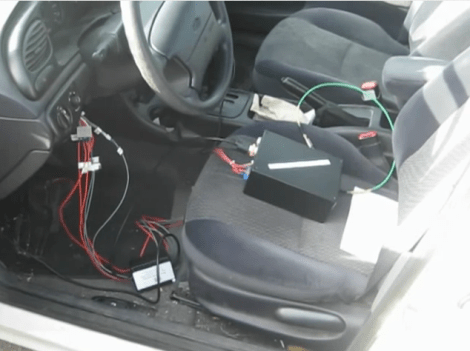
This hardware, which was built as a Computer Engineering project by [Bryon] and his classmates, gives you feedback and control of a car though a cellular phone network. It uses text messages to communicate with a control device. This can be pretty much any cellphone, but in the clip after the break they show off an Android app which puts a pretty GUI in front of you and abstracts away the tedium of specially formatted messages.

At the heart of the system is an Arduino Mega board. It has a cellular shield with an external antennae for connectivity. A GPS device, relay board, and ODB-II module provide feedback and control to the system. The relays allow the car to be started and the doors to be locked. The GPS and ODB-II module can send back location and vehicle information (anything available from the car’s sensors). There were some issues with the text messages being blocked during testing. The team thinks that the automated back-and-forth triggered some kind of spam filter from the telecom.

There’s still more work to be done if they want to actually drive the car via remote control.

Continue reading “Cellular Vehicle Information And Control”

Electric Vehicle Peripheral Controller For The Masses

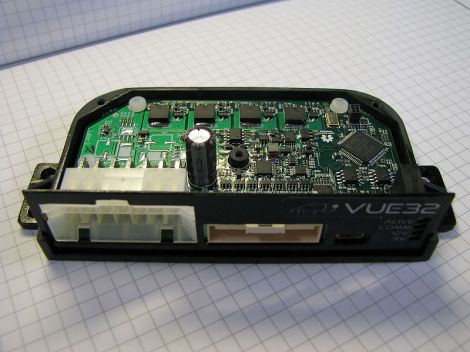
This juicy hunk of printed circuits is an open source controller for the peripherals of an electric car. It’s the product of a capstone project working on a vehicle aimed at urban commuting. There wasn’t a suitable non-proprietary module for controlling a car’s peripherals so the team built their own.

As far as we can tell this is not responsible for driving the vehicle itself. We assume there’s another piece of hardware which reads from the accelerator pedal, drives the motors accordingly, and handles things like regenerative braking. But there’s a lot of other things in a modern vehicle that need to be taken care of as well. Head, tail, and turn indicator lights must be switched. All of the dashboard controls (like the turn signal lever and the wiper blade speed settings) need to be monitored. Something needs to drive the door locks, and a system that reads the door ajar sensors and switches the dome light on and off must be handled. This is where the controller pictured above really shines.

The team has released all of the hardware information. The code is not yet available, but will be as soon as they’ve cleaned it up enough to package the first release candidate.

Turn Your IPhone Into A View-Master

This super quick hack will be fun to do with the kids. Remember the days of View-Masters? You’d put a disk of small slides into a little plastic viewer and a stereoscopic image would jump out at you in 3D! Now you can not only view stereoscopic images on your smartphone, but make your own too!

To shoot the images just hold your phone in portrait orientation and take a snapshot of your subject, then move the camera six inches to the right and take a second image. The two pics need to be displayed on the screen at the same time and for this [Plarky] uses a free iPhone app called Pic Stitch. We’re sure you can find an Android equivalent in no time if you do a bit of searching.

To view the stereoscope it helps to make a divider out of cardboard like the one seen above. You’ll need to cross your eyes and focus on a point to bring the two images together. We don’t remember having to do this with the View-Master so we’re hoping someone will take the idea and improve upon it. We’ve already seen a digital View-Master. Now we want to see those dual screens replaced with an iPhone cradle.

Configurable RFID Tag From 7400 Logic Chips

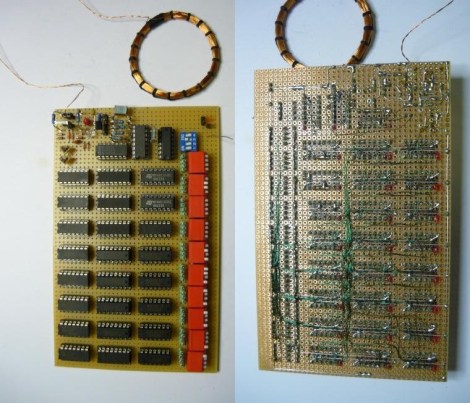
This soldering nightmare is a configurable RFID tag which has been built from 7400-series logic chips. The beast of a project results in an iPhone-sized module which can be used as your new access card for security systems that uses the 125 kHz tags. The best part is that a series of switches makes the tag hand programmable, albeit in binary.

Of course this is an entry in this year’s 7400 Logic Competition. It’s from last year’s winner, and he’s spent a lot of time documenting the project; which we love. We were surprised that this many chips can be powered simply by what is induced in the coil from the reader. This is just one of the reasons the 7400-series have been so popular over the years. After working out the numbers, a 64-bit shift register was built to feed the tag ID to the encoding portion of the design. There were many kinks to work out along the way, but once it was functional a surface-mount design was put together resulting in the final product shown off in the video after the break.

Continue reading “Configurable RFID Tag From 7400 Logic Chips”

Emulators 101: How To Write A Program That Functions Like An NES CPU

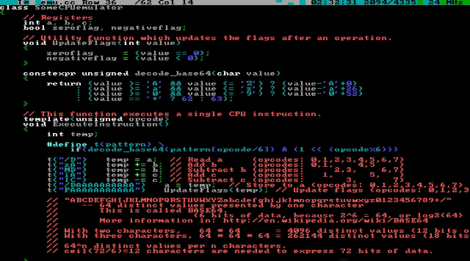
We’d bet everyone reading this article has played a game on an emulator at some time or another. And you may have a base idea of how those emulators work. But we’d wager the vast majority of you are clueless about the actual implementation of game emulators (we know we are). But that has all changed after seeing this demonstration of how [Bisqwit] wrote his own NES emulator. The description doesn’t cover anything more than the basics of writing code that emulates the NES CPU hardware itself. But it’s presented in such a way that makes it quite easy to understand for anyone who has a basic knowledge of programming. He starts with a switch statement for handling the processor’s opcodes and then moves through piece by piece showing how he refined his code to make it work while keeping it readable. We think this is a great teaching method and appreciate the time he put into producing this tutorial.

The explanation starts about 4:22 into the video which is embedded after the break. You’ll also find the first two demo videos there. Those involve mostly fast-motion text editing of the emulator coding process with some gameplay tests at the end of the second video.

Continue reading “Emulators 101: How To Write A Program That Functions Like An NES CPU”

Arduino Voice Changer Turns You Into [Vader]

Halloween is just around the corner, so of course we’re looking forward to a bunch of awesome costumes put together by Hackaday readers. In an effort to match his voice to his costume, [Phil Burgess] over at Adafruit (and former Hackaday alumnus) put together an Arduino-powered voice changer to give his voice the gravitas of [James Earl Jones] or the lightheartedness of a member of the Lollipop Guild.

If you’ve ever played with a turntable, you’ll know playing a 33 RPM record at 45 or 78 RPM turns your treasured copy of Dark Side of the Moon into a lighthearted aural experience with a pitch that is much too high. Likewise, playing a single at 33 or 16 RPM means those once dulcet tones are now recordings of tormented souls in an acoustic hell.

[Phil]’s voice changer operates on the same principle by recording sounds from a microphone into a circular array and playing them back at a different rate; faster if the desired effect is a Munchkin, and slower if this year’s Halloween costume will be a Sith lord.

The completed build incorporates a 10k pot to dynamically change the timbre of the voice changer, as well as an Adafruit Wave Shield to play back a few pre-recorded sounds of lightsabers clashing. In all, a very cool project for your Halloween costume that’s also a very good introduction to DSP and real-time audio modifications with a microcontroller.

Continue reading “Arduino Voice Changer Turns You Into [Vader]”