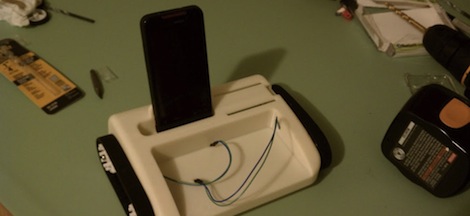
Another Android Controlled Roving Robot

[Sam] has been working on a cellphone controlled robot for a while now and with the launch of a few similar Kickstarter campaigns he thought it would be good to share his progress so far.

[Sam]’s robot is controlled by an Android device with the help of an IOIO dev board. This setup provides more than enough computational power to send a robot on its merry way, and has the bonus of allowing [Sam] to connect additional sensors.

The case is designed to put the headers on the IOIO board on the outside, just above a little shelf perfect for holding a breadboard or two. With the right hardware and software setup, [Sam]’s bot can rove around the neighborhood collecting data and sending it to a server in real time.

If you’re wondering why a tiny Android/IOIO powered sounds so familiar, it might be because of the Botiful robot we posted a few days ago. Unlike Botiful, [Sam] can only control his treaded Android bot through Bluetooth as the whole ‘programming a web interface’ is a bit over his head. Hopefully [Sam] will meet an enthusiastic coder when he brings his Arduino tank to Dorkbots Boston this evening.

You can check out a prototype of [Sam]’s bot in action after the break.

Continue reading “Another Android Controlled Roving Robot”

Adafruit’s Custom Rasp Pi Distro Eases Some Pain

Many of you have still not yet received your Raspberry Pi. When you do, you’ll find that there is work to be done in the operating system to get things working as you might want them to.  The wonderful folks over at Adafruit have tackled this by releasing their own distribution of Linux for the Raspberry Pi.

Based on the shipped distribution “Wheezy”, Adafruit’s distribution “Occidentalis v0.1. Rubus occidentalis” or “the Black Raspberry” now includes the following:


Robotic Manta Ray (Mantabot)

The Robotic Manta Ray codenamed MantaBot created by the Bio-Inspired Engineering Research Laboratory (BIER Lab) is set to make a splash. The next evolution in underwater Robotics is here. We have seen the likes of robotic fish and Jelly fish now to be added to the school is the MantaBot which has been designed to mimic the unique swimming motion of the Manta Ray,

This biologically inspired under water robot’s has been designed with a primary goal to be autonomous using its onboard electronics to make its own decisions to navigate its watery domain. BIER Lab has received major funding from the Department of Defense (DoD) Multi-disciplinary University Research Initiative (MURI) program. Part of its goal in the long run is to reverse engineer the biological systems of such creatures to the point of creating simulated artificial skin and muscle.

[Via dvice.com]

Continue reading “Robotic Manta Ray (Mantabot)”

Super Nincoffee Jr.

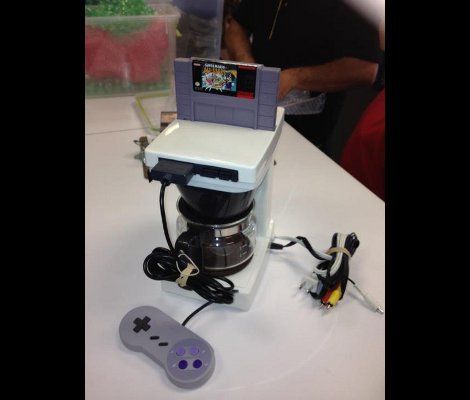
Your morning routine doesn’t include enough old-school gaming. Break the caffeine habit and get your Mario on at the same time with the help of the Super Nincoffee Jr.

[Luigifreakout123] shares the details of the build in the video clip after the break. He starts by revealing that this is the second version he’s made. The first wasn’t a Jr., but instead used a full-sized Mr. Coffee unit. Neither make coffee, but instead serve as an enclosure for the gaming hardware. The on/off switch and original power cable are used to control the electricity to the console. Openings have been cut in the tops and front for a game cartridge and the two controller ports. A composite video and stereo audio cable comes out the back of the machine next to the power cord.

Yeah, it’s super simple, but sometimes that all it takes for a project to be a delight like this one is.

Continue reading “Super Nincoffee Jr.”

Atomic Clapperboard

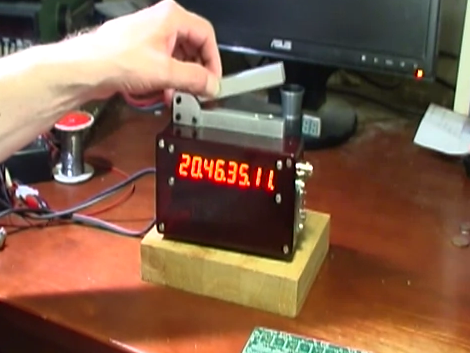
Whether you know it as a clapperboard, a slate, slate board, time slate, or by another name, you probably recognize this staple of movie making. It’s a handy way to help synchronize sound with video, and to keep track of clips when it comes time to edit. But this clapperboard is quite a bit more accurate than most. It’s got an atomic clock source for dead-on accuracy.

The project came from the growing availability of Rubidium clock source modules on eBay. They can be had for under $100 and you’ll enjoy accuracy of 0.1 ppm. [Luddite Tech] grabbed one for himself and included it in this build. As you can see in the clip after the break, the contrast of the eight-digit display is adjustable, and shines brightest when the marker is snapped. We’d guess the cable he connects at the beginning of the demo is used to set the initial time reference. After that the in-built WiFi can be used to push the time markers to a computer.

Continue reading “Atomic Clapperboard”

Home Security Anyone Can Build And Install

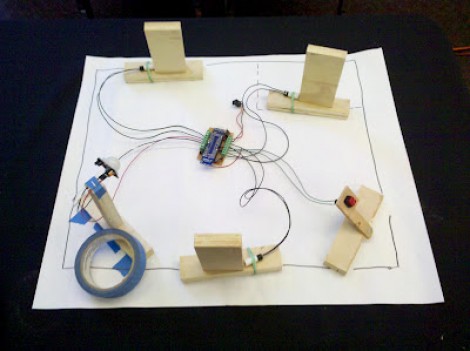
We’ve been seeing quite a few home security hacks around here lately and we think they’re a lot of fun. This is one that we missed a few weeks ago. [Sharpk] used his existing home security system as inspiration for a completely DIY security system. Above you can see the tiny models he used to help visualize how the system would be installed.

The board at the center is a JeeNode, a development board that pairs an ATmega328 with a wireless module. There are three magnetic door sensors which you can easily find at the home, hardware, or electronics store around the corner. They’re basically a reed switch and a magnet; one mounts on the door, the other on the jamb. There is also a panic button and a PIR motion sensor. [Sharpk] has even been working on a UI for the system. He crafted a 3D model of his home’s floor plan in SketchUp and uses it to indicate which part of the system has been triggered.

Now he just needs to add a keypad for arming and disarming the system.

Building An Isolation Booth For Your Home Recording Studio

[Brattonwvu] wanted to lay down some tracks with as high an audio quality as possible. To help get rid of the noise pollution of the everyday world he built this isolation booth in his attic.

The project started off with a trip to the home store for some 2×4 stock and OSB to use as sheathing. The framing is as you would expect, but to help deaden the sound he went with a surprising material. He’s filled the cavities between each 2×4 with stuffed animals and old clothes. The same is done in the walls and the inside surfaces are all covered in fabric to prevent echoing. The door has a lip and we can just make out what looks like weather stripping to provide a seal. There is just one opening in the box, where a PVC pipe allows electrical and microphone cables to pass through. [Brattonwvu] reports that you can hear your heartbeat in your ears when standing inside the sealed booth.