This Toy Intercom System Is Way Better Than A Pair Of Tin Cans And Some String

toy-intercom-system

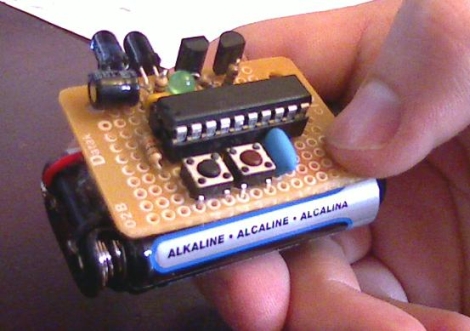
On his blog, [Kenneth Finnegan] recently showed off a replica of a fun toy he used to play with as a kid, a telephone intercom system. The setup is pretty simple, requiring little more than a pair of analog phones, a battery, and a resistor.

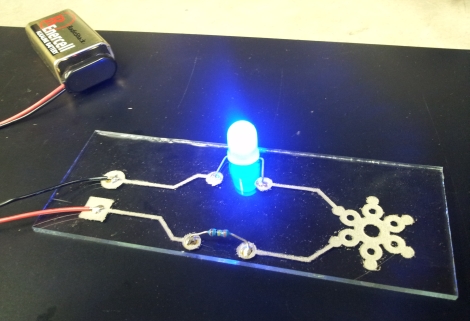
The phones are connected to one another using a standard telephone cable, but [Kenneth] uses a 9v battery to introduce a small bias current into the loop, allowing the speakers at either end to hear one another. He also added a small LED into the circuit so that there is a visual indication as to when both handsets are off hook.

The setup is very simple at the moment, though [Kenneth] does have some ideas in mind to enhance his intercom system. He hopes to tweak the remote phone to ring when the local phone is picked up, among other things.

Telephone technology is nothing new, but for just a few dollars (or less) your kids can be entertained for hours as [Kenneth] was way back when.

Continue reading to see a short video overview of the phone system, and be sure to share your ideas for enhancing it in the comments section.

Continue reading “This Toy Intercom System Is Way Better Than A Pair Of Tin Cans And Some String”

Two Telescope Improvements

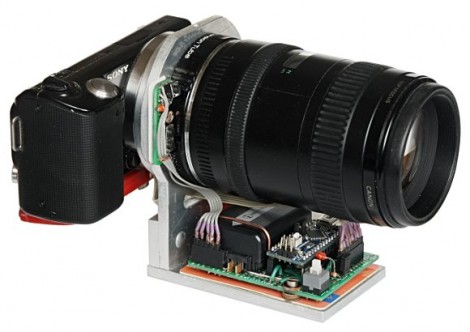
Despite being a college class everyone regarded as an easy ‘A,’ astronomy is very hard work. Not only do many hours go into capturing a single image, the equipment itself must be constantly monitored well into the freezing cold of night. [Jerry] sent in a few neat projects that have made his nights much more comfortable.

First up is a mod for a focus controller. The focus of a telescope changes constantly with temperature, atmospheric conditions, and especially what filter is being used. The stock USB-nSTEP focuser [Jerry] used required hard-to-find unipolar steppers, so he modded his USB-nSTEM to accept bipolars with a Pololu A4988 driver.

Next up is [Jerry]’s very impressive DIY Off-axis guider that he machined himself. An off-axis guider allows an astronomer to guide the ‘scope without having to deal with a dinky, surprisingly flexible guide scope. We’re really impressed with [Jerry]’s machine skills, but that’s what you get when you’ve got an awesome mill like his.

Update: Tiny Line-follower And More

This tiny line-following robot is quite impressive. It’s [Ondrej Stanek’s] second take on the design, which he calls PocketBot 2. Just like the earlier version, this robot is small enough to fit in a matchbox, but it’s received several upgrades in this iteration.

The coin cells that ran the previous version have been replaced by a rechargeable Lithium Ion cell. The ATmega8 which controlled the first robot has been swapped out for an ATmega128 running at 32 MHz. You won’t find an IR receiver on this one either, it’s been traded for a Bluetooth module which adds a quantum leap in functionality. For instance, the graph in the upper left of this photograph shows the reflective sensor data readings used to follow the line.

There’s all kinds of great engineering in this design, which is shown off in the video after the break. One of our favorite parts is that the axles are attracted to the center of the robot by one rare-earth magnet. This keeps the rubber tires pressed against the motor spindles rather than use a gearing system.

Continue reading “Update: Tiny Line-follower And More”

Slowing A Bopit So The Littles Ones Can Play Too

[Johnny Halfmoon] wanted to help out his three-year-old who was fascinated by the Bopit electronic game. In its stock condition it’s a bit too fast for the young one, so he cracked it opened and added the option to slow things down.

Above you can see the Bopit Extreme with the top half of the case removed. Although not hard to get open (there’s just 12 screws to remove) the spring-loaded appendages will fly apart when you do. He warns to pay attention at how they go back together.

There’s one axial resistor which affects the running speed of the game. [Johnny] desoldered this, replacing it with a circuit that toggles between that original resistor and a potentiometer. Now, one switch position allows for normal play, the other allows for adjustable speed based on the potentiometer position. Check out the results in the clip after the break.

Looking for some other fun electronic toy hacks? Why not try out this cursing Simon Says?

Continue reading “Slowing A Bopit So The Littles Ones Can Play Too”

Web-enabled Coffee Maker Over-complicates Your Break Time

Some think that grinding the beans and filling the coffee maker is part of the coffee-drinking ritual, but [Jamie] isn’t one of them. Instead, he’s been working to make this coffeemaker a web-enabled device. He built it as part of a class project, and has implemented most of what you need to make a cup of Joe automatically.

You can see a small pump attached to the back of the coffee maker. It sucks water from a pitcher (slightly visible to the left of the coffee maker) to fill the reservoir. He experimented with a couple of different water level sensing solutions. His most recent is a PCB with several traces of different length. As those traces are covered by water, a voltage can be read via ADC to establish water level.

He’s using an Arduino and Ethernet shield to add connectivity for the device. The problem is that there aren’t enough ADC pins left on the Arduino to read the water level sensor. Because of this, he added a self-build shield that uses a PIC to do the ADC measurements and push digital data across to the Arduino. A bit complicated, and it doesn’t load the grounds automatically (yet?). But that’s not to say we don’t appreciate complicated coffee hacks.

Reverse Engineering Bluetooth Using Android And SPOT As An Example

[Travis Goodspeed] wrote in to tell us about his work reverse engineering the Bluetooth communications on this SPOT module. He’s targeted the post as a general guide to sniffing Bluetooth transmissions, but was inspired to use the SPOT as an example after seeing this other SPOT hack. We know he’s a fan of getting things to work with his Nokia N900, and that’s exactly where he ended up with the project.

This module was manufactured to be controlled by an Android phone. But there’s no control app available for the Nokia handset. Since Android uses the open-source Bluez package for the Bluetooth protocol, it’s actually pretty easy to get your hands on the packets. After grabbing a few test sets he shows how he deciphered the packets, then wrote a quick Python script to test out his findings. After working his way through the various commands available (grabbing the SPOT serial number, getting position data from it, etc) [Travis] wrote up a frontend in QT mobility for use on the N900.

Musical [Blinky] Candy Tin

Since it’s the holidays and pine trees are being cut down and installed in living rooms all around the world, [Jarv] though it would be a good idea to make a musical Christmas ornament. He needed to keep some of his geek cred, so [Jarv] decided to build a musical [Blinky] ghost from Pacman.

A few weeks ago, [Jarv] sent in his musical greeting card that uses a minimal amount of parts to play a short 8-bit tune. His project was based around an ATtiny85 and sounded pretty good. For his [Blinky] ornament, [Jarv] used a similar circuit along with some old-school Pacman songs that sound great.

[Jarv] found a [Blinky] candy tin and after dispensing with all that pressed sugar began work on his build. In keeping with his greeting card, everything is very minimal. Just a speaker, ATtiny85, and button make up the build. Pressing the button cycles through three songs from Ms. Pacman. The result sounds uncannily like a vintage arcade game, so be sure to check out the video after the break.

Continue reading “Musical [Blinky] Candy Tin”