Ethernet Controlled Garage Door

[Thomas]’ garage door opener is a big old industrial unit, so he doesn’t have the convenience of a remote-controlled garage door opener.  Obviously, this would get annoying after a while, so [Thomas] decided to build an Ethernet enabled relay board so he can open his door with his iPhone.

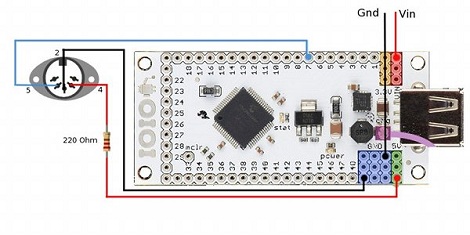
The build is based around an ATMega328 and a neat little Ethernet controller from Microchip. There are two relays on the board that connect to the Up and Down buttons on the door opener. The board receives UDP packets with instructions like, ‘RELAY 2 ON’ and the door responds accordingly.

Building just one of his boards cost [Thomas] the meager sum of $43. Considering the new Arduino Ethernet board costs around $60, we’re thinking he did a good job here. From the video after the break, we’re seeing that [Thomas] has to hold the button on his iPhone down for the door to go up. We see a few more pins on his AVR, so perhaps v.2 of his board could contain a few headers to attach sensors. Still, it’s a very nice build.

Continue reading “Ethernet Controlled Garage Door”

An Iambic Keyer In 5 Minutes

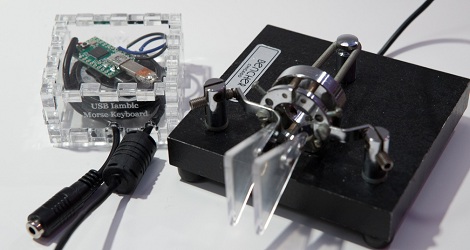
When most people think about a telegraph key, a piece of 1890s tech with a lever that moves up and down comes to mind. These ‘straight keys’ were terrible for telegraphers and led to repetitive stress injuries like carpel tunnel syndrome..Iambic keys came along and move the contacts to a horizontal position. If you ever see a HAM playing with his CW rig, chances are they’re using an iambic key. It’s great, then, that you can build your own iambic key in five minutes using parts you have lying around.

The build [Dimitris] put up is dead simple – just two metal contacts with a pair of 470K pullup resistors. All this connects to three pins on an Arduino. All the micocontroller needs to do is measure the rise time a touch sensor pin when a voltage is applied. If there’s a finger on the pin, the capacitance increases and the rise time is longer. After that, just assign one sensor as ‘dit’ and the other as ‘dah’ and you’ve got an iambic key.

[Dimitris] put all the code for his project up on his blog. His iambic key seems like the perfect project after a tiny Morse trainer. Check out the video of the key in action after the break

Continue reading “An Iambic Keyer In 5 Minutes”

The Force Is Strong With This Christmas Tree Light Show

star-wars-christmas-tree

[Zach] is a huge Star Wars fan, and in addition to the array holiday decorations that adorn his house, he says that his wife is nice enough to let him put up a Christmas tree full of Star Wars ornaments. For the past few years, the tree sat in the corner of the room unlit, but his wife thought that it should have some lights this year.

His wife came home with a small string of battery-operated lights, but [Zach] wanted something with a bit more geek cred. He decided to program the lights to play the Star Wars theme song, translating the tune’s pitch to light intensity.

He dug through his bin of electronics and found an MSP430 along with a small target board that would do the job nicely. He sat down with some sheet music, translating the notes to PWM values, resulting in the light show you see below.

While his wife provided a lovely violin accompaniment to the tree, we think that a small audio module would make a great addition to the tree next year.

Continue reading “The Force Is Strong With This Christmas Tree Light Show”

Dash-mounted Nook Color Is A Perfect Head Unit Replacement

jeep-nook-mount

XDA forum member [craigbru] wanted to beef up the audio setup in his Jeep, and thought that his Nook Color would make a suitable replacement. Since he jailbroke the e-reader, the head unit upgrade lets him do just about anything you can imagine, all from the comfort of the driver’s seat.

Seeing that he would continue to go off-road with the Jeep, he wanted to construct a mounting solution that was convenient and sturdy – something we think he did very well.

The dock was constructed using a Quadratec iVault stereo mount, along with a plastic tablet mount he had on hand. Because convenience was a primary goal, he put together a quick release charging solution as well as a simple audio interface using a set of touch contacts. This allows him to connect and detach the tablet from the Jeep without having to fuss with a bunch of cables each time. He also added an audio equalizer along with a Bluetooth OBDII interface to the setup, allowing him to tweak his tunes and monitor his engine with ease.

We think it’s a great-looking setup, and we’d be lying if we said we didn’t want one as well.

[Thanks, MS3FGX]

A Keyboard For Your FIGnition

[Carl] sent in his keyboard he made for his FIGnition microcomputer. At least now he has more than 8 buttons.

The FIGnition is a tiny little microcomputer that harkens back to the 8-bit days of yore. Designed to be an educational computer like the Altair or Heathkit (sans blinkenlights), the FIGnition gives its students ‘bare metal’ access to everything in the system. It’s powered by an ATMega168, a 4 Kb SRAM and an 8Mb Flash chip for storage. Unfortunately, the FIGnition only has 8 buttons to program Forth with, so [Carl]’s project is very much desired in the community.

To expand 8 buttons into an alpha-numeric keyboard, [Carl] came up with the solution of using two tact switches per character. The switches are of different button heights, so pressing a pair of buttons actuates the two buttons in order, which is natively interpreted by the FIGnition. It’s a perfect match for the chord-keys of the FIGnition.

Check out the video of [Carl]’s bundle of wires after the break.

Continue reading “A Keyboard For Your FIGnition”

Pick Up That Can, [Jeri]

We all need an excuse to play Half-Life 2 sometimes. [Jeri Ellsworth] put together a My First Crowbar controller to throw a few headcrabs across the room. It’s pretty much Half-Life 2 for the Wii.

The build is very simple – just a tilt switch hot glued to the underside of a childs-size crowbar. Two leads go from the tilt switch to the contacts on a (PS3?) controller. All you need to do to attack is swing the crowbar wildly.

[Jeri] has us wondering what other awesome game controllers could be made. Of course we’ve been wanting a real-life Gravity Gun or Portal Gun for years now, but right now we’re thinking about a real Katamari. We might need more hot glue.

As far as building our own, we’re thinking about using one of the Cheap DIY tilt switches we saw the other day. It’s a simple build, and sure looks like a lot of fun.

Continue reading “Pick Up That Can, [Jeri]”

An EEWeb Interview With Todd Harrison

Although Todd Harrison could be one of many of our readers (and most of our writers), it was nice to see one of “us” featured in [EEWeb]. [HAD] has featured him before in posts such as this recent one about replacing solder tab batteries.

What may be interesting to many is that soon after [Todd] graduated he took a job as a computer programmer, but like many other part-time makers, he still had the need to physically create and modify things. This article goes over some of his preferred tools, as well as some of the various projects that he’s done or is working on now.

In the article, [Todd] goes over what he sees as the biggest challenges to inspiring new generations of engineers. One of these is that circuitry is increasingly locked down and are not easily tinkered with. Without exploring how things work, his view is that fewer will be inspired to go into engineering. Although there is certainly some validity to his point, as some doors close, others hopefully will open. The accessible learning environment of the Internet, open source resources, and many maker-friendly materials like the Arduino should help to fill in the gaps.

For more information, [Todd] also has his own blog, Toddfun.com, which features his projects.