Who Needs Mecanum Wheels?

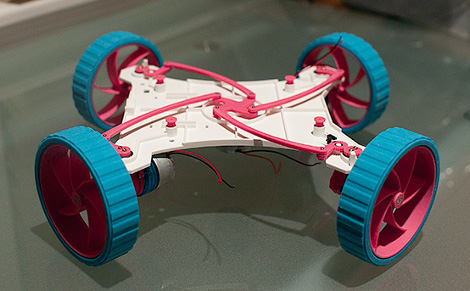
Skills are all that’s needed to solve a problem. Take this four-wheeled robot as an example. [Michal Zalewski] wanted it to be omnidirectional but wasn’t very satisfied with the concept of mecanum wheels and the like. So he designed a chassis with wheels at each corner that can pivot as one to change orientation. The image may look like a rendering at first glance, but this is actually the physical prototype. See what we mean about skills?

Okay, so the robot design is pretty cool. But we’re more excited about the build process. We’ve looked at [Michal’s] work before. He wrote a thorough guide about CNC mold making. These parts are all cast from epoxy. This starts with a rough milled mold, which is given a second pass for the fine details before being painted with a release agent and used to make a silicone mold. From this the parts are produced. Check out the Flickr set showing the casting process for the planetary gear box on each motor. If only these results were as easy to achieve as he makes it look.

[via Reddit]

Sliding Camera Mount Is Good Enough For Amateur Photography

[Unihopper] built this sliding camera mount to add some motion to his freestyle unicycle videos. It’s extremely simple, but still pulls off a pretty nice effect as you can see in the clip after the break.

The image above shows the mount without a camera attached.  You can see the threaded peg on the block in the foreground which is used for that purpose. Felt has been wrapped around the base of the block, which rides in a wooden channel. The string, which connects to an eye hook in the wood block, is attached to a spool on the far end of the plank. A K’nex motor drives that spool, slowly sliding the camera toward it.

Unlike other toy-based sleds, the use of a track system helps to maintain proper orientation of the camera. Obviously this isn’t going to achieve the perfectly smooth and precise motion you’d get out of a sled system like this rail and linear bearing version. But honestly, most of us don’t have cameras of the quality to warrant that type of high-end system. Continue reading “Sliding Camera Mount Is Good Enough For Amateur Photography” →

Meet The TM65 Liquid Propellant Rocket Engine

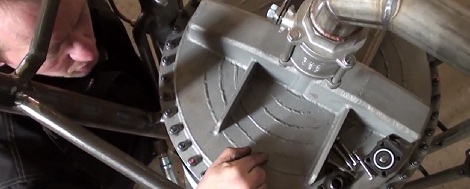
While we’re reluctant to say it for fear of being misinterpreted, the new liquid fuel rocket engine being built by Copenhagen Suborbitals is one of the most impressive, daring, and nearly the sexiest machine we’ve ever seen. Although the engine hasn’t been fired yet, [Peter Madsen], Chief launch vehicle designer at Copenhagen Suborbitals, gives an amazing 18-minute-long rundown of the function of each and every tank and tube of the TM65 in this video.

When the TM65 engine begins its firing sequence, valves attached to tanks of alcohol and liquid Oxygen are opened. The Oxygen pours directly into an injector manifold that atomizes the liquid in the combustion chamber, while the alcohol makes a much longer trip down to the engine bell, flowing between the double wall of the chamber and nozzle for cooling. Once the alcohol and Oxygen in the combustion chamber ignite, two gigantic tanks of Helium are opened and the gas is forced down to a heat exchanger at the end of the nozzle, increasing the temperature and pressure of the Helium. The Helium is then routed to the tanks, pressurizing them and forcing fuel and oxidizer into the combustion chamber at 40 liters per second. This entire process happens in only eight seconds; after that, the rocket attached to the TM65 will be on its way upward.

We’re not going to say the TM65 is the best engine ever seen on Hackaday; we’ll leave you to decide that. We can’t wait for the video of the test fire to hit the Internet, though.

Working Tachikoma Brings The Manga To Life

This Lego Tachikoma drives and walks just like in the TV program. You simply must take a peek at the video after the break. We’ve watched it several times and don’t think there’s any editing magic going on. But the movements are so intriguing part of us thinks there’s something fishy about it.

Each leg has a wheel that is connected to a motor via chain drive. But the little guy isn’t constrained to smooth hard surfaces. When the going gets rough, he struts his stuff like an eight-year-old crossing the lawn in roller skates.

This is not just for show and you can build it yourself if you like. The link at the top has assembly instructions. You will need several specialized parts though, not the lest of which is the cement mixer drum halves that make up the rounded blue chassis pieces.

Not sure what the heck this thing is? Don’t feel bad, you’d need to be a fan of Ghost in the Shell to recognize it.

Continue reading “Working Tachikoma Brings The Manga To Life” →

DrummerBot Joins The Jam Session When Your Bandmates Are Busy

drummerbot

It seems that more often than not, [Steffest] finds himself inspired to rock out on his guitar without a percussion section to back him up. Like any enterprising hacker/musician would be wont to do, he built a robotic drummer to join in when he got the urge to play.

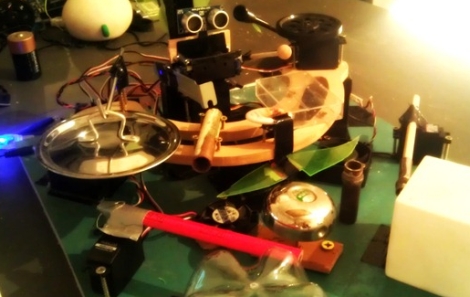
His DrummerBot is driven using an Arduino, which is tasked with controlling the 8 servo motors that the bot has at its disposal. The bot’s drum set is composed of a variety of items from fan motors to pot lids and more. [Steffest] wanted the ability to produce the maximum variety of sounds possible, so most of the servo motors are driven in two directions allowing the bot to strike more than one item with each “arm”.

[Steffest] is a big fan of interfacing physical objects with a web interface, so he built a simple HTML based sequencer that allows him to program the robot from his phone. Once the sequencer is programmed, the DrummerBot can be launched into action with the simple press of a button.

[Steffest] says that the bot works pretty well, but the sound is a bit raw if you hear it live. A little Ableton Live post-processing goes a long way to smooth things out however, as you can see in the video below.

[Thanks, Wesley]

Continue reading “DrummerBot Joins The Jam Session When Your Bandmates Are Busy” →

Sphere Morphing Hexabot Now Rolls Around

[Zenta] has been building his MorpHex rolling hexapod for nearly a year now, and good things come to those who wait. After a ton of development and fabrication, [Zenta] finally has his mechanical jellyfish robot rolling and walking around.

This isn’t the first time we’ve seen [Zenta]‘s MorpHex robot in action. A year ago, we saw the beginnings of the project with that included 25 servos mounted on a custom chassis. Last winter, the top hemisphere of the MorpHex was added, but rolling locomotion was still on the drawing board. A lot has changed since then, and now [Zenta]’s robot can roll or walk across the floor.

From the video (available after the break), we see that [Zenta] kept the one degree of freedom for the panels on the upper cylinder. He’s thinking about making the MorpHex more symmetrical; just copying the plans for the bottom hemisphere onto the top, for instance. This plan would allow the MorpHex to roll in a straight line, so we can’t wait to see what [Zenta] cooks up next.

Continue reading “Sphere Morphing Hexabot Now Rolls Around” →

Old Timey UAV Cameras

These brave birds are weapons of war. Well, not these actual birds… they’re just models used for this photograph courtesy of a taxidermist. But their living relatives were used to take spy photographs during World War I. [Dr. Julius Neurbronner] didn’t suddenly jump into the field of avian photography. He, like his father before him, used homing pigeons to deliver prescription drugs in loads of up to 75 grams. This makes us wonder if the birds are ever used in modern drug running?

The inspiration came when the doctor found out about subminiature cameras available at the turn of the twentieth century. Those cameras included a tiny roll of film, allowing for several images to be taken. He figured out a way to make a timer that used a pneumatic system to trigger the shutter in the camera. You can see a diagram of the timer mechanism here. The idea is that the birds will always be able to find their way home. So if you take them to a starting point that puts the enemy lines in between them and home base, they’ll fly over and get some juicy recon in the process.

That’s pretty old school. But we’re still tying things onto birds these days. Here’s some modern tech that uses sun-up/sun-down to track travel habits.

[Thanks F via The Atlantic]