Arduino Controlled Four Socket Outlet

Never get between a man and his salami. [Mike] needed a way to control temperature, humidity and airflow with his meat curing setup. Of course he could modify a refrigerator and humidifier to be controlled separately, but [Mike] decided the best course of action would be to control line voltage with an Arduino.

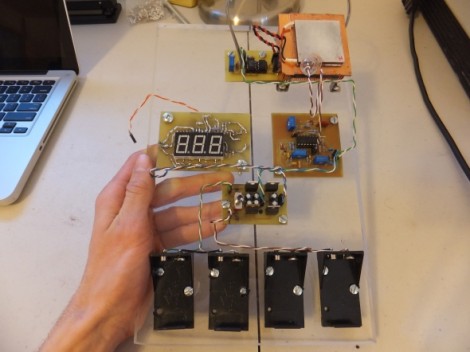
[Mike] started his build with a four socket wall housing he picked up at Home Depot for a few dollars. After wiring up each outlet so it can be controlled independently, he set out designing a four port relay board. This was a pretty simple build – four 10 Amp relays and a few terminal blocks. The PCB was designed in Eagle as a single-side board for ease of manufacturing.

The relay board is meant to fit inside the blue box along with the four sockets, so a few holes were drilled for the power and control wires. The entire assemblage was put together and tested out. [Mike] posted a video of his controllable outlet flashing a light bulb at 10 Hz. Check out that light switch rave after the break.

Continue reading “Arduino Controlled Four Socket Outlet”

Two DJ Hero Controllers Turned Into A Giant Etch A Sketch

[Ryan] sent in a little project he’s been working on. After he got his hands on a pair of DJ Hero controllers, he figured he needed to pull controller data off them.

After plugging in his two DJ Hero controllers to a breakout board, [Ryan] discovered the turntables communicate on an I2C bus. A Teensy was thrown into the mix, and work began on decoding the turntable output. [Ryan] figured out that by pulling 23 bytes from the turn table, he was left with the necessary data. Byte 20 is the state of the green, red, and blue buttons, byte 21 is the distance traveled, and byte 23 indicates clockwise or counter-clockwise. After [Ryan] figured out how to pull data off his DJ Hero controllers, the only thing left to do was build a giant Etch A Sketch on a 55 inch TV.

By the time the Etch A Sketch was completed, [Ryan] figured out that he had a gigantic rotary encoder – perfect for some classic MAME action. He started up MAME and loaded up Cameltry and Off The Wall. The DJ Hero controllers seem to work just fine, even if the hunched-over [Ryan] can’t beat the levels.

PocketStation As Two-factor Authentication

[DarkFader] sent in his build that implements two-factor authentication on a Sony PocketStation.

The PocketStation was a PS1 accessory intended to be a competitor to the Dreamcast VMU. [DarkFader] wrote an app for his PocketStation using a fabulous PocketStation emulator and uploaded it with the PS3 memory card adapter and MCRWwin.

The PocketStation app (available here) takes a key and hashes it with the current time to generate a six digit code. Combined with Google’s support for two-factor authentication, [DarkFader]‘s memory card provides access to his Google profile.

Two-factor authentication is also used in RSA SecurID key fobs that were compromised earlier this year. This lead to a huge number of companies being penetrated. For a single person, obscurity is a reasonable (but still ultimately futile) means of providing a little more security, but a PocketStation hack is still pretty cool.

Check out the video after the break that shows [DarkFader] using his PocketStation token.

Continue reading “PocketStation As Two-factor Authentication”

Ball Of Dub Has Lots Of Wub

[Lizzie] from LustLab sent in her Ball of Dub that turns a few accelerometer and a digital audio workstation and turns everything into an aural experience of wubs and dubs. The Ball of Dub can turn just about anything into dubstep, and does so with a fairly interesting user interface.

There isn’t a build log for the Ball of Dub, but  the folks at LustLab did send in a basic overview of her project. Inside the ball, there’s a Razor IMU from Sparkfun that is attached to the ever-popular XBee wireless transceiver. A tiny program on an Arduino calibrates the gyroscope and accelerometer and sends that data to the DAW at 50Hz.

The host computer is running Renoise, a very popular tracker that can accept MIDI and OSC input. A Processing app parses the ball spin, free fall and impact, averages them over a period of time, and pipes that into the OSC input of Renoise. In [Lizzie]’s video, the ball spin is sent to a low-pass filter on the baseline track, and the average impact is applied to the vocal track.

This isn’t the first time we’ve seen some fairly strange ways to modulate wub; we saw real instruments covering Skrillex earlier this month. The Ball of Dub wins in the simplicity department, though.

Halloween Hacks: Larger Than Life Costume Made From An Inflatable Lawn Ornament

inflatable_stay_puft_costume

[Brian] was trying to decide on a Halloween costume this year, and while looking through his lawn decorations, inspiration struck. In his collection he had a 9 foot tall inflatable Stay Puft Marshmallow Man, and being a guy who likes to go big or go home, he knew he had to find a way to wear it.

The first task he had to tackle was ensuring that he could keep the display inflated while on the go. He was dismayed to see that the fan’s power supply was rated for 12v AC, but when he hooked it up to a DC power supply it worked just fine. While he had his speculations, he wasn’t 100% sure why it worked but he went with it anyway, connecting it up to a battery that would keep the costume inflated throughout the duration of a party.

With that out of the way, he focused more on the mobility of the costume, adding a clear window to allow him to see, along with tweaking a few other small items.

The costume looks great, and we’re sure that [Brian] is yet again the hit of the party.

Cellphone Battery Booster Built At The Checkout Counter

When you’re away from home and your cellphone runs out of juice it can be a real downer. Sure, you could find a store and buy a wall charger, but wouldn’t it be more fun to build your own battery booster without using tools? [Spiritplumber] did just that, popping into a Radio Shack for the parts, then making his how-to video (embedded after the break) while standing at the checkout counter. You can see he hust set his camera on top of the battery display case and got to work.

He’s using four D cell batteries to provide 6 volts of power. Assuming your phone charges at 5 volts this is going to be just a bit too high, even though there’s some tolerance with most phones. To overcome that obstacle he added a diode to the circuit, taking advantage of the 0.7 volt drop that it brings to the mix. Grab a plug adapter for your model and then just hand twist the connections. [Spiritplumber] admits it would be better to solder these, but in a bind you can get away with it. We looked up some prices for this method and we figure this would cost around $18 (batteries included) depending on the price of the plug adapter for your phone.

Of course if you’re just looking for a way to charge your phone without paying consumer prices there are ways of accomplishing that as well.

Continue reading “Cellphone Battery Booster Built At The Checkout Counter”

Bluetooth For Android Open Accessories

[Ytai], the lead developer for the IOIO breakout board for the Android Open Accessory kit, figured out how to control just about anything from an Android phone wirelessly over Bluetooth.

When [Ytai] first announced the IOIO breakout board for Android devices, one of the commentors on his post said a standard Bluetooth dongle could stand in for the USB cable between the phone and the IOIO. Wireless control of home automation project and robots was just too good of an idea to let go, so [Ytai] dove into this new Bluetooth project.

After getting a cheap Bluetooth dongle from DealExtreme, [Ytai] found btstack, a lightweight Bluetooth stack that was perfect for an embedded environment. Dealing with the USB driver for a no-name Bluetooth adapter didn’t come as easily, but after a few long nights, [Ytai] emerged victorious.

He still has a few more problems to overcome. Namely, supporting environments where more than IOIO board is available. [Ytai] is thinking about adding support for WiFi dongles, something we’d love to see. Check out [Ytai]’s demo of wireless control of a servo after the break.

Continue reading “Bluetooth For Android Open Accessories”