Hackday Links: March 10, 2012

We’re throwing money at our monitor and nothing’s happening!

Sometimes we get hacks sent into our tip line that are outrageously awesome, but apart from a YouTube video we’ve got nothing else to write about. So begins the story of the flying Back to the Future DeLorean quadrocopter. Sadly, the story ends with the video as well. (If you’ve got any info, send it in!)

Fine, we’ll throw in another cool car

Mercedes covered a car with LEDs and made the James Bond’s invisible car from Die Another Day. The Mercedes video cost tens of thousands of dollars to produce, so of course there’s camera trickery; we’re just wondering how much credit Adobe After Effects gets for this build.

Microsoft touchscreen demo might be impossible

Yes, Microsoft does care about user experience. Just take a look at this video from their applied sciences group. They did user testing with touchscreens that updated every 1 millisecond, compared to the ~100ms our phones and tablets usually update. Of course the result was a better UX, but now we’re wondering how they built a touch screen that updates every millisecond? That’s a refresh rate of 1 kHz, and we’ve got no clue how they bodged that one together. We’re probably dealing with a Microsoft Surface projector/IR camera thing here, but that doesn’t answer any questions.

Edit: [Philip Rowney] sent in a tip that it could be this TI touch screen controller that can sample above 1 kHz. The only problem is this chip uses a resistive touch screen, instead of a multitouch-enabled capacitive screen. At least that solves one problem.

And now for something that can measure 1 kHz
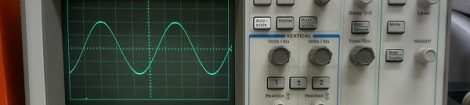
[Paleotechnologist] posted an excellent guide to the care and feeding of an oscilloscope. Most of our readers probably already know the ins and outs of their awesome Techtronix and HP units, but that doesn’t mean the younglings won’t have to learn sooner or later.

Good idea, except the part about saving it for spring

In a moment of serendipity, [Valentin] figured out how to use touchscreens with wool gloves. The answer: rub thermal grease into the tip of the index finger. It works, and doesn’t look to be too much of a mess. We’ll remember this for next winter.

The last one didn’t have a picture, so here’s this

[Darrell] used a little bit of LaTeX and Ruby to make colored labels for his resistor collection. We’re struck with the idea of using test tubes to organize resistors. It’s cool and makes everything look all sciencey and stuff.
Adding A Laser Sight To Your Drill Press In Just A Few Easy Steps

drill-press-laser-sight

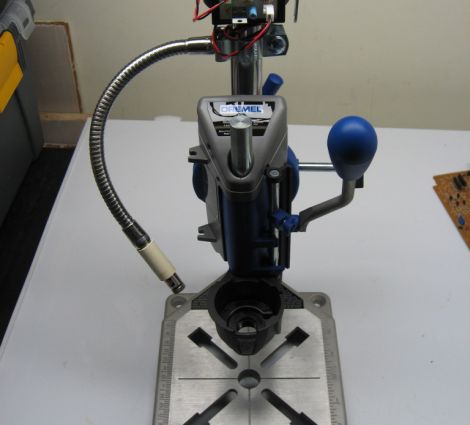
[Derek] was using his Dremel drill press to prep a bunch of PCBs, and found that it was getting difficult to focus on the spinning drill bit each time to line it up with the solder pads on the boards. He figured that a laser sight would help move the process along, but since no off the shelf solution was available for his press, he built one of his own.

He bought a cheap desk lamp with a flexible metal neck, which he disassembled, saving the flexible metal sheath. He installed a conduit clamp on one end of the neck, and a laser module at the other. [Derek] then mounted the laser arm on the press’ crow’s nest aiming it at the tip of the drill bit.

As you can see in the video below, the ability to easily position the drill bit using the laser helps him make quick work of any PCB.

Continue reading “Adding A Laser Sight To Your Drill Press In Just A Few Easy Steps” →

3D Printing From An Android Device

[skullkey] over at the House4Hack hackerspace in Pretoria, South Africa wanted a way to get kids excited about technology and desktop fabrication labs. Wanting to give kids a visceral feel for the march of technology, he created Makerdroid, an android app that allows for the creation 3D objects on an Android tablet and preparing them to be printed on a Reprap or Makerbot.

What’s really interesting about this build is not only the fact that [skullkey] and his lovely beta testers are generating .STL files on an Android device, the object files are also being converted to GCode on the Android, without the need for a conventional computer. Makerdroid uses the very popular Skeinforge to generate the instructions for the printer (although a lot of people are switching over to Slic3r).

Makerdroid doesn’t need a PC to print objects out on a 3D printer, but we think the process of shuffling GCode files from a tablet to the printer with an SD card is a little archaic. It might be possible to print directly from an Android tablet over Bluetooth with the Android Bluetooth Reprap app that is currently in development. Still, we love the idea of printing objects we just created on a touch screen, as shown in the Makerdroid demo video after the break.

Continue reading “3D Printing From An Android Device” →

Steganography In Xkcd Comics Without The Img Alt Tag

Inspired by a recent Hackaday post [austin] decided to try his hand at steganography. Steganography, or ‘concealed writing’ has come a long way from ancient Greek slaves/couriers shaving their head, tattooing a message on their scalp, and regrowing their hair. We recently saw a music file masquerading as a picture of a kitten, but that method of hiding data required running a Ruby script. [austin] thought steganography would be a great way to hone his JavaScript skills, so he made an image encoder and decoder purely in JS and HTML.

Like the previous incarnation, [austin]’s work takes a regular .PNG image file and hides stuff in the pixel data. A few of the lower bits for each pixel are modified (three bits from the red and blue, two bits from the green – a good choice, the human eye is very sensitive to green) and a file is embedded inside the .PNG image.

For an example, [austin] embedded some stuff inside the xkcd comic underneath this post’s title. Even though the image is mostly white, we can’t see anything wrong with the colors. If you’d like to decode the message, [austin] put his encoder and decoder up on github. Feel free to take a shot at it.

[Vijay Kumar’s] TED Talk On The State Of Quadcopter Research

[Vijay Kumar] is a professor at the University of Pennsylvania and the director of the GRASP lab where research centering around autonomous quadcopters is being met with great success. If you were intrigued by the video demonstrations seen over the last few years, you won’t want to miss the TED talk [Dr. Kumar] recently gave on the program’s research. We touched on this the other week when we featured a swarm of the robots in a music video, but there’s a lot more to be learned about what this type of swarm coordination means moving forward.

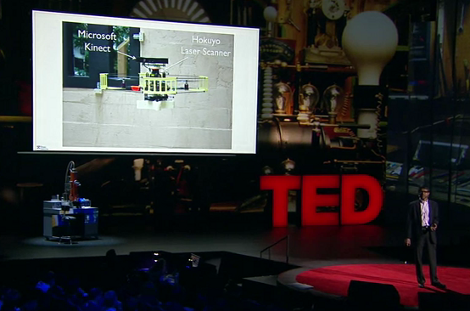
We’re always wondering where this technology will go since all of the experiments we’ve seen depend on an array of high-speed cameras to give positional feedback to each bot in the swarm. The image above is a screenshot taken about twelve minutes into the TED talk video (embedded after the break). Here [Dr. Kumar] addresses the issue of moving beyond those cameras. The quadcopter shown on the projection screen is one possible solution. It carries a Kinect depth camera and laser rangefinder. This is a mapping robot that is designed to enter an unknown structure and create a 3D model of the environment.

The benefits of this information are obvious, but this raises one other possibility in our minds. Since the robots are designed to function as an autonomous swarm, could they all be outfitted with cameras, and make up the positional-feedback grid for one another? Let us know what you think about it in the comments section.

Continue reading “[Vijay Kumar’s] TED Talk On The State Of Quadcopter Research” →

Chocolate As Rocket Fuel

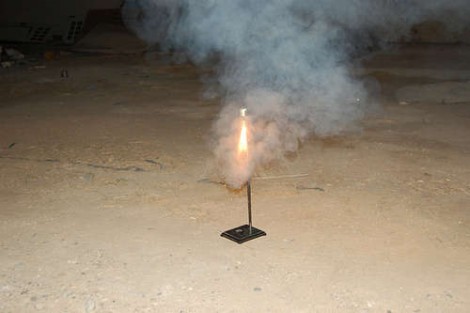
[Adric Menning] has an unfortunate allergy. He’s allergic to chocolate. Instead of eating the stuff, he’s using it to build model rocket engines. The project stems from the Quelab Hackerspace’s chocolate hacking challenge which spawned a number of interesting hacks. [Adric’s] doesn’t use pure chocolate (an experiment with a Hershey’s bar was a bust) but manages to ignite using a Milky Way bar.

This is not as unorthodox as you might think. Sugar and potassium nitrate have long been used to create solid rocket propellant. The chocolate version is swapping out plain old sugar for the candy bar. It was chopped into 10 gram chunks to make proportion calculations easier later on. The chunks go into the freezer to make them easier to grind using a mortar and pestle. Once it’s a somewhat chunk-free powder he mixes it with the potassium nitrate which previously had its own trip through the grinder. After being packed into a chunk of PVC pipe and fitted with an exhaust nozzle the engine is ready to go.

You can check out the test-fire video after the break. There’s a burn restriction in his area due to drought so this is just an engine test and not an actual rocket launch.

Continue reading “Chocolate As Rocket Fuel” →

Tuna Can And Some Other Trash Turned Into A Stirling Engine

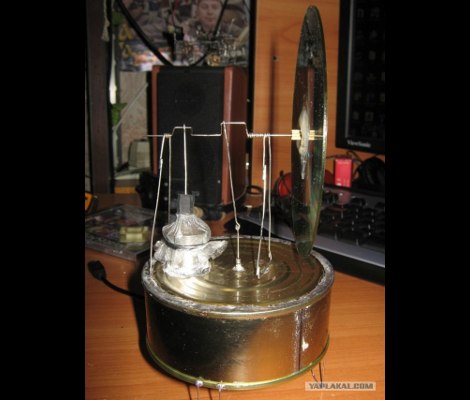
Next time you’re making yourself a tunafish sandwich, try to figure out how to build a Stirling engine from the leftovers (translated). If you can pull it off as well as [Killerlot] did we’d say you’ve earned your hacker badge.

The can used in this project was actually sardines in tomato sauce, but the former contents are moot. The can serves as a steam chamber for the sterling engine. A cam rod, piston, and valve are all fashioned from paperclips, along with the support structure that holds them in place. Inside the can is a damp sponge. When an alcohol lamp is placed beneath the can it heats the water air inside, which creates pressure on the piston, pushing it up until the cam opens the valve, relieving pressure just in time for the cycle to start over again. Momentum is a necessary part of the mechanism and that’s where the CD fly-wheel comes in. See it chugging along in the clip after the break.

Update: Corrected spelling thanks to [Chris Muncy] and removed references to water/steam thanks to this comment from [Khordas].

Continue reading “Tuna Can And Some Other Trash Turned Into A Stirling Engine” →