Announcing Our Next Theme: Halloween Hacks

It seems every year, Hack A Day is a little bit behind the times when it comes to Halloween hacks. Builds like the Mario costumes and the house singing Thriller are great, but it makes a lot more sense for us to post them before Halloween.

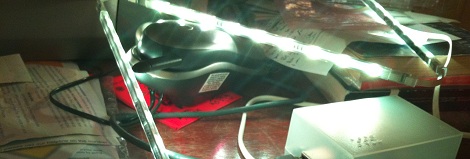
To introduce our Halloween theme, we’d like to present [heavyweighthowe]’s Halloween project. It’s a small lighting automation build that syncs a string of lights to the theme of the best Halloween Christmas 2nd best [Tim Burton] movie, The Nightmare Before Christmas. [heavyweighthowe] used Vixen to sequence the lights and an Arduino to interpret the serial commands from Vixen. It’s a nice build that would look great sitting on a porch next to a giant bowl of candy.

If you’ve got a Halloween build you’d like to show off, like a haunted house ride an awesome costume or even a really great Jack-O-Lantern, send it in on the tip line. We’re planning on putting up at least one Halloween post a day, so keep sending in those builds.

Genetic Testing With Lego

From the dark recesses of the Internet circa 2009 comes the BioBrick-A-Bot, a liquid handling system for molecular biologists.

The 2009 iGEM competition was a student competition to build devices for synthetic biology. The BioBrick-A-Bot’s goal is to build a simple, low-cost liquid handling system that sucks liquids out of petri dishes and into vials.

Like most lab equipment, the commercial version of this tech is insanely expensive – about 10 grand for a commercial liquid handling robot. The BioBrick-A-Bot is made nearly entirely out of LEGO parts, so the cost of the entire system was brought down to about $700.

There are two main parts to the BioBrick-A-Bot. The Alpha module holds four pipette on a delta platform We’ve seen this type of robot built out of LEGO before, but moving liquids is new territory. The Phi module contains all the mechanics to suck microliters of liquid into a pipette and spit them out into vials.

The BioBrick-A-Bot didn’t win the 2009 iGEM competition (that honor was taken by students from Heidelberg Cambridge), but we’d take a LEGO robot any day of the week. Check out the demo after the break.

Continue reading “Genetic Testing With Lego”

Building A Multidimensional Display From Trash

Here’s a simple concept that will let you turn any LCD screen into a multidimensional display (translated). [Herdek] used bits of that impossible to open clear plastic packaging to construct this add-on for the smart phone seen above. Three pieces of the material have been mounted at a 45 degree angle between the screen and viewer. The material is both reflective and transparent, depending on the angle at which light hits it. This allows it to reflect the light from the screen toward the viewer, but let light from the baffles behind it pass through unimpeded. The three baffles allow the LCD to be partitioned into three different sections whose images will appear to be at different depths according to the viewer’s vantage point. After the break we’ve embedded a demonstration video, as well as the how-to that shows the construction technique for the add-on.

This follows the same concept at the pyramidal volumetric display, which is still one of our favorite LCD hacks.

Continue reading “Building A Multidimensional Display From Trash”

Simple Circuit Reminds You To Lock The Door As You Rush Out Of The House

door_lock_minder

It seems that [pppd] is always rushing out of his apartment to catch the bus, and he finds himself frequently questioning whether or not he remembered to lock the door. He often doubles back to check, and while he has never actually forgotten to lock the door, he would rather not deal with the worry.

Since he finally had some free time on his hands, he decided to put together a simple device that would help end his worry once and for all. Using an ATtiny13, [pppd] designed a circuit that would detect when his door has been unlocked and opened, beeping every few seconds until the lock is reengaged. The circuit relies on a reed switch installed inside the door frame, which is tripped by the magnet he glued to his door’s deadbolt.

He says that the system works well so far, though he does have a few improvements in mind already.

Link Spam Your Friends With Printed QR Codes

qr_printer_sharing_links

While [Oryx] is down with social media like Facebook and Twitter, there are times when he wants to share things with people he is hanging out with in the real world. Sure, he could always email his friends links to the latest video of a cat doing something totally hilarious, but he wanted something a bit more tangible.

He had a small thermal printer from SparkFun kicking around, and thought it would be the ideal medium for sharing things with others. He sat down and put together a bit of code that allows him to interface the printer with his computer, generating QR codes from his web browser with the simple click of a button. Now, when he wants to pass something along to a friend, he can quickly print out a label bearing both a QR code and URL for easy access later on.

All in all it’s an interesting idea, though we would be curious to see what would happen if we handed our non-techie friends a printed QR code.

Character LCD Spectrum Analyzer Made Simple With A Dedicated IC

[El Artis] just finished building an audio spectrum analyzer that uses a character LCD. The uses an Arduino to drive the display, but unlike other meters that use the microcontroller for analysis, [El Artis] is using a discrete IC for that task.

This project uses the MSGEQ7 graphic equilizer display filter chip to grab frequency data from the audio source. The chip connects to your microcontroller of choice using two digital pins and one analog pin. [El Artis] points us to [J Skoba’s] post about how to use it with an Arduino, then adds his own custom character routines for an HD44780 display. You’ll notice that there are sixteen bars in the image above, which conflicts with the 7 outputs the chip offers. [El Artis] averages neighboring values in order to add the extra outputs.

Don’t miss the demo video after the break. If you’re looking to use this part in one of your projects, we noticed they’re a little hard to find (octopart doesn’t return any suppliers) but SparkFun has them.

Continue reading “Character LCD Spectrum Analyzer Made Simple With A Dedicated IC”

Full-color EBook Reader Needs Only 8-bits Of Muscle

[Rossum’s] still coming up with great ways to use his microtouch hardware. This time, he’s taken his inspiration from Amazon’s announcement that a full-color eBook reader (and movie player) is on the way. Judging from the video after the break, his fully functional reader is a big win for the device.

You’re probably familiar with the hardware, an ATmega644-based board connected to a touch sensitive LCD screen. You can make your own or buy one pre-assembled (but currently out-of-stock). The board has a microSD card slot making it quite easy to add books to the device. At the start of the project [Rossum] thought he might be able to read ePub files directly, but the embedded images, and unzip function needed to open the package file is a bit too much for the 8-bit processor’s restrictions. One simple step does the trick. A helper script can be used to format the files before transferring them to the device. This does the unzipping, scales the images, and repaginates the text into a format friendly for the display size.

Now if we only had a nice little case to house the hardware we’d be in business.

Continue reading “Full-color EBook Reader Needs Only 8-bits Of Muscle”