Get Digital Plastic Surgery Thanks To OpenFrameworks And Some Addons

[Kyle McDonald] is trying out a new look, at least in the digital world, with the help of some openFrameworks video plugins. He’s working with [Arturo Castro] to make real-time facial substitution as realistic as possible. You can see that [Arturo’s] own video has a different take on shading and color of the facial alterations that makes them a bit less realistic than what [Kyle] was able to accomplish (see that clip after the break).

The setup depends on some facial tracking software developed by [Jason Saragih]. That package is wrapped in ofxFaceTracker (already linked at the top of this article) which makes it play nicely with openFrameworks. From there, it’s just a matter of image processing. If you think you’re up to the challenge, grab your own copies of the source code and get to work. We’re shocked by how real this looks, even when [Kyle] grabs his cheeks and stretches them out. If someone can fix some of the artifacts around the edges of the sampled faces this would be ready to use when video-conferencing.

It kind of makes us think of technology seen in The Running Man.

Continue reading “Get Digital Plastic Surgery Thanks To OpenFrameworks And Some Addons”
Cocktail Machine Minces Words

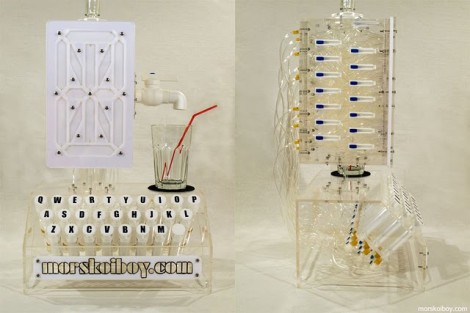
For those living in a magical land of candy, with orange-faced helpers to do their bidding, the ability to taste your words is nothing new. But for the rest of us, the ability to taste what you type in cocktail form is a novelty. [Morskoiboy] took some back-of-the-envelope ideas and made them into a real device that uses syringes as keys, and facilitates the injection of twenty-six different flavorings into a baseline liquid. He figures that you can make each letter as creative as you want to, like representing different alcohols with a letter (T for tequila) or matching them to colors (R for red). Check out the video after the break to see an ‘Any Word’ cocktail being mixed.

This setup is entirely mechanical, and makes us wonder if [Morskoiboy] works in the medical equipment design industry. Each letter for the keyboard is affixed to the plunger on a syringe. When depressed, they cause the liquid in an external vessel (not seen above) to travel through tubing until it fills the proper cavities on a 15-segment display to match the letter pressed. From there the additive is flushed out by the gravity-fed base liquid into the drinking glass. We can’t imagine the time that went into designing all of the plumbing!

Continue reading “Cocktail Machine Minces Words”

Recreating The First PC

If you’re looking for a simple Ardunio project, why not replicate the first personal computer?

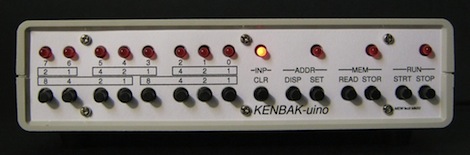
After discovering the Arduino, [Mark] realized recreating really old computers would be a fun project. An Altair 8800 was on the table, but the sheer number of blinkenlights, switches and the Intel 8080 CPU made that a fairly difficult project. After a bit of searching, [Mark] discovered the Kenbak-1, widely regarded as the first personal computer. The Kenbak also had the added bonus of having a very minimal I/O compliment and was built entirely with TTL components.

Since the Kenbak-1 is an extremely simple computer, [Mark]’s build ended up being fairly minimal. The schematic is only an ATmega328, a few shift registers and a real-time clock for a few added features the OG computer didn’t have. The completed build is programmed by pushing buttons to enter machine code into the mega’s RAM and then executed. [Mark] has a few programs already figured out – a program that counts in binary, a ‘Cylon eye’ and a BCD and binary clock. While the Kenbak-uno doesn’t have the awesome vintage case of the original, it’s still a remarkable build.

Check out the videos after the break for a walk through.

Continue reading “Recreating The First PC”

Using Polycarbonate Filament With A RepRap

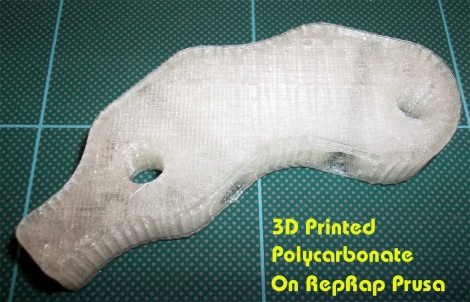
[Rich] couldn’t find any instances where RepRap owners had used polycarbonate as a 3D printing source material. He’s filled that knowledge gap by running multiple polycarbonate printing tests. Polycarbonate is a plastic that is highly resistant to shattering yet it’s still rather soft. With enough effort it can be bent and stretched, but it’s fairly difficult to break the material.

The test spool of polycarbonate was special ordered for this project. [Rich] sourced 1.6mm filament since 3mm material would have been difficult to spool. It melts at a temperature range of 280-300 degrees Celsius, which he reaches with a hot-end extruder design. The printed material comes out a bit cloudy, which may be due to the heating process itself, or due to extruder reversals (he’s not quite sure what’s causing it). But as you can see above and in the video after the break, it’s certainly a viable printing medium.

Continue reading “Using Polycarbonate Filament With A RepRap”

Video: Soldering Our PIC Development Board

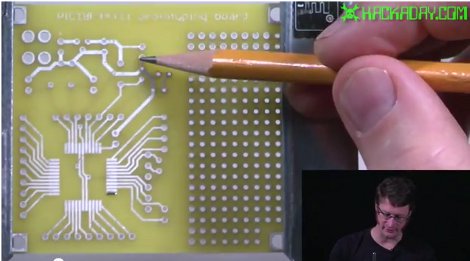
For those of you who followed along with our Eagle CAD series, here is the final payoff where we assemble the circuit board that was designed. In this video, [Jack] explains where things will go on the board and then shows you how to solder the parts. For the advanced folks out there who haven’t moved to solely surface mount parts when you can get away with it, he shows an easy way to solder the processor, which is a TQFP-44 part. This can seem like a daunting task but it really isn’t.

If you would like to make your own board like this, you can find the files here. Please note that although this board shouldn’t have any issues, we haven’t tested it ourselves yet. [Jack] is going to do some videos about a different topic for a few weeks but will pick back up with this board again when they are done.

Video is after the break. Continue reading “Video: Soldering Our PIC Development Board”

Workshop 88 Hosts A Near Space Balloon Contest

hackerspaces_in_space

Launching high-altitude balloons to take pictures of the Earth from space is great fun. Heck, even credit card commercials are now suggesting you cash in your rewards points to organize a space balloon adventure for you and your friends.

Capturing snapshots of the Earth from space is such a good time that Workshop 88, a hackerspace located in the Western suburbs of Chicago, is making a contest out of it. They recently kicked off their second annual “Hackerspaces in Space” competition, a contest to see who can build the best near space balloon for under $250. The contest pits individuals, groups, and hackerspaces against one another, assigning each team a score based on the performance of their high-flying rig.

The winner of the contest will have their design replicated by the crew at Workshop 88, who will then hand out the space balloon kits to randomly selected K-12 schools around the country.

If this sounds interesting, but a contest entry just isn’t in the cards, you can always support the kit distribution by funding their Kickstarter project here.

Sustainability Hacks: Heliostats

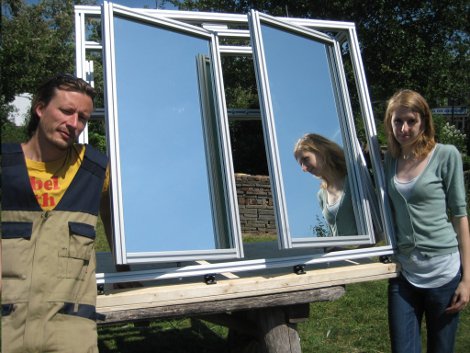
Solar panels are a popular item among people who are trying to do more with less but, at least in the past, they have been pretty expensive to install. For some uses, you can forget using solar panels and use the sunlight directly with very little efficiency loss. A device that lets you do that is called a heliostat, which is really just a fancy mirror that you can set to reflect sunlight to wherever you might want it. You could aim it through a window so that it hits your ceiling and diffuses throughout the room or you could point it towards a location where you could collect the sun’s energy to heat something directly.

For a really good rundown on how heliostats work and how you can build one, check out this page where you can find all sorts of information. Heck, they even have an Arduino controlling some of them!