Motorized Coop Door Lets The Chickens Out For You

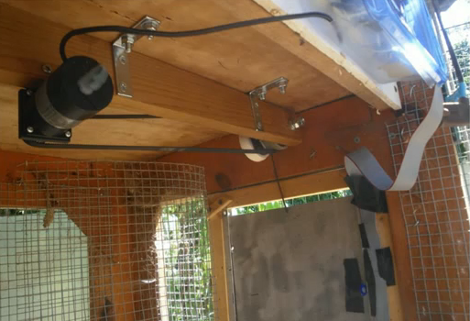
[Larry] and [Carol] just upgraded the coop to make their lives easier, and to help keep the chickens happy. The image above is a chicken’s-eye-view of the newly installed automatic door. It’s a guillotine design that uses the weight of the aluminum plate door to make sure predators can’t get in at night. This is much easier to fabricate than a locking coop door would have been. Some leftover aluminum channel guides the door on either side, with a spool above it to wind up some rope, thereby lifting the door.

You can see the belt-drive motor is also mounted inside, out of the element. To the right of the image you can just make out a plastic food container. This protects the electronics from the elements. Inside you’ll find an H-bridge to drive the motor, a real-time-clock to make sure the schedule is well-timed, and an Arduino. There are a couple of reed switches which let the microcontroller sense the position of the door.

After the break you can see a demonstration video, as well as a slide show with build details. The motor is pretty quiet and, although it spooks the chicken in the demo just a bit, we’d be they’ll be used to it in no time.

Continue reading “Motorized Coop Door Lets The Chickens Out For You”

Swap-O-Matic: An Automat With Recycling In Mind

The Swap-O-Matic is vending machine built for recycling, not consuming. Instead of feeding money into the machine, you can get an item out of the machine by swapping it for something you don’t need anymore. It’s a great concept with a great retro design, probably influenced by the age of the automat.

[Lina Fenequito] and [Rick Cassidy] built the Swap-O-Matic around the time [Lina] was getting her MFA. The build was in Wired in 2005, but the project has been updated since then and has a new home at LaunchPad in Brooklyn, NY. The first version used a separate computer next to the machine that gave out combinations to locks on the doors. It looks like the new version has been improved with an integrated touchscreen and computer-activated locks leaving [Lina] and [Rick] with a very clean build.

It’s a great idea if you have a relatively homogeneous population with similar interests, so we expect to see some of these popping up at a few hackerspaces. Check out the Swap-O-Matic promo video after the break.

Continue reading “Swap-O-Matic: An Automat With Recycling In Mind”

SPDIF Passthrough Lets You Digitally Manipulate The Audio

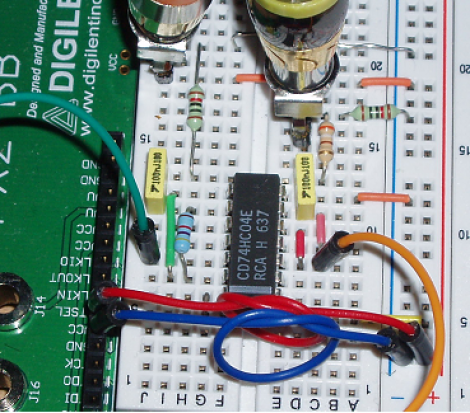
[Mike Field] took what he had learned with a few past projects and combined them to make this FPGA-based SPDIF audio pass-through. In order to get the SPDIF signal ready for the FPGA he needed a few components to use for level conversion. Once everything was connected he used a first in first out (FIFO) buffer to ensure that the outgoing bitrate is the same as the input, while still allowing enough time for the FPGA to do some digital manipulation.

This reminds us of the NeTV, which is an HDMI pass-through device. That one allows you to overlay your own video information to any TV that has an HDMI port. This would allow you patch into any audio system that’s using SPDIF, letting you inject your own audio, such as a paging system in a public lobby, or the ringing of a phone when you get a call, or to create your own sounds.

We like his overhand knot cable management system to keep those jumper wires from becoming too much of a mess on the breadboard.

JGPX Keeps The Bachelor Party Moving In The Right Direction, Regardless Of BAC

jGPX_bachelor_party_navigator

[Davy] and his friend [Chris] were tasked with putting together a bachelor party for their friend [J], and had a little more in mind than the standard drunken revelry. To earn the privilege of partying his brains out, they decided that [J] would have to fulfill a series of tasks and challenges before joining up with the rest of his friends for the evening’s events. [Davy] didn’t specify what these tasks were, lest he spoil the surprise, but he did let us in on a little device that he and [Chris] built to help guide the bachelor through his day.

They were a bit worried that the bachelor would get sidetracked during his journey if he happened to imbibe along the way, so they built a device called jGPX that would ensure [J] stayed on track and on time. jGPX is a custom GPS navigator consisting of an Arduino, a GPS module with built-in antenna, and a compass.  The pair created a set of routes in Google Earth, exporting the data to KML for interpretation by their device. The jGPX is meant to guide [J] along via a small LCD screen that shows him the distance to his target as well as the proper direction of travel to get there.

It looks like [J’s] friends put a lot of effort into his party, and although there are no details as to how things went, we’re sure it was a blast!

Burning Man 2011: Peter Hudson’s Charon Strobe Sculpture

Here at Hackaday the only thing we like better than giant whirling artistic desert based contraptions are interactive giant whirling artistic desert based contraptions. [Peter Hudston]’s Charon is no exception. Known for his strobe sculptures [Peter] has returned from a two year hiatus with possibly one of the craziest and nightmarish sculptures found on the deep playa. The work features a gigantic spinning wheel that has posed human skeletons mounted on it’s inner edge. Onlookers can pull a series of 6 rope pairs which cause the wheel to rotate rapidly. When the rope pullers are coordinated enough to get the wheel spinning at the right speed, a strobe is activated revealing the skeleton’s animation.

I wandered over to this thing one night after hearing the local buzz about the piece.  The towering wheel was spinning away as the rope pullers of the moment tried desperately to get the strobe to activate, every couple of minutes or so somebody would try and coordinate the pulling only to confuse things.  From my perspective it seemed to be very difficult to get the right speed, and the pullers had to yank the rope practically to the ground. During the short time I was watching the piece (jaw to the floor) the strobe activated once or twice and honestly it was completely worth the effort. To see what this monster looks like in action check out the video after the jump.

Continue reading “Burning Man 2011: Peter Hudson’s Charon Strobe Sculpture”

ATtiny Hacks: Roll 2d6 With An ATtiny

A pair of 6-sided electric dice (original in Dutch, here’s the Google Translate link) was sent in on the tip line for our ATtiny hacks theme. We really appreciate the simplicity of the circuit; it really shows how the complexity of discrete components can be cut down with a simple microcontroller.

The circuit is very simple – An ATtiny26 serves as the core of the project. Fourteen LEDs are connected to fourteen pins on the micro. The tiny26 might be a bit overkill. With Charlieplexing, we suspect this build could have been completed with an 8-pin micro like an ATtiny25. The code for the build (written in BASIC with BASCOM-AVR), board files and schematics have all been posted.

We’ve seen a few electronic dice builds before. this build uses an ATmega328 in a hugely overwrought circuit. Compared to what can be done with a 555, the ATtiny26 build provides a very nice middle ground.

Thanks [Roeland] for sending this in.

Steerable Bristlebot Via IR Control

Looking at the size of this bristlebot the first thing we wondered is where’s the battery? All we know is that it’s a rechargeable NiMH and it must be hiding under that tiny circuit board. But [Naghi Sotoudeh] didn’t just build a mindless device that jiggles its way across a table. This vibrating robot is controllable with an infrared remote control. It uses an ATtiny45 microcontroller to monitor an IR receiver for user input. An RC5 compatible television remote control lets you send commands, driving the tiny form factor in more ways than we thought possible. Check out the video after the break to see how well the two vibrating motors work at propelling the device. They’re driven using a PWM signal with makes for better control, but it doesn’t look like there’s any protection circuitry which raises concern for the longevity of the uC.

This build was featured in a larger post over at Hizook which details the history of vibrating robots. It’s not technically a bristlebot since it doesn’t ride on top of a brush, but the concept is the same. You could give your miniature fabrication skills a try in order to replicate this, or you can build a much larger version that is also steerable.

Continue reading “Steerable Bristlebot Via IR Control”