Quick And Easy DIY PIC Development Board

diy_pic_dev_board

A few months back, [Phil] was looking to get into PIC development, but he couldn’t seem to find a simple development board for the PIC16F883 microcontroller he wanted to use. Since no retail offering had exactly what he was looking for, he decided to put together a dev board of his own.

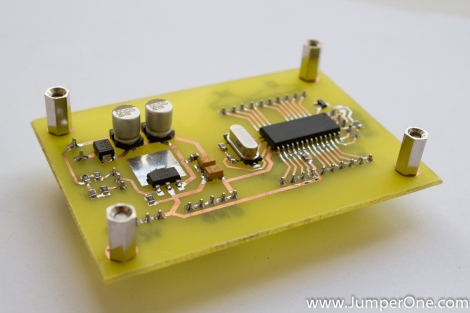
He spent a couple hours in Eagle, putting together a simple board layout. [Phil] then busted out the iron and copper clad, making his dev board a reality using the tried and true toner transfer method.

He says that the board itself is quite simple, consisting of little more than the PIC, an LM1117 linear voltage regulator, and all the pin headers you could possibly need. While very basic and not necessarily a hack, we do like seeing people make their own tools when the market doesn’t provide what they want.

If you have been looking around for a simple PIC development solution, be sure to swing by [Phil’s] site – all of the schematics and layout files are free for the taking.


Adalight: Ladyada’s Ambilight

The latest and greatest ambilight clone, the Adalight, comes from the fruitful mind and cluttered workbench of the sometimes Hack A Day contributor [Phil Burgess].

We’ve seen a few clones of the Philips ambilight tech, but [Phil] knocked this one out of the park. The hardware is a string of 12mm RGB LEDs connected to the Arduino of your choosing. After attaching the LEDs to the rear of the TV using anything from, “laser-cut acrylic to nothing more than a pizza box,” it’s on to the software.

The Processing sketch performs a series of screen captures and averages the pixels around the perimeter of the screen. Reportedly, Carl Sagan’s Cosmos looks fantastic with the Adalight but there might be a better option.

[Phil] used 25 LEDs on his Adalight, more than the usual 6-10 we see on other Ambilight clones. Check out the video after the break to see the Adalight in action.

Continue reading “Adalight: Ladyada’s Ambilight”

Sustainability Hacks: Auto-feeding Wood-fired Generator

Here’s a project that’s hard to categorize. It generates electricity by burning wood. The diamond-plate wrapped column to the right is a magazine that stores the wood, which is gravity fed as pieces below are consumed. The heat is used to drive a power turbine which is responsible for generating the electricity.

This begs the question, is this a sustainability hack? From one perspective it’s burning renewable biomass. Right now that’s wood, but it could be compressed blocks of grasses or wood manufacturing byproducts. So in this sense it is sustainable. Unfortunately it still doesn’t solve the problem of carbon emissions.

The build log for the project is both image and video heavy. You can see the initial prototypes which are not self-feeding, but burn so hot that there’s a nice pink glow to the entire assembly. But by the time they get to the final prototype it’s running much more efficiently, and can put out a peak of over 100 amps!

[Thanks DerAxman]

Very Impressive Steampunk Keyboard

After spending more than 250 hours on his project, [Admiral Aaron Ravensdale]’s steampunk keyboard is finally done.

The keyboard mod was designed around a Model M. After removing the keycaps, [The Admrial] upcycled the keys from old Continental typewriters. Because his typewriters only had 47 keys and the Model M needs 104, three typewriters needed to be sourced off of eBay. Polishing the metal rings of the typewriter keys ate up more than 100 hours.

After building a brass frame from 8mm tubing and candle holders, the stained wood inlay was drilled for the keys. Status lights were installed and the PCB was connected. A pair of ‘gaslight’ keyboard lights were fabricated using 3mm tubing and very fitting “Golden White” LEDs.

[Admrial Ravensdale] put up an Instructable walking through the build process of his keyboard. There’s also a German-language PDF build log that shows every picture of every step.

This isn’t [Admrial Ravensdale]’s first Hack A Day feature, but with a build that might one-up the original steampunk keyboard we can’t wait to see what comes out of [The Admiral]’s workshop next.

WiFi Jamming Via Deauthentication Packets

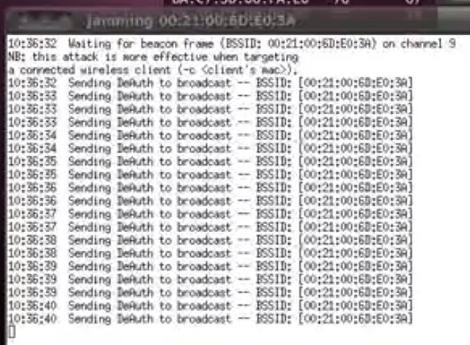
[Elliot] put together an intriguing proof-of-concept script that uses repeated deauthentication packet bursts to jam WiFi access points. From what we can tell it’s a new way to use an old tool. Aircrack-ng is a package often seen in WiFi hacking. It includes a deauthentication command which causes WiFi clients to stop using an access point and attempt to reauthenticate themselves. [Elliot’s] attack involves sending repeated deauthenitcation packets which in essence never allows a client to pass any data because they will always be tied up with authentication.

After the break you can see a video demonstration of how this works. The script detects access points in the area. The attacker selects which ones to jam and the script then calls the Aircrack-ng command. If you’ve got an idea on how to protect against this type of thing, we’d love to hear about. Leave your thoughts in the comments.

Continue reading “WiFi Jamming Via Deauthentication Packets”

Effortlessly Troll Your Friends Each Time They Reach For A Snack

trolling_your_friends_abusive_refrigerator

If you’re trying to lose some weight, [Grissini] has got the just the thing you need!

He recently tweaked his refrigerator to throw out insults each time its opened, though not for his own physical well-being. While we imagine that an abusive refrigerator would help curb your appetite for late night snacks, [Grissini] makes no bones about the fact that he simply wants to effortlessly and automatically troll his roommates.

The device is pretty simple, consisting of an Arduino and an Adafruit wave shield stuffed inside a styrofoam coffee cup. A photocell is used to detect when the refrigerator door has been opened, triggering the Arduino to play a sound bite from the on-board SD card. [Grissini] even spent a good chunk of time working with a text to speech engine in order to create a customized list of insults that point out his friends’ idiosyncrasies – what a guy!

Continue reading to see his abusive fridge in action, and be sure to check out his Instructableto learn how to make your own.

Continue reading “Effortlessly Troll Your Friends Each Time They Reach For A Snack”

Gaming Scoreboard And Storage Box In One

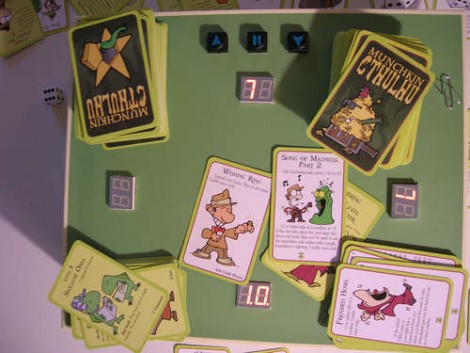
This game storage box will also keep score for you. [Marcus] built it for playing the card game Munkin, but some clever programming could adapt it for most needs. The hardware is built around an ATtiny2313 to do the thinking, and a MAX7219 to drive the 7-segment displays. Each player has their own two-digit score readout, which is perfect for this game which only tracks scores from -9 up to 10.

In the video after the break you can see [Marcus’] explanation of the user interface. One player acts as scorekeeper for the game. That person uses three buttons to adjust the score as necessary, and to move the current player marker, expressed as a decimal point on one of the displays. Pressing all three keys will put the unit into programming mode. This lets you select the number of players and at which position they are sitting, as well as make adjustments to the score if necessary.

Continue reading “Gaming Scoreboard And Storage Box In One”