Be sure to check out Part 1 of the KC Maker Faire photo series. In this post, we explore some of the big hitters of the show, including crowd favorites ArcAttack, as well as battling robots. Read on to see the wonders!
Be sure to check out Part 1 of the KC Maker Faire photo series. In this post, we explore some of the big hitters of the show, including crowd favorites ArcAttack, as well as battling robots. Read on to see the wonders!
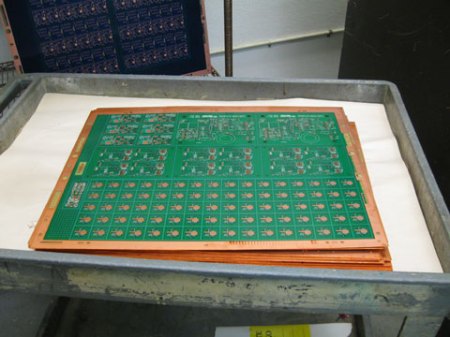
Although not a hack in itself, many of you may be interested in seeing how a printed circuit board is made in the manufacturing world. This tour of Advanced Circuits does a good job of explaining the process. The article explains how a PCB will go through a CAD/CAM review, drilling, deburring, and the various chemical etch, plating, and curing processes.
Although many hackers make their own PCBs, having it professionally done can be a good option depending on how many copies are needed. One benefit of this is that PCBs can be checked by an optical inspection process, or even by a “flying lead” machine which works by contacting leads automatically in a computer controlled setup.
A video of this incredible machine is included after the break. Around 0:26 is when it really starts to get going. Continue reading “Tour Of Advanced Circuits – A PCB Manufacturer”
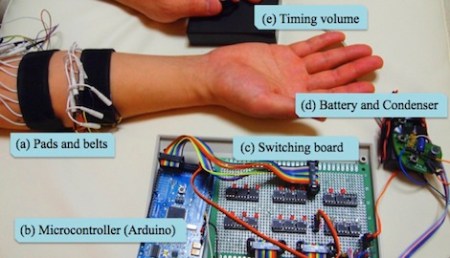
[Emi Tamaki], [Miyaki Takashi] and [Jun Rekimoto] at the University of Tokyo came up with a device called the PossessedHand that electrically stimulates muscles to train someone to play a the koto, a Japanese stringed instrument.
The PossessedHand ‘triggers’ individual fingers with precisely placed electrodes. Sixteen joints in the hand can be controlled independently by placing one electrode on the muscle that controls the joint and a ground electrode on the tendon of that muscle. Users of the PossessedHand reported no pain from the device when 30 Volts were sent though the electrodes.
The paper (PDF warning) goes into detail about the reactions of the users of the PossessedHand. While a few subjects thought the PossessedHand was scary, many enjoyed it – one subject even thought it was possible to fly a helicopter without training. While this isn’t downloading a rotary wing licence into your brain like The Matrix, the PossessedHand did prove to be a useful tool for learning the fingering for the koto. You can see a video of the PossessedHand in action in the New Scientist story.
[via New Scientist]
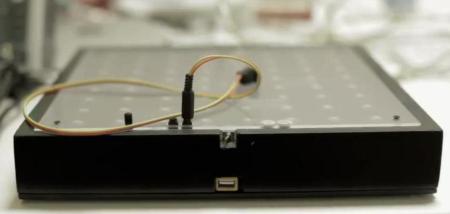
Many hacks are, of course, interesting in their own right. Hacks like this one, however, fulfill a much greater purpose by helping people overcome their disabilities. The PixBoard is “an illuminated board adapted for disabled people, especially for people with cerebral palsy, giving them access to games using shift technology.”
This device was developed for a girl that has cerebral palsy and can’t control her arms or legs effectively. In order to interact with the world more effectively to play board games and the like, this system was developed. The PixBoard scans an 8×8 matrix of LEDs allowing her to select the piece to be moved and where to move it. This is done using only simple buttons and the processor’s timer.
The system is controlled using an Arduino, so anyone is free to create their own games for this system depending on the situation. The following video is in Spanish, but shows this device in action around 1:20. Continue reading “The PixBoard”

When you really want your feelings known, we always say that bigger is better. [Gavin Smith, aka The Mechatronics Guy] must come from the same school of thought, because there’s absolutely no mistaking what he is trying to say with his latest project.
Inspired by this WiFi signal painter we featured a while back, the LightScythe is a 2 meter long bar composed of multi-color LED strips that he bought from Adafruit. The light bar is controlled by a Seeduino micro controller, which takes direction from his laptop via a pair of XBee units. Once he generates an image from text with ImageMagic, a Python script is used to match the colors as close as possible to the RGB color space. The image is then converted to raw serial data for playback on the Scythe. When he is ready to go, he triggers his camera to take a 10-15 second exposure, during which he walks across the frame, painting his images with the LightScythe.
We always enjoy seeing creative derivations of previous projects we have covered, and the LightScythe does it well. He actually built a pair of these that can work in concert or independently, which we imagine can make for some pretty awesome pictures.
Be sure to check out his Flickr photostream for more examples of what the LightScythe can do.
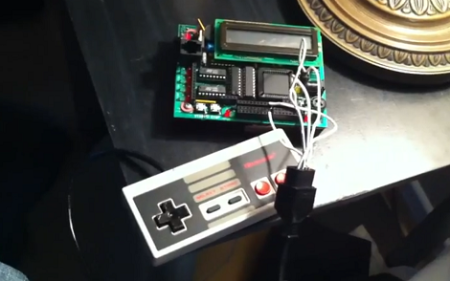
[Alex Busman] has been working with an old microcontroller board called the Handy Board. Recently, he figured out how to interface an NES controller to play music. With 8 buttons on an NES controller, [Alex] has control over an entire musical scale, so he demonstrates this in his video by covering the Dr. Mario Theme.
The Handy Board is a microcontroller board originally designed in 1995 for LEGO robots. With a 68HC11 μC running at 2MHz and 32KB of RAM, the Handy Board has been superseded by the LEGO Mindstorms NTX NXT, the Handy Board is thankfully still being supported, and is still a great platform to learn embedded design.
It’s great to see a build on relatively obsolete hardware, especially considering this would be a trivial build with an Arduino. We think it’s great [Alex] is learning the ins and outs of ‘difficult’ hardware – it’s a great way to learn something. Check out the walk though of [Alex]’s build after the break.
Continue reading “Handy Board Plays Music With An NES Controller”
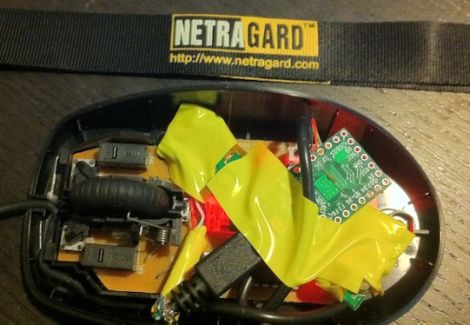
While some people know that you should be wary of USB drives with unknown origins, the same care is rarely, if ever exercised with USB peripherals. The security firm Netragard recently used this to their advantage when performing a penetration test at a client’s facility. When the client ruled out the use of many common attack vectors including social networks, telephones, social engineering, and unauthorized physical access from the test, the team at Netragard knew they would have to get creative.
They purchased a Logitech USB mouse and disassembled it in order to add their clever payload. A Teensy uC was programmed to emulate keyboard input, entering commands via the mouse’s USB connection once it had been connected to a computer. Using an undocumented exploit in McAfee’s antivirus suite, they were able to evade detection while their system entered commands to install malware from the flash drive they hid along side the Teensy.
Once the mouse was reassembled, they repackaged it along with some marketing materials to make it look like part of a promotional event. They purchased a detailed list of employees and singled out an easy target, sending their malicious mouse on its way. Within three days, their malware was loaded onto the victim’s computer and their test was deemed a success.
[Thanks, Aaron]