Machining Replacement Parts With Hand Tools

Jeff is a huge music fan, and like many of us likes old technology, so it seemed a bit silly (to him) that he did not have a turn table. His dad had a spare in the basement. A neat old Braun model from the 1970’s that was broken.

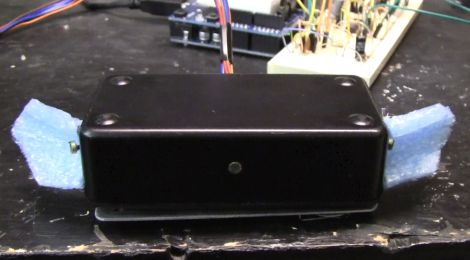
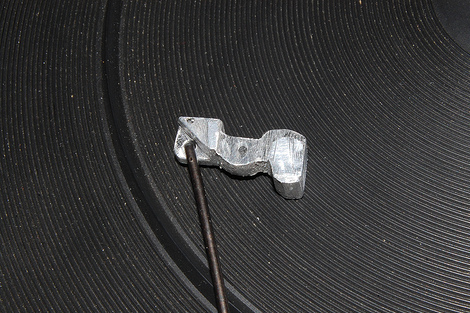
Opening the unit up he found that part of the arm mechanism was broken, and thanks to the age of the turntable and the wonders of mass production chances of finding a replacement were slim to none. Not being discouraged he busted out the hand tools and fabricated the replacement out of some aluminum. The end result is a perfectly functioning turntable that will serve many more hours pushing out warm jams.

Check out the fourm post above to get details and pictures, and we just wanted to tell [Jeff], awesome job!
Arduino Magnetic Core Memory Shield

mag_core_memory

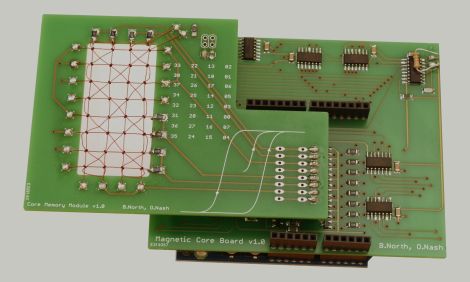
Magnetic core memory turns 60 years old today, and as a tribute [Ben North and Oliver Nash] have created a 32-bit magnetic core memory board for the Arduino.

Magnetic core memory was used from the 1950s through the 1970s, and provided a non-volatile means for storing data, as each magnetic core retained its orientation, even when the power was cut. While it sounds a lot like a modern hard drive, these devices were used in the same fashion as RAM is utilized today.

While the pair used surplus ferrite cores manufactured just before magnetic memory stopped being produced, they did allow themselves to use some modern components. Items such as transistors and logic gates were not available to the first magnetic core memory manufacturers, but the use of these items helped them complete the project in a reasonable amount of time.

Their final result is a magnetic memory board which can be used by any USB-enabled device and is reliable enough to withstand billions of read/write transactions.

Cheap Open-source Pace Clock Keeps Your Practice On Schedule

pace_timer

Pace clocks are used in a variety of sports, from swimming to track. The systems are typically expensive however, often beyond the reach of smaller organizations and underfunded programs. For their electrical and computer engineering final project, Cornell students [Paul Swirhun and Shao-Yu Liang] set out to build a much cheaper alternative to commercial pace clocks, with a far simpler wireless user interface.

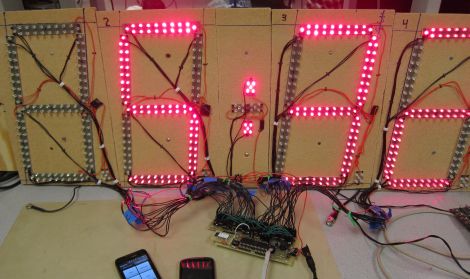
Their clock uses an ATmega32a to handle all of the processing which is paired with a RN-42 Bluetooth module for communicating with Android smartphones. Their seven-segment displays are built using custom PCBs that they designed and fabricated for the project which are controlled by TLC5940NT LED drivers. The Android software allows users to connect to the pace clock remotely, creating any sort of multi-layered swimming or running routines.

When the project was completed, the pair tallied their total hardware cost to be under $250 apiece at low production volumes. Even when taking assembly time into account, their solution is several magnitudes cheaper than similar commercial systems.

Stick around if you are interested in seeing a demo video of their final product in action.

Continue reading “Cheap Open-source Pace Clock Keeps Your Practice On Schedule”

DIY Sound Localization Sensor

sound_localization_sensor

Sound localization is very popular in law enforcement circles due to its accuracy and ability to quickly separate gunshots from other similar noises. These systems don’t come cheap, and after trying to build one himself, [Fileark] knows why.

He thought it would be neat to build a sound localization sensor based on how the human ear determines a sound’s source. Once he got started however, he realized just how hard it was to do localization just right.

He used an LM324N op-amp as a volume comparator, which he says works decently enough though he figures there are ICs out there that can do a better job. [Fileark] reports that the sound detector works well when the source is within about a foot of the sensors, but performance deteriorates at greater distances. He may consider using an ARM Cortex-M3 as his sound processor if he builds a second version, since the Arudino he used just doesn’t have enough power to sample and run calculations within the 10-50 microsecond window he requires.

Keep reading to see a video of his sound localization sensor in action.

Continue reading “DIY Sound Localization Sensor”

Open Source Linear Bearing System

makerslide

While we normally don’t make it a habit to feature Kickstarter projects, we couldn’t pass this one up. [Barton Dring] from BuildLog.net is putting together a project called MakerSlide that we’re sure will interest many of you out there.

Through his various CNC builds, he has found that one of the more expensive and frustrating components to obtain is a linear bearing system. He notes that commercial systems are expensive, and while an occasional eBay bargain can be found, it’s not the ideal way of going about things. He also points out that homebrew systems usually work after some tuning and adjustments, but can be time consuming to build.

He is proposing a v-groove bearing system, complete with wheels made from Delrin, as a standardized replacement for all of the aforementioned solutions. He anticipates selling the rails for about 10 cents per centimeter, putting the average cost of a 4 foot system around $20.

As a bonus, he is offering up free MakerSlide materials to anyone that sends him a “new, innovative  or interesting open source design or basic idea that uses the material.” You would only have to pay shipping in order to get your new project off the ground.

Standardization is always good, and seeing this rail system go into production would definitely benefit the hacker community. Take a minute to check it out if you are so inclined.

DIY Portal Turret Is… Looking Pretty Good.

[Ryan Palser] wrote in to tell us about his Portal Turret. [Ryan] set about making this Portal 1 style turret by first carving a Styrofoam form, bondo and waxing then casting molds of the various components. Anyone interested in mold making (like us) should check out all the pictures and comments in the stream. The turret’s camera lens style eye has some excellent detail including a laser cut aperture with text inlay. A couple LEDs behind the eye assembly provide the signature red glow and evidently [Ryan] also fitted the little guy with a red laser. An internal Arduino (Incident Resolution Chip?) takes ques from a PIR sensor mounted in one of the turret’s arms to play one of 17 sound clips through a sparkfun MP3 player shield. In order to fight repetition the sound module runs through a playlist of the 17 tracks then shuffles it before playing through again. Theme music can also be spammed by pressing a button in the back of the motion sensing arm. The turret can be battery powered or plugged into a wall socket for constant operation. All that’s missing are the Aperture-Brand Resolution Pellets. We would love to see this integrated with some similar turret projects previously featured here.

Are you still there? We have more Aperture Science stuff including a Sentry Turret, Weighted Companion Cube, and even a portal shirt. If you are interested in more model making check out the spectacular Daft Punk helmet build from a little while back.

Human-powered Quadcopter Flies Live Tomorrow

A team from the University of Maryland will be taking their human-powered helicopter to the air tomorrow. The current flight record for this type of vehicle is just over 19 seconds of flight at a height of about 8 feet. What surprises us about this attempt is that they’re not pedaling just one main rotor. It seems that the most success in man-powered helicopter flight has come from helicopters with a total of four rotors.

The image seen above is a 2009 test of just one of the four rotor arms that will go into UMD’s finished chopper. Fully assembled it will be about 1/3 the size of a football field, dwarfing the autonomous quadcopters we usually see around here. Get the details about the design from the video after the break. It’s interesting to hear [Dr. Antonio Filipone] talk about the need to generate both the lift and the thrust, where human-powered fixed-wing aircraft only need the thrust. He predicts that human-powered helicopter flight is possible, but that it will only lift the aircraft, with little possibility of moving it in one direction or the other.

The team is attempting to grab the $250,000 Sikorsky Prize with their creation. We wish them the best of luck.

Continue reading “Human-powered Quadcopter Flies Live Tomorrow”