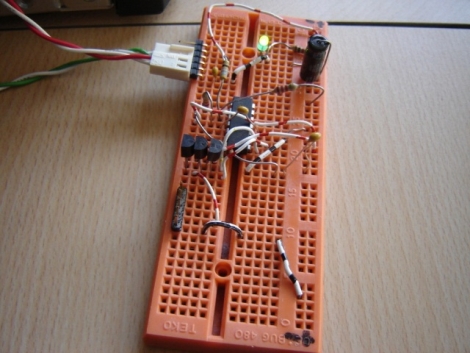
PS2 To USB Keyboard Converter Also Logs Your Keystrokes

[Shawn McCombs] is up to no good with his first Teensy project. The board you see above takes the input from a PS2 keyboard and converts it to a USB connection. Oh, and did we mention that it also keeps track of everything you type as well?

From the beginning the project was intended to be a keylogger. It’s a man-in-the-middle device that could be hidden inside the case of a keyboard, making it appear to be a stock USB keyboard. Data is stored to an SD card so an attacker would need to gain access to the hardware after the data he’s targeting has been typed.

It works mostly as [Shawn] expected. He is, however, having trouble handling the CTRL, ALT, Windows, and Caps Lock keys. If this were actually being used maliciously it would be a dead giveaway. Many secure Windows machine require a CRTL-ALT-DELETE keystroke to access the login screen.


Automatically Weed The Celebrity Gossip Out Of Your TV Time

[Matt Richardson] came up with a doozy of an idea: using an Arduino to monitor the closed caption on TV and mute it when news about ridiculous celebrities is on-screen.

He’s using the video experimenter shield to monitor the captions. This shield connects via composite video, and can be used to decode the binary code that carries the captions in the overscan at the top of the screen. When a keyword comes through, an IR LED sends the mute command to the television, then waits until 30 seconds have gone by since the last keyword before un-muting. It’s like a troll-sniffing rat for your television! Now we just need to figure out how to use it to mute during commercials too.

[Matt] suggests we should imagine all of the cool stuff we could do with access to the closed caption data; we were already deep in thought by the time he got around to the suggestion. This would be a fantastic prank in a location were the television sound is not being used. You could put the Arduino inline with the video feed, then program it to wait for keywords in the news report and alter them in funny ways… like a live mad lib.

You can see [Matt’s] video explanation of the project after the break.

Continue reading “Automatically Weed The Celebrity Gossip Out Of Your TV Time” →

Easy To Build Z80 Single Board Computer

[Alexis] sent in a single board computer he’s been working on. The project goal of his build was making it easily reproducible. From looking at the schematics, it’s one of the simplest fully-functional computers we’ve seen. The build runs CP/M 2.2 off of two 3.5 inch floppies. This opens up a lot of options as to what software is already available. Although it operates over a serial terminal, [Alexis] pretty much duplicated an Osborne I, only at double the speed.

[Alexis] got a little e-fame from his earlier 8088 homebrew computer built from very early 8088’s rescued from an electronics junk shop. These 8088 computers made the blog rounds by playing Still Alive with a SID chip from a Commodore 64 and a YM2151 FM synth chip.

For now, I guess we’ll have to settle for a video of [Alexis]’ Z80 computer running CP/M. Check out a video after the break of his computer running the greatest Infocom adventure, Hitchhiker’s Guide to the Galaxy.

Continue reading “Easy To Build Z80 Single Board Computer” →

Autonomous Tank Will Track You Down, Cover You In Welts

autonomous_airsoft_tank

[Dan] wrote in to share a project he recently finished up, an autonomous Airsoft tank. The toy tank makes use of a wide array of technologies to get the job done, and will stop at nothing to hunt you down (provided you are wearing an IR beacon).

An Arduino board is used to control the tank’s motors, while a Lego NXT module handles most of the other operations. The tank makes its way around using an ultrasonic sensor, which ensures it doesn’t get stuck on any errant furniture or hung up in a corner. While driving around autonomously is well and good, [Dan] upped the ante a bit by making the Airsoft turret completely autonomous as well.

He fitted a Wiimote IR sensor to the tank, successfully interfacing it with the NXT module after a bit of trial and error. Now that things are up and running, he can place his IR beacon anywhere in the room, and the tank will drive around scanning its surroundings until the target is found. Once the tank locks on, a flurry of Airsoft pellets take down whatever stands in its way.

We think that [Dan] did a fantastic job here, but see for yourself in the videos embedded after the break.

[via HackedGadgets]

Continue reading “Autonomous Tank Will Track You Down, Cover You In Welts” →

Controlling Muscles With High Intensity Magnetic Pulses


ben_krasnows_transcranial_magnetic_stimulation

We’re not quite sure what’s going on with our fellow hackers lately, but they all seem quite interested in finding inventive ways to scramble their brains. [Ben Krasnow] has put together a pair of videos detailing his experiments in transcranial magnetic stimulation, a process that looks like it would go quite nicely with the Brainwave Disruptor we showed you just yesterday.

Instead of building a coil gun with a set of supercapacitors he had on hand, [Ben] decided to build a magnetic coil that can be used to stimulate his brain through his skull. Once his capacitor bank is charged, a high current pulse is sent through the coil held against his head. This pulse generates a strong magnetic field in the coil, which in turn produces neuron stimulation in his primary motor cortex.

Be sure to watch both videos embedded below, as the first one mostly covers the theory behind his experiments, while the second video gives us the goods.

[Ben’s] day job involves working with professional grade TMS devices, so he has some experience with this technology. Before you try this on your own, be sure that you are doing this safely, because a misdirected pulse of 1700 volts to the head does not sound like a fun time at all.

Continue reading “Controlling Muscles With High Intensity Magnetic Pulses” →

Shock Yourself To Better Health!

cranial_electrotherapy_stimulation_rig

Flickr user [n Bryan] has been keeping busy lately, trying his hand at developing some cranial electrotherapy stimulation instruments for home use. While visions of [Peter Venkman] electrocuting hapless college students initially came to mind, this sort of therapy is not the same thing, nor as painful as what is depicted in the film.

Cranial electrotherapy stimulation relies on small currents which are pulsed along a patient’s skull at specific bioactive frequencies. It is believed that these treatments can have positive responses on the nervous system, and in fact has been approved by the FDA for certain ailments such as insomnia and anxiety. [n Bryan’s] rig is controlled by a PIC 16F88, which generates both the carrier and pre-programmed bioactive frequencies used in electrotherapy sessions.

As with all things that involve strapping electrodes to your head, take caution if you plan on replicating his work in any way, shape or form. With that said, we’d be willing to give it a shot.

[via BuildLounge]

Converting PWM To DC Signaling For More Precise Fan Control

pwm_to_dc_fan_control

[hedgehoginventions] wrote in to share a little modification he made to his video card in order to keep it from overheating during strenuous 3D tasks. Having swapped out the stock cooler on his Nvidia 9600GT graphics card, he found that it did not need to utilize the fan while doing mundane things like checking email, but that it still required extra air flow while playing games.

He figured he get the fan to shut off by tweaking the PWM signal, but he found that he could not get the duty cycle under 20% using software, which still caused the fan to run at all times. The circuit he built takes the PWM signal output by the card, cleaning it up before converting it to a corresponding DC voltage. The fan then runs at the same speed it would if driven directly by the PWM signal, though it can now turn off completely when not required.

It’s a nice way to do automatic fan control when you can’t otherwise get your GPU fan to shut off. Nice work!