Junkyard Jumbotron Is Begging To For An Open Source Project Clone

Idle developers of the world take inspiration from this project and unite to create your own version. It’s called the Junkyard Jumbotron because it takes many different displays and allows them to be used as one big interactive display. The image above shows a collection of smartphones displaying a test pattern. The pattern is unique for each device and is used to calibrate the display. Using a digital camera, a picture of these test patterns is snapped, then sent to the server. The server calculates the position of each of the screens, then sends the correct slice of a large image back to each phone.

It’s funny that they use the word Junkyard in the name of the software. Each display needs to be able to run a web browser so you can’t just use junk displays. But one nice side effect of the hardware requirements is that you can still do things like panning and zooming as seen in the video after the break. Here’s the real question: can you make this work as an open source project? How about something that can be easily set up to work with a LAMP server?

Continue reading “Junkyard Jumbotron Is Begging To For An Open Source Project Clone”
Free Home Phone Method Uses Parts We’re Familiar With

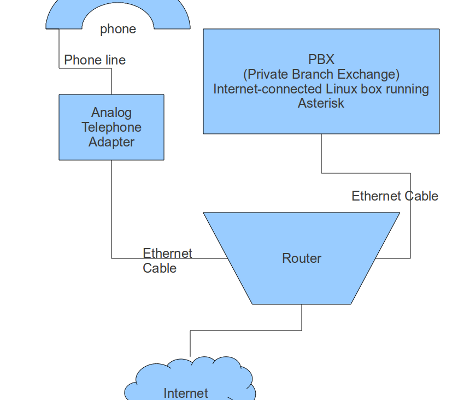
[Headsheez] found a way to get his home phone service for free. He’s using a set of tools that we’re familiar with to route service from a typical analog phone system (which involves the extensions wired into your home) through a server to the Internet. On the hardware side of things this starts out with an Analog Telephone Adapter which translates the analog signal for use in a PBX system. He uses a copy of the open source PBX project called Asterisk which we’ve also seen used on devices like routers and the SheevaPlug. The actual telephone number comes from a Google voice account which for now is a free service but there’s no guarantee that it will remain that way in the future.

This should provide seamless service just like you’re used to with a traditional home phone line. There’s even caller ID for the number – but not the name – for incoming calls. The one big feature that is missing from this setup is the ability to call 911 for emergencies.

[via Reddit]

Robot Gets Around On Lopsided Wheels

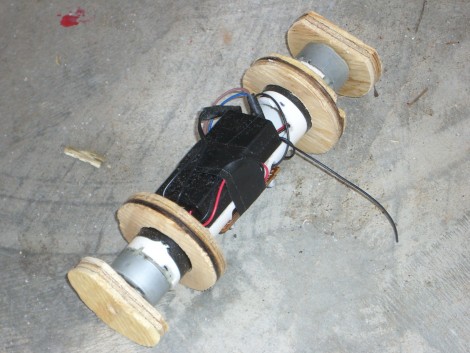
This concept robot uses angular momentum to roll around. You can see that on either end of the robot there are two discs which have been cut on one side to make them off-balance. For locomotion, two DC motors spin the outer discs which are not in contact with the floor. This spinning action exerts a force in the opposite direction on the body of the vehicle, causing it to move.

It’s not a perfect system and there is one major flaw with using this system. When the forces have equalized acceleration will stop and it will eventually come to a standstill. You can’t just stop spinning the motors because that will act as a braking mechanism. But still, it’s a concept we haven’t seen before and we love the experimentation that’s happening here. Take a look at the test footage after the break and don’t hesitate to let us know if this starts causing light bulbs to flip on above your head.

Continue reading “Robot Gets Around On Lopsided Wheels”

Audiophile Quality Headphones At A Fraction Of The Price

diy_hifi_headphones

If you are in the market for a nice pair of Hi-Fi headphones, it is not uncommon to to find price tags in the range of $300-$500. [Stacy] loves her music, but she had no desire to pay that high a price for a pair of good portable cans. Instead, she upgraded a set of cheap, knock-off headphones to near-audiophile quality for less than $50.

She starts off by explaining the technology behind the expensive headphones you see in stores, and why the sound quality is so much better. She says the orthodynamic drivers used in these products produce far better sound due to the placement of the voice coils, and their lack of delay when producing sound.

She found a pair of orthodynamic drivers for $30 and fit them into her knock-off headphones with a reasonable amount of effort. A bit of insulation and supporting plastic was added to ensure proper mounting of the drivers, then the headset was painted and reassembled.

[Stacy] claims that the end result is easily comparable to far more expensive headsets, especially when connected to a proper amplifier. If you are looking to step up your audio game on the cheap, here’s your chance.

Free Energy Is For Fools?

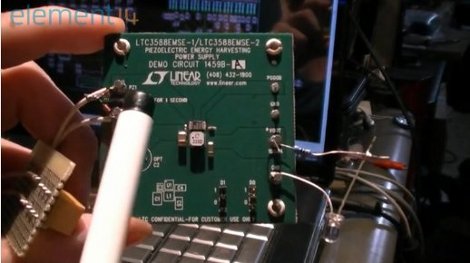
In her new element-14 video [Jeri Ellsworth] explains some  concepts about “free to you” energy and features the LTC3109EUF, an Auto-polarity, Ultra low Voltage Step-Up Converter and Power Manager, along with the LTC3588EMSE a Piezoelectric Energy Harvesting Power Supply.

Using the LTC3109EUF she is able to power a modified Nintendo Entertainment System, and LCD using a small generator and an exercise bike. The LTC3588EMSE is wired up to piezo’s in different applications including being squashed, vibrated, and temperature difference to power low current devices.

All this and a totally 80’s theme, so poof up your hair, get your spiked dog collar, and find those neon green shades because this is a fun and informative video available on element-14.

Bill Hammack Explains How LED Backlit LCD Monitors Work

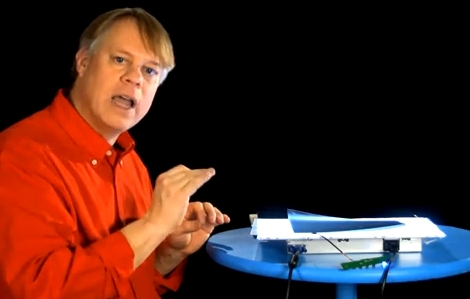
We had a basic understanding of how LCD monitors worked, and you may too. But the thing is, [Bill Hammack] doesn’t just explain the basics. Since he’s the Engineer Guy he explains the engineering principles behind how LED backlit LCD screens operate. But he does it in a way that everyone can understand.

After the break we’ve embedded his five-minute video. In it you’ll see him strip down a monitor to the back plate and then build it up piece-by-piece. We enjoyed his discussion of how the diffuser panels work together to even out and distribute the light. Theses are made of several layers and, although we knew they were there from working with salvaged LCD screens, we never knew quite what they were doing. He also covers how each liquid crystal cell works along with polarizing sheets to either block or allow light passage. And he’ll bring it on home by show how thin-film transistors in each subpixel of the screen work to multiplex the display, just like we did with that pumpkin back in October.

Continue reading “Bill Hammack Explains How LED Backlit LCD Monitors Work”

Pitch Shifter Makes Your Band Sing Higher

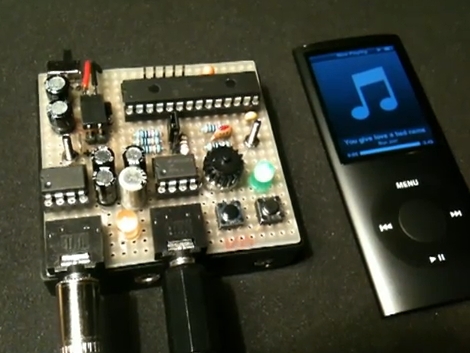
[Markus Gritsch] tipped us off about this little module he built to shift the pitch of audio playback. It uses a PIC 24FJ along with a couple of LM386 amplifier chips to manage the input and output signals. At the push of a button, audio being fed through the device can be modulated to a different key without changing the playback rate. Here it’s being used with a iPod but because this device just sits between an audio source and a signal input we wonder if you can have some fun on the cellphone with this circuit?

Check out the video after the break to hear it in action. We must compliment [Markus] on his layout. We haven’t seen the underside of that protoboard but he’s done a great job of fitting everything into a small area. You can find the schematic for the circuit by following the link at the top of this feature. He took a picture of his hand-drawn plans which saves him time from laying it out with something like KiCAD but still gives us the details that we love to see with your projects.

Continue reading “Pitch Shifter Makes Your Band Sing Higher”