Real-time GPS Tracker With Mobile Phone Uplink

[jayesh] wasn’t actually trying to solve any clever problems when we built his homebrew GPS tracker. He just had the hacker mentality and wanted to build something fun and useful while geeking out with electronics and software.

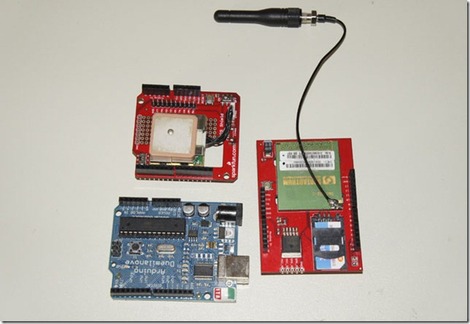
On the hardware side, he started with an Arduino, then added a GPS module for location detection and a GMS/GPRS module for the data uplink to his server over AT&T’s network. The Arduino uses several libraries and plenty of custom code. On the server, he worked up some wizardry with open-source packages and the Google Maps API. All of the source code and hardware details are well-documented. Put together, it’s a GPS tracker that can update a map in real-time. Sure, there are commercial products that do roughly the same thing, but where’s the fun in that? The principles here can also be put to good use in other microcontroller-based projects.
Analog Scope Stands In To For Laser Light Show

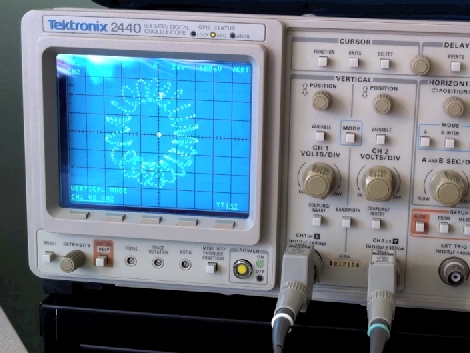
[Joey] likes to dabble in laser projection, building his own hardware and writing the software that drives it. One way that he tests his setup is by replacing the laser assembly with an analog oscilloscope. This allows him to ensure that the driver board is receiving data from the software, and translating it into the correct electrical signals to drive the motors controlling the mirrored redirection of the laser beam.

In the video linked above [Joey] walks us through this process. It starts by connecting scope probes to the digital-analog-converter card that outputs image data for the projector. From there the XY mode is used to map the two channels perpendicular to each other; the motors that these signals are meant to control have mirrors that also move perpendicular to one another. After adjusting the scale and the timebase you will see the pattern the laser dot is meant to trace.

[Joey] entered this in a Tectronix contest. There’s plenty of other interesting entries to browse though. If have an entry that you’d like to see featured, or if you come across any other interesting stuff, don’t forget to tip us off.

Doorbell Hack Makes Coworkers Less Annoying

doorbell_wav_player

Hackaday reader [Sprite_tm] works in an office building that used to house several businesses, and as a remnant of the previous configuration, a doorbell sits in the hallway just outside his office. Several of his coworkers get a kick out of ringing the doorbell each time they enter the office. While not annoyed at the practice, he was getting tired of the same old “ding-dong” and decided to shake things up a bit.

He wanted to modify the doorbell to play random sounds when triggered, but he was pressed for time as it was March 31st, and he wanted to get it installed for April Fools’ Day. Without any real plan or bill of materials in mind, he pieced things together with whatever he happened to have sitting around.

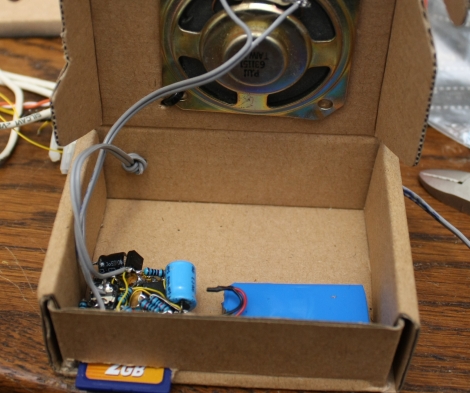
He used a design borrowed from Elm-chan in order to play wav files from an SD card with an ATTiny85, and used an L293 H-Driver as an improvised sound amplifier. After sorting out some power-related problems, and configuring the circuit to be as stingy with its battery as he could, he declared the project complete. He originally aimed to deadbug everything on the metal sleeve of the SD card socket (which is awesome), but considering the size of the speaker and the battery he selected for the project, he ended up stuffing everything into a cardboard box.

We don’t care too much about how he packaged it, we just wanted to know what his co-workers thought of his doorbell augmentation. In the end, they loved it, but we imagine this doesn’t do anything to discourage any of them from hitting the doorbell multiple times a day.

Stick around to see a quick video of his doorbell hack in action.

Continue reading “Doorbell Hack Makes Coworkers Less Annoying”

knex_plotter

K’nex Whiteboard Plotter

[Jerry] has been wanting to put together a whiteboard plotter for some time and just recently got around to building one.

The plotter draws pretty much about anything he can imagine on a white board measuring just shy of 2′ x 3′. The design first started off with a Basic Stamp board at the helm, which he sourced from another project he no longer had any use for. The Stamp worked for awhile, but eventually he ran into problems due to the board’s limited 128 bytes of program space. Needing a more robust micro controller, he switched to an Arduino mid-project, which he says runs the plotter far faster than the Stamp ever did.

The plotter uses a pair of stepper motors mounted on a horizontal platform situated above the whiteboard. Much like this large-format printer we featured earlier this week, the steppers vary the length of a pair of fishing lines, moving the pen precisely across the board.  As you can see in the image above, [Jerry] has been able to create some pretty intricate patterns with his plotter, and we imagine they will only get better with more refinement.

Be sure to check out his site for more details on his build process as well as several additional samples of the plotter’s capabilities.

Hackaday Links: April 13, 2011

Oven parts scrounging

oven_desoldering

In response to last week’s post about parts scrounging with a heat gun, Hackaday forum member [BiOzZ] decided to try doing the same thing in his oven. It seems to work quite well, but we’re wondering if there should be any concerns over the lead content of the solder. Anyone care to chime in?

Spill-proof parts holder

parts_holder

Have you ever been in the midst of disassembling something and knocked over your container full of screws onto the floor? [Infrared] has a simple solution to the problem which also happens to keep a couple of plastic bottles out of the landfill.

Easy button stops abuse of the word awesome

easy_button

Do you often repeat a word ad nauseam? Make author Matt Richardson does, and he hacked a Staples “Easy” button to help him break his addiction to the word “Awesome”.

Cheap Remote-controlled baseboard lighting

baseboard_lighting

[Sean] scored a pair of LED deck lighting kits for a steal and decided to install them into his newly renovated kitchen. They are currently remote operated, but he plans on adding an X10 interface as well as PIR sensors for automatic triggering in the near future.

Yet another LCD recapping guide

monitor_recap

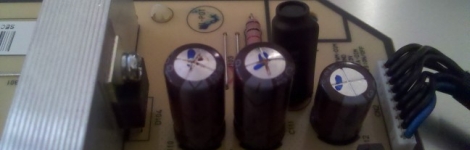
It starts with a finicky backlight, or perhaps a high-pitched whine from the back of your display – by now, we’re sure that everyone knows the symptoms of an LCD panel that’s just about to die. [Eric’s] Syncmaster recently quit on him, so he pried it open and got busy recapping. It’s running again, and he wanted to share his repair process in case others out there own the same display.

Haptic GPS Sneakers For The Visually Impaired

gps_haptic_shoe

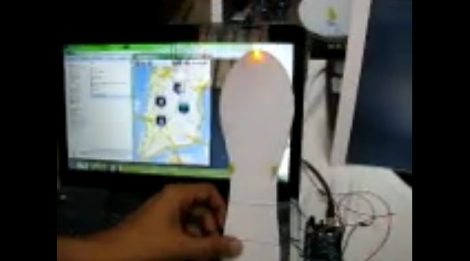
The world can be a pretty difficult place to navigate when you lack the ability to see it. There are many visually impaired people across the globe, with some figures claiming up to 40 million individuals affected. While walking canes and seeing-eye dogs can be a huge help, [Anirudh] of Multimodal Interactions Group, HP Labs India, and some students at the College of Engineering in Pune, India (COEP) have been hard at work constructing a haptic navigation system for the blind.

[Anirudh Sharma and Dushyant Mehta] debuted their haptic feedback shoe design during an MIT Media Lab Workshop hosted at COEP. In its current form, Google Maps and GPS data is sourced from an Android device, which is fed to an Arduino via Bluetooth. The Arduino then activates one of four LEDs mounted on a shoe insert that are used to indicate which direction the individual should travel in order to safely reach their destination. While the current iteration uses LEDs, they will be swapped out for small vibrating motors in the final build.

We’re always fans of assistive technology hacks, and we think this one is great. The concept works well, as we have seen before, so it’s just a matter of getting this project refined and in the hands shoes of those who need it.

Stick around for a quick video about the project filmed at the MIT/COEP event.

Continue reading “Haptic GPS Sneakers For The Visually Impaired”

Using Kinect To Make Human Marionettes

kinect_neurostim

[Choi Ka Fai] has been experimenting with neurostimulation for some time now. His body of work has focused on exploring the possibility of using neurostim devices to replay pre-recorded muscle movements.

Until now, he has been recording his muscle movements as acoustic waveforms for real-time playback in the bodies of his research partners. This usually requires him to sit beside the subject, tethered to a machine. This tends to limit his movement, so he has invested in a new form of movement recording technology – a Kinect sensor.

Using fairly standard skeleton tracking as we have seen in some previous Kinect hacks, he has enabled himself to direct the motion of his subject by merely moving in front of the camera. The benefit of using the Kinect over wired sensors is that he can use any body part to direct his partner’s movements by simply changing how the software interprets his actions. As you can see in the video below, he uses his hands, knees, and even his head to direct the motion of his partner’s arm.

It really is a neat application of the Kinect, and we are totally digging the shaky “human marionette” effect that it produces. Since this was only an initial test of the system, expect to see some more cool stuff coming from [Choi] in the near future.

Stick around to see a quick video of the Kinect-driven neurostim rig in action.

Continue reading “Using Kinect To Make Human Marionettes”