Birthday Gift Is A Constant Reminder Of Impending AARP Membership

birthday_countdown_timer

Sometimes milestone birthdays can be a bit depressing. 30 is rough, and 40 tougher – but 50…that’s a big one!

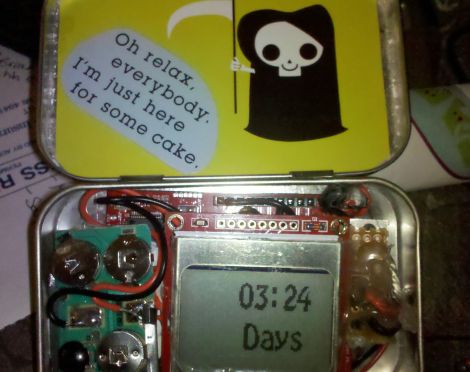
[Ryan’s] uncle is going to be turning 50 shortly, and in the interest of good-natured fun, he has constructed a handy birthday countdown timer for his uncle, lest he forget (or tries to avoid) the big day.

The device displays the amount of time left before his uncle’s birthday, playing an audio clip of “Don’t fear the Reaper” when the clock strikes 00:00. This is accomplished by using the MSP430’s internal clock to keep time, while also interfacing with a Nokia 3310 LCD panel to display the countdown timer. The music is provided by the circuit board from a greeting card he gutted for the project, which was wired to the LaunchPad in order to be triggered at the right moment. Everything was crammed inside an Altoids tin, as you can see in the picture above.

Though not overly complicated, it’s a fun little project, and we’re hoping his uncle gets a big kick out of it. Once his birthday has come and gone, [Ryan] plans on converting the piece into a permanent desktop clock for his uncle.
Wristwatch Turntables

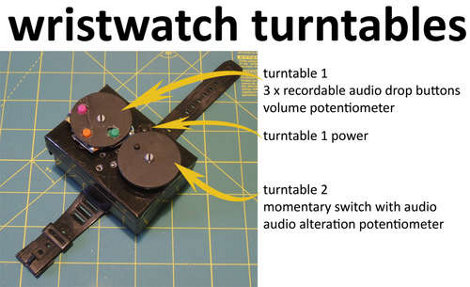
Ever wish you could DJ on the fly while using equipment that your already wearing? Well neither have we but heck now we can, cheaply and easily with the Wristwatch Turntables. While being functional and stylish, this interesting project is fairly easy to construct and if need be, even sports a full function digital watch.

The audio electronics are donated by a pair of talking / musical  greeting cards. Both, “record your own” and “just deal with what we give you” types, though which ones you choose is left up to your taste. The greeting cards are then cut apart for their hidden goodies and then a little circuit bending action is performed to monkey with the amplifier of the sound module.

Potentiometers are added, buttons are relocated, and everything gets housed in a small box, with a wristwatch ran down the middle so you can wear the whole deal and blast your funky beats anywhere you may be. Join us after the break for a quick video.

Continue reading “Wristwatch Turntables”

RF Range Finder Doesn’t Need To See To Calculate Distance

radio_rangefinder

Instructables user [Jones Electric] has been quite busy lately, building a radio-frequency range finder. Built as part of a German youth science competition, he and his partner built a pair of transmitter/receiver modules that can be used to measure distances of up to a mile (~1.5km). Their argument for radio-based rangefinders is that laser rangefinders are obviously limited to line of sight, whereas their range finders are not.

To determine the distance between the two stations, the base station is triggered, which starts a counter and sends a 433 MHz signal to the second station. When the second station receives the signal, it in turn broadcasts an 868 MHz signal, which is received by the base station. The total distance between the points is then calculated based upon the round trip time of the two radio signals.

[Jones Electric] claims that the range finder is relatively accurate, with a deviation of up to 5 meters per measurement, and that the accuracy could be increased by adding a higher frequency crystal to the timing circuit.

We are pretty sure using these two frequencies in the US without a license is not allowed, though we are unsure of the usage laws in Germany, where this was constructed.

TI’s Grace – A New MCU IDE GUI (DNFTT)

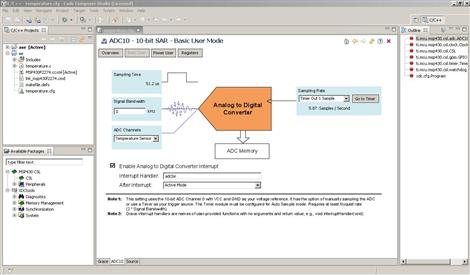
TI has recently been fighting to gain traction in the market of low-cost microcontroller development platforms with products such as the MSP430 Value Line Launchpad.  In order to meet the needs of a rapidly growing customer base and appeal to a broader market they have recently released Grace beta Graphical Peripheral Configuration Tool. Grace is a plugin for TI’s own Code-Composer Studio (CCS) IDE that allows users to graphically control many aspecst of MSP430 development and is compatible with all MSP430F2xx/G2xx MCUs.

Utilizing a simple “wizard-like” interface, Grace allows users to quickly and efficiently control peripherals such clocks, timers, OpAmps,  ADCs, GPIOs, comparators, and even more advanced features such as serial communications or the configuration of low-level register settings. Once everything is configured as desired, Grace outputs standard C code that can be debugged and handled as if it were hand-written.

Although Code-Composer Studio is not free, there is a 30-day full-featured trial available as well as other (restricted) free licensing options as well. Since CCS is based on the Eclipse open-source  software development framework, perhaps we will see other similar development tools in the near future. Although not an apples-to-apples comparison, we could imagine that such a tool might provide many novice users with a simple and cost-effective alternative to the Arduino IDE.

The questions then becomes: If a later incarnation were to raise the MSP430 line to “Arduino-killer” status, would it be rejoiced as such or would it simply then become a new target for those die-hard microcontroller purists who love to shout “overkill” on the forums at the slightest provocation? Of course we would love to hear your take in the comments below!

Magic 8 Thing Answers All Of Your Burning Questions

magic_8_thing

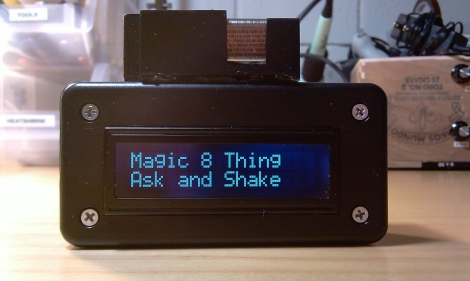
[Pete] was hard at work putting off a repair job for a friend, and wondered how much longer he could possibly procrastinate. With no fellow humans in earshot to which he could propose this question, he thought it would be great if he could ask a Magic 8-ball for an answer. Alas, he doesn’t have a Magic 8-ball, so he would have to build one if he wanted his answer.

Continuing to delay the repair job, he scrounged around his house and dug up an ATmega328 to control the 8-ball and a LCD panel to display the sage-like responses. He wanted the 8-ball to be as authentic in operation as he could, so he had to locate some sort of sensor that would register if the device had been shaken. With no accelerometer at hand, he opted to use a mercury tilt switch that he scavenged from an old thermostat. He wrote some software to display the responses from the original Magic 8-ball when shaken, then he threw the components together in a small plastic case.

As you can see in the video below, his Magic 8-thing works just like the original, sans the dark fluid and icosahedron. If you were wondering, he did finally ask the 8-thing whether he had procrastinated long enough on his initial task – the response: “Yes”

If you’re in the mood for more Magic 8-ball shenanigans, check out these posts!

Continue reading “Magic 8 Thing Answers All Of Your Burning Questions”

pov_business_card

POV Business Card Is Guaranteed To Get You Noticed

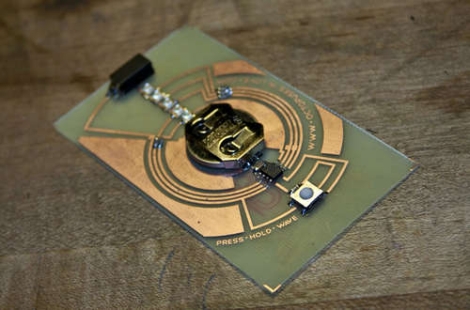
Some say that handing out business cards is an antiquated practice due to the ubiquity of smart phones which can be used to trade or record contact information in mere moments. Instructables user [sponges] however, doesn’t agree and is pushing a “business card renaissance” of sorts with his POV business card.

Hand-built in his basement, the cards feature a handful of SMD LEDs that display his name, followed by his phone number when waved back and forth. Constructed to be nearly the same size as a standard business card, his verison uses a PIC to manage the display as well as a tilt sensor to monitor the card’s motion. His walkthrough is quite thorough, and includes tutorials for each of the steps required to build the card. He discusses constructing your own etching tank, converting a laminator for PCB transfer purposes, building a solder reflow oven controller, as well as hacking an aquarium pump for use as a vacuum-powered pick and place.

The end result is a sharp looking business card that ensures you won’t forget meeting him. Keep reading to see a video of the card in action.

Continue reading “POV Business Card Is Guaranteed To Get You Noticed”

herf_gun

HERF Gun Zaps More Than Your Dinner

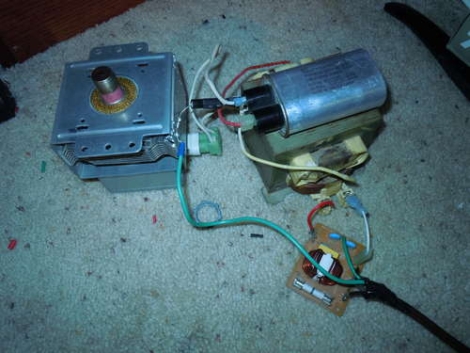
Instructables user [Jimmy Neutron] had an old microwave sitting around and figured he might as well gut it to build a high-energy radio frequency (HERF) gun.

The concept of a HERF gun is not incredibly complex. Much like your microwave at home functions, a high voltage power source is used to drive a magnetron, which produces micro wave radiation at 2.45GHz. These waves are then guided away from the magnetron using a waveguide, towards whatever the target might be. These waves then energize the target in a similar fashion as the water molecules in your food are energized during cooking.

[Jimmy] has not quite finished his HERF gun as he still needs to build a waveguide for it and then safely mount it for use. In the meantime, check out the pair of HERF guns we found in the videos below.

As a parting note, we must stress that building a similar device is dangerous, very dangerous – especially if you do not know what you are doing. Microwaves contain high voltage components, and exposure to microwave radiation can be deadly under certain circumstances. Stay safe!

Looking for more microwave fun? Check these out!

Continue reading “HERF Gun Zaps More Than Your Dinner”