Roll Away Clock Becomes A Programmable Rover

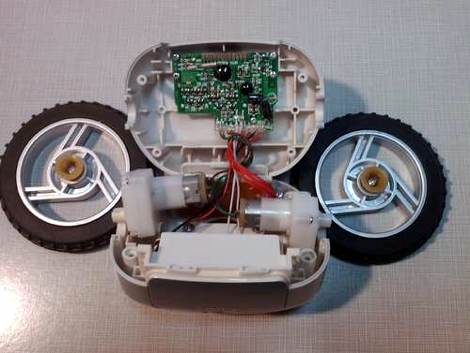
The parts laid bare in the picture above all make up a roll away alarm clock that flees when you don’t get out of bed. It’s an interesting idea, but considering most folks don’t sleep on hardwood floors we can understand why [TheRafMan] was able to pick this gem up for under $5. That’s quite a deal because there’s a very usable LCD module at the top. But for this hack, he focused on using the gearhead motors to make a programmable rover.

In order to make this programmable [TheRafMan] had to add a microcontroller. He chose an Arduino variant, called the Ardweeny. It’s a board that piggy-backs the ATmega328. But he didn’t use a stock Ardweeny; he’s altered it to play nicely with jumper wire. The uC is able to interface with the gearhead motors thanks to an L293D h-bridge motor driver chip. As you can see in the clip after the jump, the rover can now be driven around using a Wii Nunchuck or via a USB connection. If you’ve got a Bluetooth module lying around it wouldn’t be hard to make this a wireless solution that can be controlled with the accelerometers in a Wii remote.

Continue reading “Roll Away Clock Becomes A Programmable Rover”

RC Override For Autonomous Hardware

[Simon Inns] developed this board to act as a radio controlled override for autonomous hardware. It sits between some servo motors and two different sets of controllers for those motors. One set of hardware that can control the motors is a microcontroller programmed for autonomous tasks. In [Simon’s] case this enables a sailboat to navigate open water with out human intervention. But if that board fails, or if you just need to call the boat back to port, this module allows for a traditional RF vehicle controller to take command.

The board seen above, dubbed the Servo Switcher, uses a PIC 12F683 to monitor the incoming signal from the RF receiver. If that signal is not present it switches control of the motors over to a separate microcontroller board. This means that the override control is established simply by turning the handheld controller on. This will save you a swim to retrieve your boat, which is a nice convenience. But if you modify this for a plane or helicopter, it can save your aircraft from certain destruction. Check out the video walk through after the break.

Continue reading “RC Override For Autonomous Hardware”

Terapixel Images And See-through Cameras: Real Or Fake?

invisible_camera_lol

Once again it’s time for you, the sharp-eyed readers of Hack a Day, to decide whether the following video demonstrates technology at its finest, or if it is complete hogwash. This edition of Real or Fake? is brought to us by Hack a Day reader [Wizzard] who sent us a link to “The Invisible Camera

Watch the video embedded below to see the unveiling of this camera as well as a discussion of its new, revolutionary technology by its creator – photographer Chris Marquardt. The camera is composed of a simple, non-moving lens mounted in a completely transparent box made of specially polarized glass. This glass is supposed to align the ambient lighting, which amplifies the energy coming through the lens, in order to expose the special film they created for the camera.

The film was developed using standard film “combined with innovations in chemistry” to produce ultra-low sensitivity image media, which the creators are calling “Directionally Desensitized” film. This film can be handled in full light, as it is only sensitive to the high-energy light directed on its surface by the aforementioned lens. It is claimed that due to this special film, the camera goes beyond the Megapixel, past the Gigapixel, and captures images in Terapixels.

Now, call us skeptical, but isn’t it a bit early for April Fools jokes? We just can’t imagine any scenario where holding a piece of film in the sun as shown in the video would not cause it to be exposed in at least some areas due to the massive amounts of reflected light in the environment.

What’s your take?

Continue reading “Terapixel Images And See-through Cameras: Real Or Fake?”

PC Case Using CNC Router And Home Building Products

[Reinventing Science] needed a project that he could use to test out his skills on a new CNC routing machine he recently acquire. He settled on building a PC case using easily obtained materials. What he ended up with is the clean-looking case seen above that was machined from materials you can pick up at the home store.

The bulk of the case is made from extruded PVC which is designed to perform like solid wood trim. He picked up one piece of the ‘lumber’ and cut out the front, back, top, bottom, and drive bay bezel. We expected the joints between the horizontal and vertical pieces to either be butt joints, or rabbits. But [Reinventing Science] wanted a cleaner look and managed to mill mortise and tenon joints. These are strong joints that leave a very nice finished look. Since the material is designed as a lumber replacement it shouldn’t be too surprising to see drywall screws used as the fasteners.

In addition to joinery, some other CNC tricks were used. The sides of the case were cut from clear acrylic, with a decorative bead milled in the surface. There’s also fan ports cut in the top and vents on the bottom, as well as some engraving with the name of the project just above the optical drive. The wood-grain embossing makes for an interesting final look; we’d like to see how this takes a few careful coats of paint.

If you’re interested in the CNC hardware used, take a look at the unboxing post that shares a few details.

Autonomous Paintball Sentry Gun

What is the best thing about making a computer program that targets and kills anything that enters its sight? Why giving it a weapon, of course! No, we are not talking for real, but the next best thing, an Autonomous Paintball Sentry Gun.

The autonomous part of the device comes from a pc on the sideline and is fed input though a standard webcam. The feed is ran though a processing script where, once accustomed to the background has the option to fire at anything it sees moving, or a nice point n click manual mode.

The Arduino part is in a the role of driving the servo motors for X/Y movement and a trigger and is powered by a fist full of D cell batteries to give plenty of time for fun. Also, be sure to check out our other sentry guns, one using Microchip PIC, and another sporting a super compact computer running Ubuntu

Hackaday Links: March 22, 2011

3D holographic fog display

3d_fog_display

Some researchers in Japan are hard at work building a 3D volumetric fog display that would allow you to live out some of your Leia-related Star Wars fantasies. Using a column of fog and three projectors, they were able to create a display that looks three-dimensional from any angle. It might be a while before the technology hits your living room, so don’t clear your calendar just yet, Obi Wan. [via Neatorama]

The Claw – a three-fingered robotic gripper

the_claw

Instructables user [AntMan] has been hard at work revising his robotic claw gripping mechanism. Laser cut from wood, this servo-driven claw can easily grasp small objects with little effort. We can’t wait to see someone build a version from milled aluminum!

Ben Heck’s retro Xbox 360

ben_heck

[Ben Heck] is at it again, and has recently given the Xbox 360 a sweet retro makeover. Taking inspiration from gaming consoles of the 70’s, he converted an Xbox 360 into a laptop-style portable (again), but this time with the look and feel of an old Atari 2600. Retro gamers rejoice, you can now get your Xbox on while enjoying the sweet simulated wood-grain you grew up with.

Rocket-based ice fishing notification system

ice_rocket

What fun is ice fishing if you have to sit outside freezing your butt off? We’re assuming that was the driving thought behind [Mike’s] rocket-based ice fishing rig. A model rocket is attached to his fishing sledge, which is triggered when a fish is detected on the line. Using a low-tech detonator, the rocket lets him know it’s time to check the lines. Now only if we could get the fish to fillet themselves…

Case modding video series hits the web

modmen_logo

The “Mod Men” is a fairly new web series that takes you out of the basement and into the garage for some professionally constructed case mods. Described as “American Chopper for geeks with a dash of This Old House”, the creators aim to showcase over-the-top case mods with a professional flair. They already have three episodes under their belt, all of which are available on their site.

Paper Mechanical Iris

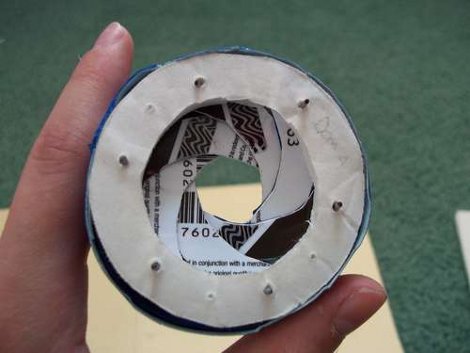
This functioning mechanical irs is made from paper templates, foam core poster board, old credit / gift / etc cards, paper clips and masking tape. First, patterns are designed and multiples are printed and laid out to make the 10 parts needed. Two rings are cut out of foam board and a third ring is cut into wedges to form a cam mechanism on top of one of the other two rings.

Twelve shutters are then cut from the credit cards, and small pieces of paper clip are glued to each end and both sides. One side rides the cam mechanism the other side is punched through the final ring.

We found it to be an interesting project that should be pretty easy for just about anyone to replicate (now that its all figured out for us), and besides, you never know when you might stumble across a small box of hotel key’s with a defunct pizza parlor’s advertisement on the back.