1Hz Timebase

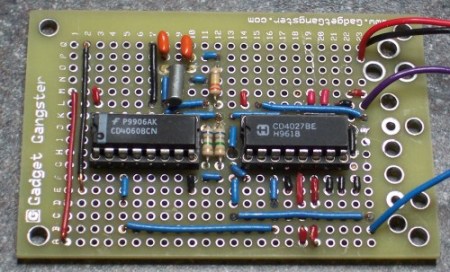
Check out this nice simple method of achieving a 1Hz timebase. This is basically a lesson in dividing crystal frequencies in circuits to get the desired result. In this case, they are starting with a 32.768KHz crystal and dividing it down. Instead of using an NE555 like many projects, he chose to go a direction that would yield results less prone to drifting with temperature variation. The method chosen was a CD4060 frequency divider, basically just a chain of flipflops. The divider is one step short of getting to the desired result so an additional flipflop has to be added. This is pretty basic stuff, but a great read. They go into detail as to how it all works and why you would use this method.

Pssst, hey, remember that time I told you to just use a 1Hz crystal? yeah, we can laugh at that again.

[via HackedGadgets]

Displaying Video And Gifs On RGB LED Matrices

led_matrix

[Mathieu] was on holiday in China and picked up some fun toys while perusing the numerous electronics markets there. The most interesting things he discovered were a pair of RGB LED matrices. They came in two different flavors, one made for indoor and one for outdoor displays, sporting a 64×32 and 32×16 resolution, respectively.

If you’ve read his blog before you know he is a big fan of LED matrices, so it’s only natural that bought a whole bunch of them and started experimenting once he got home. Using the same Atmel FPSLIC LED matrix control board he showed off in this previous hack, he was able to get the LED matrices up and running in no time. He adapted his webcam project to utilize the new panels, and he added a whole new feature as well. Via MatLab, he can now display any sort of animated gif on the panels, as you can see in the video below. The panels look great, and if we had a few of these around, there’s no doubt we would probably play this video on infinite repeat.

He says that the despite their somewhat questionable origins, the panels are of top notch quality, and he is willing to organize some sort of group buy if others are interested.

Continue reading “Displaying Video And Gifs On RGB LED Matrices” →

Uber Keyboard Hides Security Tools In Plain Sight

uber_keyboard

[EverestX] works in the Security industry and is often required to recover or penetrate various systems for a variety of reasons. He wanted to create an all-in-one tool that he could easily carry from job to job which would provide him with several essential functions. He required that the device house a bootable operating system through which he can perform his work, have an Internet connection capable of injection, and have enough storage capacity to back up passwords, images, etc.

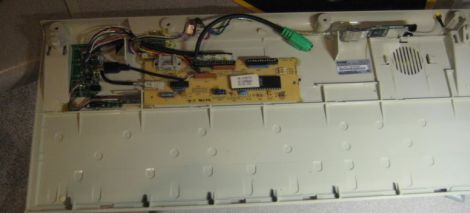
He decided to build the system inside an old IBM M-type keyboard, which provides a solid typing experience and plenty of real estate for his various components. After converting the keyboard from PS/2 to USB, he installed a USB hub along with his flash drive and WiFi card.

Once he gets everything reassembled, it should prove to be a pretty stealthy and useful piece of equipment. A word to the wise – if you happen to see someone sneaking around your office with a 20-year old Type-M keyboard, be wary.

Arduino Arcade Rom Dumper

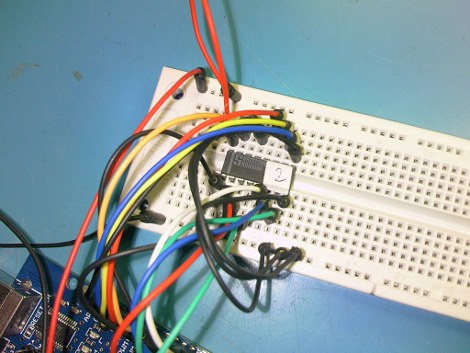
[Vincenzo] wanted to read some 82S129 bipolar proms, and why not, they were very common in the 1980’s arcade scene. The problem is that its kind of an odd ball part now, and typically only (even) more expensive EPROM programmers can read them. An Arduino, breadboard and some quick scripting quickly takes care of that problem with this Arcade Rom Reader.

You stick the prom in your breadboard, and wire it up to the appropriate ports and pins of the Arduino, which bit bangs the prom and returns the results though the serial connection of the Arduino. Using a terminal program on the pc side you capture the text and use a script to convert the ascii values into a binary nibble format and save as hex.

This makes it much easier for us to dump roms from old arcade boards, because you never know when you might run across an old Polybius arcade board on your next outing to the salvage or scrap yard.

Join us after the break for all the details and as always comments!

Continue reading “Arduino Arcade Rom Dumper” →

Aux-in Hacking An ’04 Subaru Radio

[Jordan] writes in to show us his hacked up car stereo. [Jordan]’s 2004 Subaru, like many of our cars, does not offer any kind of auxiliary input, and aux-in/mp3 adapters tend to run on the not so cheap side of the price scale. Even a replacement head unit was too rich for his blood. So it was time to wire something to the old head unit.

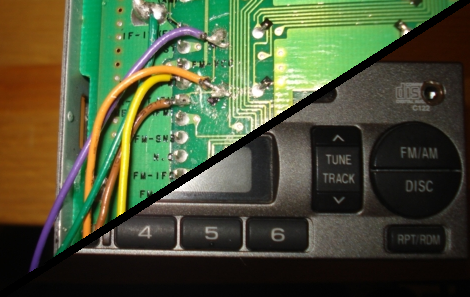
On inspecting the radio’s PCB [Jordan] managed to locate the traces that carry audio from the FM receiver to the stereo’s amplifier.  Most aux input hacks we have seen involve fooling the stereo into thinking some media is inserted, even if interfacing with the audio lines on the PCB. These require that the tape/CD functionality be altered, perhaps permanently. Even worse you may have to shlep around a blank CDR with a bunch of tracks on it! All just to fool the stereo into enabling audio output.

Instead [Jordan] targets the audio lines from the FM stereo, since radio is always enabled when active. Once the audio traces are located they are severed  and bypassed with a 1/8″ stereo plug. This setup allows the FM audio signal to pass through the connector when disconnected, and cuts off any radio audio once your mp3 player is. We have seen this same method used on a vintage stereo hack as well. Nice work!

Quick Project: Hard Drive System Meter

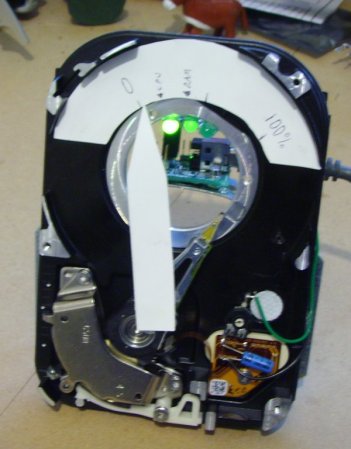
[Ginge] sent in this fun little project. He gave himself 3 hours to complete a hack (not including research time) and managed to come up with this cool activity meter. He handles the entire project like it is some kind of contest. Ground rules are laid out, requiring practicality of the final product, minimum investment, and almost complete use of junk pile pieces.

Using an old hard drive for the frame of the project as well as the “dial” part of the meter, he hacked together a system load/ hdd and proc activity meter. The brains of the project are an AVR and he even implemented some PWM to smoothing things out. He goes into some fair detail on the construction of the thing (was the writeup included in your build time? -50 points!). Even though he’s using a piece that he manufactures and sells (OSIF), you could probably figure out how to do it without.

You can see a video of it in action after the break

Continue reading “Quick Project: Hard Drive System Meter” →

Lego Technic Super 8 Movie Projector

lego_super_8

It always blows our mind to see the things that people dream up when playing with Lego. Given enough time, you could likely replicate almost any mechanical device with the right amount and type of blocks.

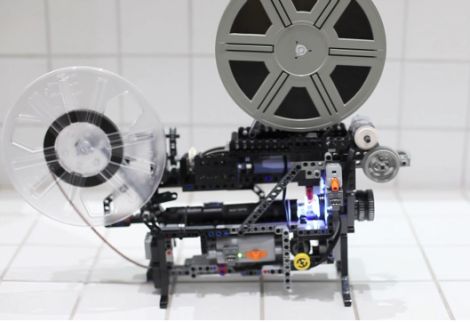
[Friedemann Wachsmuth] recently wrapped up construction on a very impressive Super-8 movie projector with the help of his friend [Kalle]. The projector is fully functional, and is made completely from Lego aside from the reel spindles, the lens, and the lamp. As you can see in the video below the projector plays the film quite well, and even though it is only lit using an LED flashlight, it’s more than bright enough to get the job done.

The projector boasts automatic film feeding, a 24 fps framerate, as well as fast rewind capabilities – all provided by just two small Lego Technic motors.

You really need to watch the video to appreciate how much work went into this projector – it’s amazing.

[via RetroThing]

Continue reading “Lego Technic Super 8 Movie Projector” →