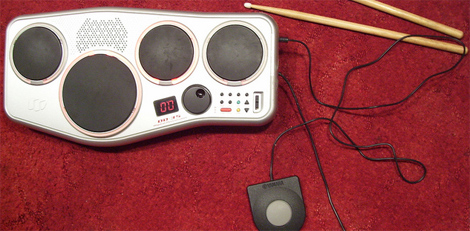
Adding A Pedal To A Yamaha DD35 Drum Kit

[Paul] Wrote in to tell us about a quick project that might be useful to others out there. He was having some problems with the DC jack on his Yamaha DD35 portable drum kit. Naturally, he did what most of us would do and just broke out the soldering iron and prepared to solder it back in place(hot glue it afterwards, that always helps too). That part isn’t a big deal, we’ve all seen it a million times. However, while inspecting the DC jack, he noticed something silk screened on the board right next to it.  As it turns out, that was a kick pedal jack. After a few minutes hunting for a victim around the house that would be sacrificed for its plug, he got his hands on one. A few moments later he was jamming away with a kick pedal.

We absolutely love these super quick upgrades. [Paul] thought maybe this feature was left out at the last minute, and we’ve seen this type of thing for a number of reasons. Maybe that was a feature kept aside for a more expensive model, maybe there was some other reason it was left off. Frankly, we don’t care, we just think it is awesome that it works!

Stay with us to see a quick video demonstration.
Continue reading “Adding A Pedal To A Yamaha DD35 Drum Kit” →

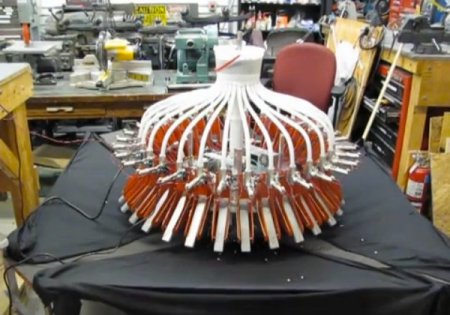
The Vibrotron

Behold the Vibrotron! Constructed by the Carnegie Melon University robotics club, the vibrotron is a piece of a larger project called the robOrchestra. The mechanics in action here are quite simple. You have two reservoirs of small steel balls. One at the bottom, one at the top. The bottom ones are fed to the top ones using an Archimedes’ screw. Once at the top, they are dispensed through some tubing down to plink off of a vibraphone key. All of the timing is done via solenoids mounted at the end of the tubes. The final product reminds us of the Animusic animations that were put out a few years ago.

For this system, since they wanted this to be an automated and reconfigurable bot, they are using an Arduino to control the solenoids. This way they can change songs as they please. We have to admit though, we’d love to see one where the timing for the song was all done through tube length or some other passive system allowing it to be hand cranked and purely mechanical.

Continue reading “The Vibrotron” →

Mini LED Message Board Built From Retro Displays

personal_electronic_retro_telegram

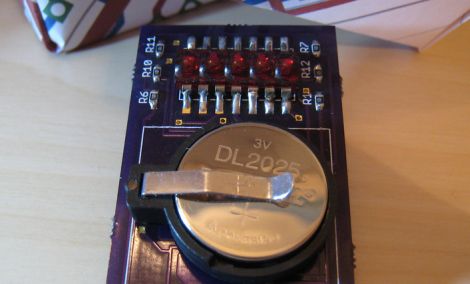
[Iain] is getting to the point in his life where he finds himself waxing nostalgic about various different technologies from his youth. One item he has always been fond of is first generation 7 segment consumer LED displays, like those found in old calculators.

He was excited to find one of these displays at the bottom of a box full of electronics odds and ends he received from a friend. After identifying the display and tracking down a data sheet online, he decided that he wanted to build some sort of little gadget out of it.

His first inclination was to build a tiny text scrolling gadget from the display, and thus his “Personal Electronic Retro Telegram” (P.E.R.T) was born. With Arduino in hand, he prototyped the circuit on a breadboard, then sent away to have some PCBs built. Once he received the boards, alll of his prototyping components were swapped out with SMD versions, including a TQFP ATMega168 chip in place of the full-sized Arduino board.

The final result is a nice melding old and new technology which he decided to give to his girlfriend as a gift. Continue reading to see a quick video of the P.E.R.T in action.

Continue reading “Mini LED Message Board Built From Retro Displays” →

Hacking Cakes With LEDs

led_cake

A large part of science is making mistakes and learning from them in order to make each subsequent design that much better. When your experimentation involves hacking cakes, each failure is an exercise in deliciousness.

[Craig] and his group of research partners often bake electronics-related cakes whenever part of the team departs in search of other opportunities. Over the years, farewell parties have seen renditions of anything from multimeters to quantum computers. This time around, he wanted to make something that contained actual electronics parts, while still remaining edible.

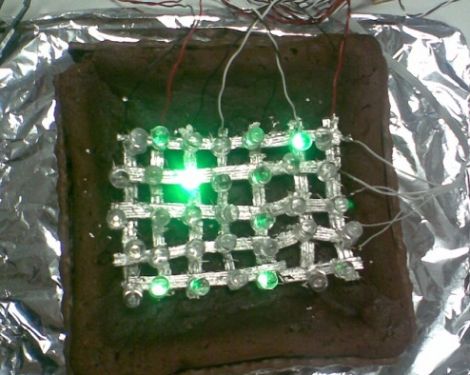
He settled on making an LED matrix inside of a cake, using silver foil wrapped licorice for wires. In the end however, he found the silver foil to be incredibly difficult to work with, and the matrix ended up being little more than a few randomly blinking LEDs.

Even though things didn’t work out quite how he planned, he is not discouraged. The cake was still quite tasty, and through this process he has discovered edible silver paint, which will undoubtedly make it into the next farewell cake.

Hacking Analog Phones For VOIP

analog_phone

[Tyler] has been using Google Voice extensively for some time now, but he hasn’t quite found a microphone/speaker setup he is happy with. He tried a headset, but that just didn’t do it for him.

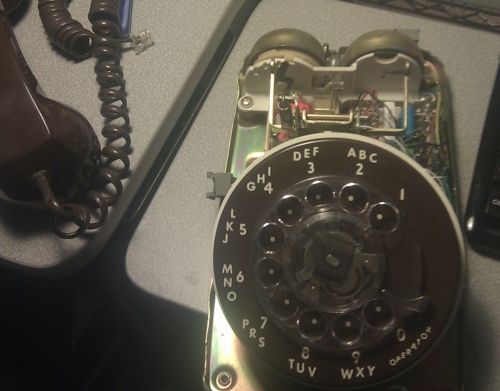
While browsing around at his local thrift store, he came across an old Model 500 rotary phone for just a few dollars and decided it just might do the trick. Once disassembled, he mapped out the circuitry and got busy wiring up the handset to a pair of 3.5 mm stereo plugs – one each for the earpiece and microphone.

Once everything was reassembled, he hooked it up to his computer and gave it a spin – success!

While he is happy with how the phone works at the moment, he already has plans for improving it. He is currently looking for a way to use the handset hook to disconnect calls as well as a way to implement the rotary dial for number entry. We think that hacking a Bluetooth headset would easily take care of the first part, as well as eliminate the need for any sort of wired interface to his PC. It would also make it dead simple to use with any other Bluetooth-enabled device such as a cell phone.

We’re pretty sure he is open to implementation suggestions, so let us know what you think.

The LayerOne Hacking Conference Is Around The Corner

We just wanted to give a heads up to everyone to remind them that the annual layerOne hacking and security conference is coming up soon. They have announced their speaker line-up which includes talks on home monitoring, lockpicking, mobile malware and tons more. The event is located in Anaheim California on May 28-29.

They sent us sort of a press release with some information on the event and some details on the badge. You can read their email after the break.

Continue reading “The LayerOne Hacking Conference Is Around The Corner” →

Simple AVR Based GPS Tracker

The latest project from Lucidscience.com is a simple AVR based GPS tracker. As usual, the instructions here are quite in-depth including schematics and step by step procedures all the way down to modifying cables when necessary. What we found interesting is that the GPS module he’s using is so simple. It only requires 3 wires, one for power, one for serial communication, and one for a heartbeat.

For the microprocessor, he’s using an ATMega 324, which is a bit of processing overkill but he needed the SRAM for the GPS point storage. You could obviously expand to external storage but the goal here was to keep it extremely simple. Actually, there just isn’t a whole lot here other than the microprocessor, the GPS module, and a level converter. After wrapping up the circuit he goes on to explain how to get the data into Google Earth for display. After a few trips around the block you can see the results are quite nice.