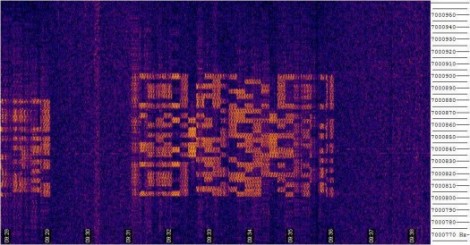
Barcode Challenge For Radio Operators

[Scott Harden] came across a few posts about QR code matrix barcodes coming through on the 40m baud radio band. A few operators had captured the signals and assembled them into the code block seen above but they weren’t able to get a clear enough shot for a smartphone to decode the image. [Scott] took on the challenge and decoded the mysterious message himself. He tried some graphic editing to separate and enhance the color channels in order to up the contrasts of the image. This helped, but still couldn’t be read automatically. In a move similar to those seen in Hackaday’s own barcode challenges he dropped the image into Inkscape so that he could manually clean it up. Once it was overlaid on a grid the job was pretty simple. the left side did require some more image manipulation and precision”squinting” to eliminate interference from the vertical banding, but he managed to get the message. We won’t spoil it here in case you want to take on the challenge yourself. Good luck!

Automated Chicken Coop Door Is Solar-powered

[Fileark] has been busy with the hacks lately. This time around he’s built a solar-powered chicken coop door that opens in the morning, and closes at night. A single motor slides the door open and closed using a loop of spring-loaded string. There are limiting switches on either side of the door jamb to ensure proper positioning. The grey box seen above houses the hardware; a regulator for the solar panels perched atop the roof line, a battery from a broken UPS, and the driver board itself. An AVR chip running the Arduino bootloader monitors a phototransistor to detect sunup and sundown, driving the door motor appropriately using a pair of relays.

Check out the demonstration and hardware overview after the break. [Fileark] was inspired to build his after seeing the alarm-clock coop door. We don’t know if he got a chance to look at the vertical coop door, but we think his less mechanically-complicated solution is just as elegant.

Continue reading “Automated Chicken Coop Door Is Solar-powered” →

Surprisingly Simple Magnetic Card Spoofer

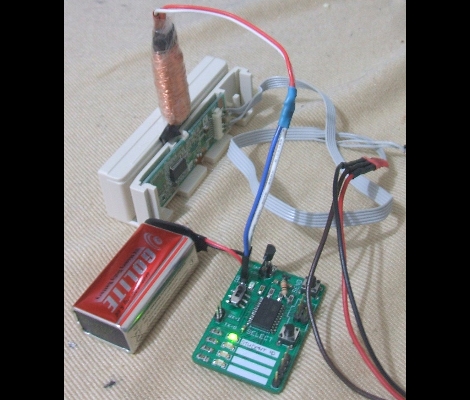
[Craig’s] magnetic card spoofer is both simple and brilliant. There are two parts to spoofing these cards and he took care of both of them. The first part is getting the actual card data. He designed the spoofer board with a header that connects to a card reader for doing this. The second part is the spoofing itself, which is done with an electromagnet. As with past spoofers, he wrapped a shim with enamel-coated magnet wire. An old knife blade was picked for its thickness and ferromagnetism.  This magnet is driven by an ATtiny2313 which stores the data, and is protected by a transistor driving the coil. There were a few design flaws in his board, but [Craig] was able to get the same track data out of the spoof as the original card despite the LED being used as a protection diode and an ‘aftermarket’ resistor on the transistor base.

Arduino Electronic Speed Control Explained

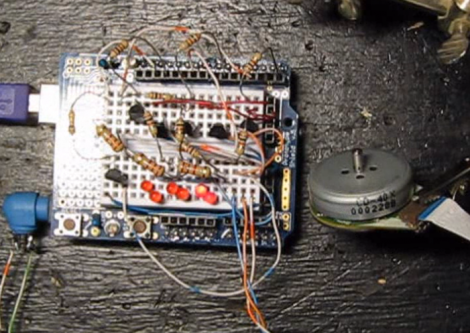
You can salvage some nice motors out of optical drives but they can be tricky to control. That’s because brushless DC motors require carefully timed signals used in a process called Electronic Speed Control (ESC). [Fileark] built and ESC using an Arduino and has a couple of posts explaining the concept and demonstrating how it works. His test circuit uses six 2N2222 transistors to protect the Arduino from excessive current. You can see six red LEDs above which are inline with the base of teach transistor. This gives visual feedback when a transistor is switched, a big help for troubleshooting your circuit.

Once you’ve seen the videos after the break you’ll probably come to the conclusion that this is an impractical way to use a brushless motor. But it is a wonderful way to learn about, and experiment with the concept of ESC. Chances are you can get your hands on an old optical drive for free, making this an inexpensive weekend project.

Continue reading “Arduino Electronic Speed Control Explained” →

Thanksgiving Turkey Quadcopter Shenanigans

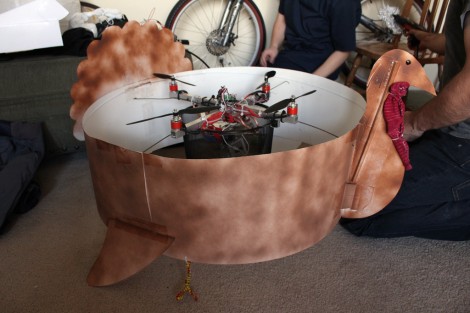
The challenge: can you build a flying turkey that drops pumpkin pie bombs? That’s the question that Utah Aerials asked themselves and they did manage to make it happen. Of course they’re not starting from scratch, but adding a little holiday cheer to an existing quadcopter in the form of a spray painted turkey fuselage. The cheapest pumpkin pie they could find was hung from the copter with care, and dumped thanks to a servo motor. Check the video after the break to see if they were able to hit their balding-bullseye or not.

Seems like the wicked witch music should have been the background for that video.

Continue reading “Thanksgiving Turkey Quadcopter Shenanigans” →

Ubertooth Board For Bluetooth Experimentation

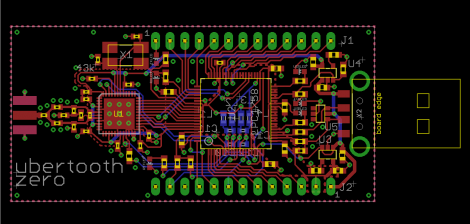
Ubertooth Zero is the first offering in [Michael Ossman’s] quest for a Bluetooth sniffing and hacking hardware platform. We’ve seen some of his hacks in the past, like the build-in guitar tuner and some pink pager fiddling. The Ubertooth dongle is his original design based around an LPC1758 ARM Cortex-M3 processor paired with a Texas Instruments 595-CC2400-RTB1 to handle the 2.4 GHz RF communications. Looking at the bill of materials shows a very low cost for the components at just under $30 (if you can get your hands on a PCB to mount them on). He’s written firmware as well as host code to help you up start pulling Bluetooth packets out of the air as quickly as possible.

What can you do with this? That’s up to you, but whatever it is you accomplish, we’d like to hear about it.

Roller Curtains With Your Graphics On Them

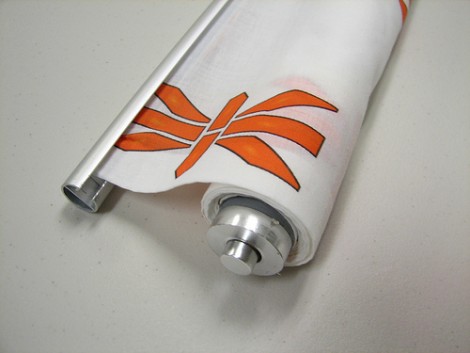
[Lenore] added a bit of customization to her office window hangings by fitting roller curtains with custom printed fabric. The treatment seen above is a $20 Enje roller blind from Ikea but that logo is all Evil Mad Science. The weight at the bottom of the fabric uses a friction-fit plastic insert that can be stapled onto new material. Some fusible tape was ironed onto the sides to finish those edges, and the roller at the top has strong adhesive that remains for a second use after peeling off the original material.

A fabric printer was used to produce this rendition of shades. But we’d like to see some conductive thread added for a fabric-based display that can be rolled up when not in use.