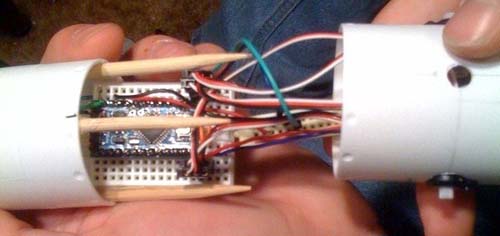
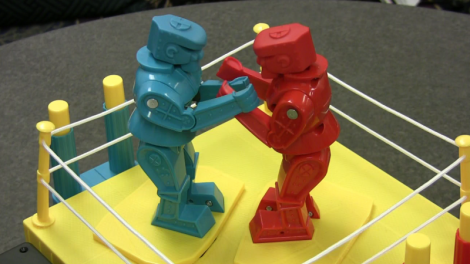
The classic injection molded plastic Rock ‘Em Sock ‘Em Robots has been upgraded to use motion control. The project uses four TI Chronos watches, one on each wrist of both players. In the video after the break we get a good look at the guts of the base unit. We’re quite impressed with the quality craftsmanship that went into retrofitting the plastic bots with four servos each. The electronics include some bells and whistles such as an SD card that records scores and can replay a match via saved inputs. If you’ve got a couple of these watches on hand we’d love to see you port this project and make it a Punchout controller.
Continue reading “Robot Boxing With Wrist Watches”
Driving With Android
[youtube=http://www.youtube.com/watch?v=tIx2ihZ7728]
[Elrik] converted an RC car so that it can be controlled with an Android phone. He wisely uses the accelerometer for steering with a button for forward and another for reverse. There’s even control for the headlights. The car itself has had a servo retrofit for steering but it’s the Bluetooth module that catches our eye. It’s a GP-GC021 which you can get your hands on for under $20. It has a serial UART for easy interface with a microcontroller at up to 9600 baud.
Now you can convert over that larger vehicle to use Bluetooth instead of WiFi, just don’t hurt yourself. And if you’re just starting out with writing Android apps, don’t miss our series: Android Development 101.
Reverse Engineering Apple’s Recharging Scheme
[vimeo=http://vimeo.com/13835359]
[Ladyada] has been hard at work reverse engineering the charging method used by Apple products. This saga takes us through the years as new devices were released and subsequently broke Minty Boost’s charging capabilities. It seems the data lines were gradually adopted as a means for iPhones and iPods to identify the charger that had been connected. By adding voltage dividers to the D+ and D- lines you can instruct the handheld to pull 1 Amp (with data voltages of 2.8v and 2.0v) for wall chargers or 0.5 Amps (2.0v on both data lines) for portable chargers. In the video above [Ladyada] removes the surface mount resistors from a commercial charger in order to measure the voltage divider and discover the secret.
DIY Guided Missile (…err Model Rocket)
Hackers [Navic] and [K.o.D] have fitted an Arduino Pro Mini and an array of components into an off the shelf rocketry kit to create a guided model rocket, taking the whole idea of Arduino-based space technology to another level
The Arduino reads signals from internally mounted accelerometers, and adjusts balsa fins (via 4 micro servos) to correct the rocket’s flight path. Due to the nature of model rocketry, the active guidance is limited to the 3 seconds that the rocket is traveling upwards. A valiant effort nevertheless. Videos of the rocket’s maiden voyage, and a system check after the break. Continue reading “DIY Guided Missile (…err Model Rocket)”
Android Controlling Mindstorms NXT
[youtube=http://www.youtube.com/watch?v=bEEVwf6E10M]
Here’s an Android device controlling a LEGO Mindstorms robot. [Josh] and a couple of his colleagues developed software to get both Android 2.1 (video above) and Android 1.6 (video) to work as Bluetooth control devices. The NXT cube is running leJOS, a Java virtual machine, allowing you to program Mindstorms using Java. Although their code is at an early Alpha stage, this shows that it works and is a very welcomed tool for NXT development once they get to a more stable point and release it to the masses.
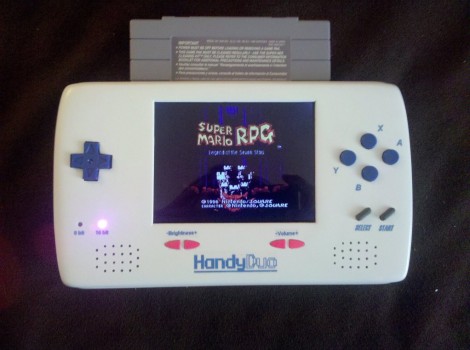
Handheld Plays SNES And NES Carts

Light Bulb Form-factor Computer

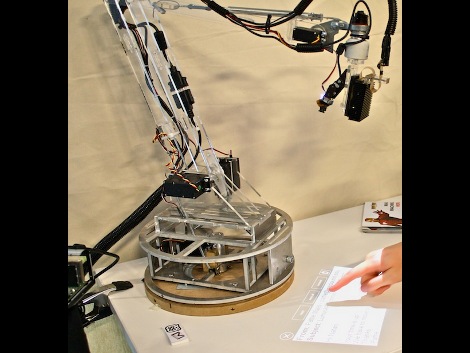
This computer can be mounted in any standard light bulb socket. It uses a pico projector combined with a camera to generate a touch display wherever you shine it. The photo above and the video after the break show the bulb in a motorized lamp arm but that’s just smoke and mirrors, the bulb itself is the core concept. We think there’s real potential for home-built versions. We’ve seen touch displays similar to this that mount on the side of a laptop, but why have the computer around at all? Ditch the USB connection for wireless and have it connect to your home server for processing power. It becomes a perfect solution for places that aren’t traditionally computer friendly. For instance, that kitchen computer you don’t want to touch with dough-encrusted hands becomes washable when the display is projected on a cutting board. Continue reading “Light Bulb Form-factor Computer”