Robotic Mobility For The Little Ones

Researchers at the University of Delaware are helping disabled kids by designing robot transportation for them. Exploring one’s environment is an important part of early development. Disabilities that limit mobility can prevent young children from experiencing this. Typically children are not offered a powered wheelchair until they are five or six years old, but adding intelligent technologies, like those found in the UD1, makes this possible at a much younger age. Proximity sensors all around the drive unit of the robot add obstacle avoidance and ensure safety when used around other children. When confronted with an obstacle the UD1 will stop, or navigate around it. The unit is controlled by a joystick in front of the rider but it can also be overridden remotely by a teacher, parent, or caregiver.

[via Robot Gossip]

Monotron Openly Monophonic

Famous synth manufacturer Korg has released the schematics (get them here if you don’t like to fill out forms) for their wee little Monotron for all to see and use! This is great news for anyone looking to build up a synth from scratch or to circuit bend their existing monotron. The filter circuits alone would be fun to add to an existing electronics setup.

Granted there are already many examples of monotron mods out there, but that shouldn’t stop you from experimenting with your own variations. Now with the schematics you can make fundamental changes to the architecture of the synth all from the comfort of your own CAD software. Want more oscillators? Distortion? It’s all out there for you to explore. We’re very interested to see how far people will run with this. And big ups to Korg for recognizing the value of hacking!

[via Retrothing]

Continue reading “Monotron Openly Monophonic” →

Kinect Open Source Driver Demo And Hacking


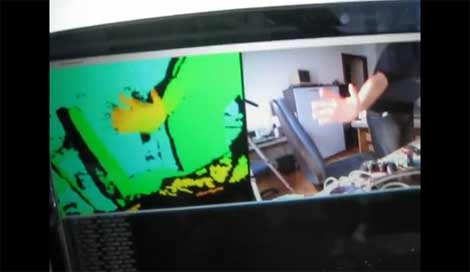
The competition for the first Open Source driver for the Kinect is heating up.  [Marcan42] has released a driver that does video and depth.  He was able to do this without an Xbox and you can see it in action after the break. [LadyAda] has been hard at work as well, recording and dumping the data, and even writing a “hello world” that utilizes the motors in the Kinect.
We don’t know for sure how [Marcan42] recorded his data, but we can see [Ladyada] is using a high speed Beagle USB 480 to record the data going both ways between the Xbox360 and the Kinect.  That’s the kind of toy we would like to have sitting around. For those who don’t know what all the fuss is about, there’s a contest to see who can get an open source driver out there first. The prize has grown every time Microsoft says something bad about it.

[thanks Rapps]

Continue reading “Kinect Open Source Driver Demo And Hacking” →

Permanent Root Exploit Found For G2

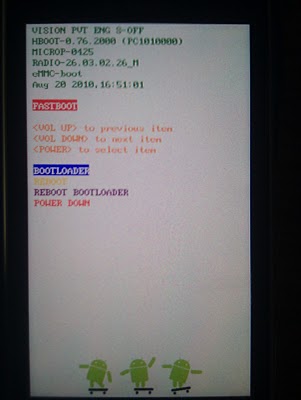
The g2 has finally been rooted. Even though a temporary root exploit was found shortly after the phones release, a NAND lock prevented modifying the non-volatile RAM for a permanent root. Some controversy surrounded the g2 when it was erroneously thought to have a rootkit protecting the OS.  Supposedly the rootkit would watch for changes to the file system and then reset the phone to default settings when any unauthorized changes were made.  On the other hand a NAND lock functions by fooling the operating system into thinking there isn’t any memory available, essentially “locking” the memory in key areas.  Once it was discovered to have the NAND lock it was only a matter of time before the g2 was permanently rooted.  NAND locks have become a popular (and unsuccessful) deterrent employed by device makers to stop the jailbreaking comunity.  While this exploit is nothing groundbreaking it is another notch in the belt for the jailbreaking community and a welcome benefit to g2 users.

Android Talks Pulsewave

Serial communications are a mainstay of digital computing. They don’t require much physical infrastructure and they exist in variations to fit almost any application. The behaviour of serial communications lines, varying from high to low voltage in a timed pattern, is analogous to a 1-bit DAC. Using a whole DAC for serial communication would be a waste in most cases, but the [RobotsEverywhere] team found an exception which you may have encountered already.

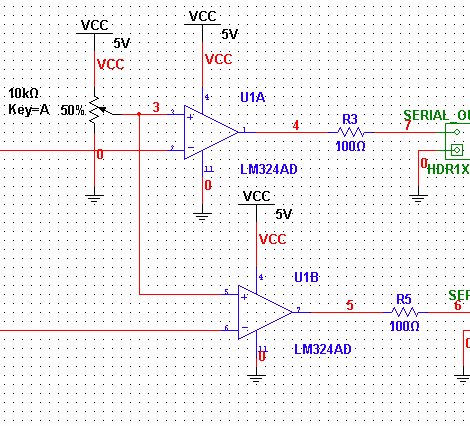
Since the audio output of the Android is accessible and addressable, [RobotsEverywhere] wrote source code to use the left and right channels as separate serial communication lines. This circumvents the need to bust into the device and muck about with the hardware which is great if you want a no-risk hack that allows communications to an RS232 port. Any hardware on which you can write to the DAC (and control the sampling rate) is a potential target.

There are some external electronics required to convert the audio signal to TTL, but it’s not very complicated–a couple of comparators and change. You can see it in action after the break.

As a bonus, when you’re done for the day you can plug in your headphones and listen to the soothing poetry of pulse waves all night long.

Continue reading “Android Talks Pulsewave” →

Beginner Concepts: LEDs And Laws

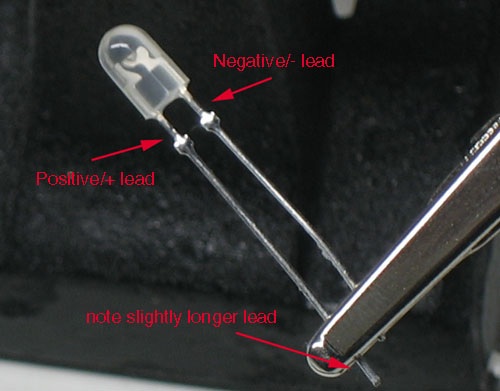
Adafruit has a new LED tutorial for people wanting to get started with electronics. It is full of useful diagrams, pictures, and quizzes to help make sure you are understanding the concepts. This is the real basic stuff here: LEDs, resistors, and the laws from Kirchhoff, and Ohm. It starts out explaining the parts of an LED. Then variations of LEDs: illumination versus indication, clear versus diffused, brightness, color, and size. The mass of the tutorial covers how and why an LED’s brightness can be changed by a resistor and why a resistor is needed to keep an LED from burning out. Such as how Kirchhoff’s Voltage Law works with Ohm’s Law to help you determine the proper resistor for an LED. If you found useful the other beginner concepts posts about Analog Circuits and Electronics basics from the Giz, you should find this tutorial to be useful.

Propeller And Machine Gun Timing

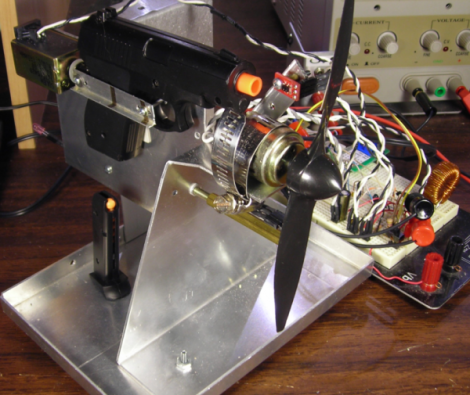
[Matt] was looking for a challenge. Inspired by the machine gun setups on World War I planes he wanted to make a gun that can shoot between the blades of a spinning propeller. The original guns used an interrupter gear that synchronized machine gun firing with the engine mechanically. [Matt] set out to do this using a microcontroller.

To make this work there are two important pieces of information; how fast is the propeller spinning right now, and how long does it take for the pellet to pass the blade? [Matt] used an oscilloscope and some infrared sensors to establish the firing delay at about 20-22ms. Another sensor shows the propeller is spinning at 500 RPMs, with some simple calculations showing that there is indeed a big enough window of time to fire between the blades. After testing with a visible LED and then building out the rest of the circuitry he accomplished his goal. He even added a test function that purposely hits the blades just to see how accurate the system was. We hope this shows up in a Red Baron RC replica, or other flying arsenal.

[via Hacked Gadgets]