Try As You Might, Scooty Won’t Fall Over

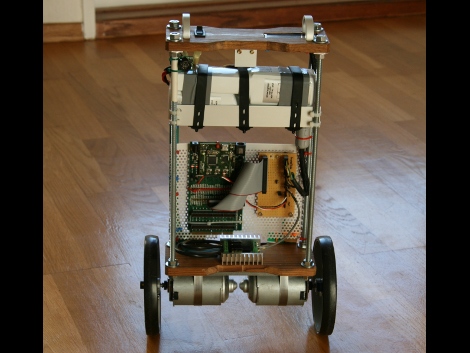
Scooty is a balancing robot based around a PIC32. The project is the first iteration in a long road toward a ridable version. The video after the break shows some incredible promise. Scooty is pitted against a large rubber ball. The two roll into each other but Scooty maintains balance thanks to that powerful processor, an inertial sensor, and a range finder.

Scooty versus a ball isn’t really fair to the ball. We’d like to see Scooty versus the ball balancing robot.

Continue reading “Try As You Might, Scooty Won’t Fall Over” →

Electric Mountainboard With Wireless Control

[youtube=http://www.youtube.com/watch?v=AkhjeEDaagQ]

[Andres Guzman] is chauffuering himself around the University of Illinois campus thanks to his wirelessly controlled mountainboard. He added a brushless motor to drive the rear axel with the help of a chain. Power is provided by a Lithium Iron Phosphate battery which we’ve seen used in other electric vehicles due to its lightweight properties. A wireless PlayStation 2 controller operates the motor but steering remains a lean-to-turn system.

Top 10 Features We’d Like To See In Android 3.0

UPDATE:

Hello HaD readers,
Sorry for the delay in updating this. I was on probation while the editors worked with Jason to figure out some things.

Clearly, for my recent debut article, I didn’t research Android OS well enough. After reading each of your comments, I realize that the article fell short of HaD’s and its readers standards for high-quality writing and reporting. Every point I made in the article were problems I noticed in my experience with Android, but I should have done more research on others’ experiences and the capabilities of each version of the OS. To each reader, I am sorry and will do better by you in future posts.

Poor Google. Despite its numerous capabilities with smartphones spread across a variety of carriers, Android still struggles to garner the prestige and positive perceptions of iOS 4. Sales continue to rise, but at the end of the day, the average person is still left lusting for an iPhone. Well, here are 10 features  that should be added to Android 3.0 that could change the tide.
1. A no-brainer task manager.
Google says Android doesn’t need a task manager, that it closes programs efficiently without any user-intervention, substandard apps often suck memory dry. Because of this, Android users are forced to download complicated task-managers, each with its own odd UI, and weigh which one works the best. Google, please fess up to the problem and put something in there a computer novice could use.  Something with big buttons would be nice.

Solar MintyBoost

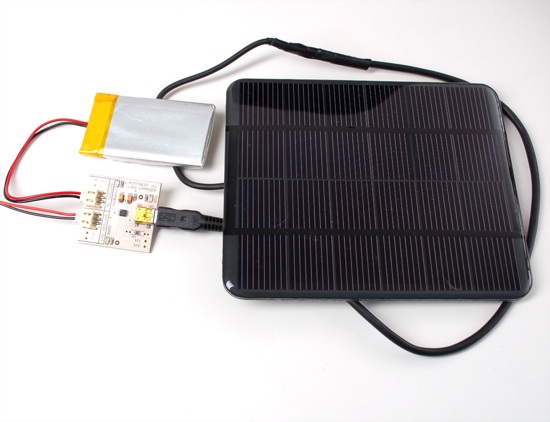
We first wrote about the MintyBoost back in 2006. Today, Adafruit has created a tutorial for making a solar powered MintyBoost. Using a MintyBoost, a solar panel, LiPo battery and a charger, they built on their Solar LiPoly tutorial. They fed the power tap output of the LiPoly charger into the battery input of the MintyBoost to perform the voltage step-up for USB devices. Based on an instructable that used SparkFun parts, this tutorial shows how to use parts that are available from one source. We hear that there will be some evolution of the MintyBoost coming down the line that will including charging capabilities.

Server Enclosure From 22 Rolls Of Tape

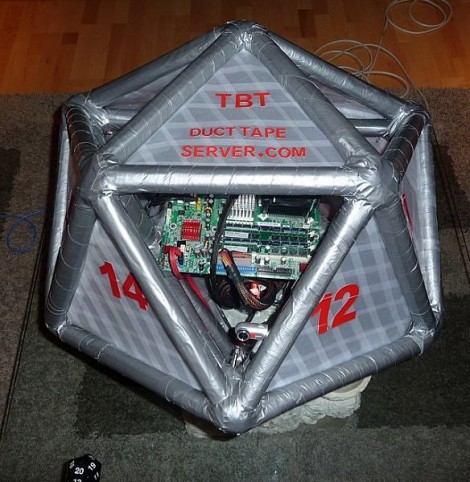
Who needs metal, wood, or acrylic if you are talented with duct tape? This server is housed in a 20-sided enclosure made entirely of duct tape, 22 rolls of it. A team of seven completed the project after eight build session over the course of about ten days. It’s currently in use at this year’s MillionManLan 9 as confirmed by this incredibly boring live feed.

However whimsical, we do appreciate the build process. Tubes are rolled until they reach the specified thickness, then cut to length on a chop saw. More sticky stuff is applied to the joints and piece by piece the frame comes together. From the diagram laying off to the side in one of the pictures it looks like they did the smart thing by designing this in CAD before getting their hands dirty sticky.

Waking Up With The (fake) Sun

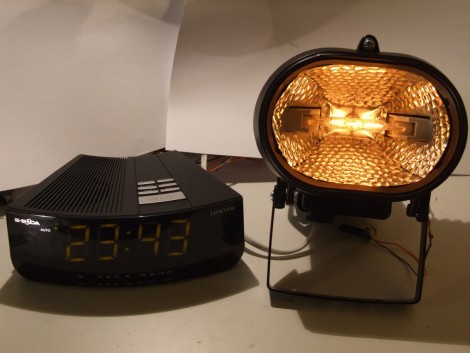
[Bogdan] has some trouble getting up in the morning. A blaring alarm will do the trick but that’s no way to start the day. To get him through the dark winter months he wanted to try a sunrise simulator. He patched into the alarm signal of his bedside clock, intercepting the command from the clock’s microprocessor and using it as an input for his own ATtiny13. From there, the tiny13 gradually brightens a 150W halogen lamp using a triac until his room is as bright as a July morning. A signal is then sent to the alarm clock’s audio amplifier to turn on the audible alarm. He’s got the system set for a 20-minute sunrise so it’s just a matter of programming his alarm 20-minutes early than the ‘I absolutely have to get out of bed now’ time.

Autonomous Battery Exchange


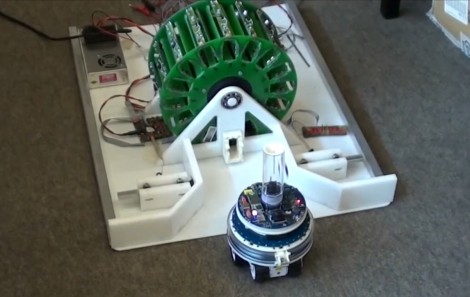
That may look like a Ferris wheel but it acts a battery replacement station for small robots. The marXbot heads to the battery station when it gets low on juice. Once in the cradle, arms on each side hold the bot in place while the low battery is sucked out and a fresh one from the 15-slot carousel is inserted. The robot doesn’t power down but relies on stored electricity from some large capacitors during the changeover. See it happen after the break.

A while ago we saw a robot that could plug itself into a wall outlet. That’s great because the robot doesn’t have to return to a charging station, but it still has to wait for its battery to top off. With a few strategically placed battery stations it’s easy to keep a robot up and running with almost no down time for a battery swap.

Continue reading “Autonomous Battery Exchange” →