Minneapolis Hackerspace: Twin Cities Maker

After announcing the grand opening of a St. Louis Hackerspace, we received a tip that another group of our readers had an event coming up. Twin City Maker of the Minneapolis/St.Paul area are hosting a Maker Faire and art show next weekend. Unfortunately, we don’t have any writers in that neck of the woods, so there wont be an official Hack a Day presence, but we are sure all of you who make it out there will do us proud. Take pictures, wont you?

The Minne-Faire will be located at:

Hack Factory
3119 E 26th St. Minneapolis, MN 55406

Mini Maker Faire 2-6 PM
Art Show & Party 7-11 PM
Beginner Concepts: 555 Push Button Toggle

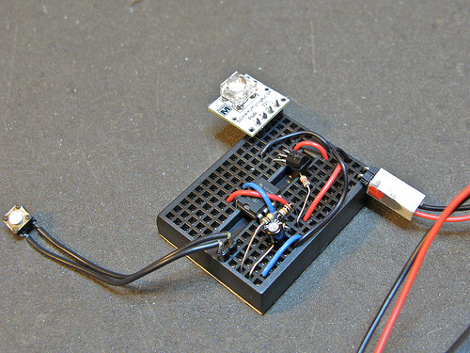
PIC, AVR, and Arduino are ubiquitous in projects these days and a lot of the time it’s easy to over-complicate things with their use. In this case, [Tod] wanted to use a momentary tactile switch to turn something on and off. Instead of going with a microcontroller he built the circuit around a 555 timer. What he really needed in this case is a flip-flop but lacking a chip for that he went with the 555 because it has one built-in. Three resistors and a capacitor later he’s in business, adding another resistor and a transistor to deal with the load switching. We’ve embedded video of the circuit controlling an LED after the break. This IC ends up in a lot of projects so dig through your parts bin and give this circuit a try.

Continue reading “Beginner Concepts: 555 Push Button Toggle”

Icosatetrapedal Robot

[youtube=http://www.youtube.com/watch?v=REzrYWOzhWc]

24, Icosatetrapeds have 24 legs.  This robot, built by [Monica Anderson] back in 2005 has 24 pneumatic soft legs. The motion is fantastic, like watching some kind of sea creature walk. Though it only goes about 1 meter per minute, we just couldn’t stop watching.  The compressors were scavenged from some military equipment designed for nerve gas detection, and the brain is a mac mini. The rest is just valves, solenoids, wood, and tube.

[thanks Tom]

Game Controllers Using USB Host Shield

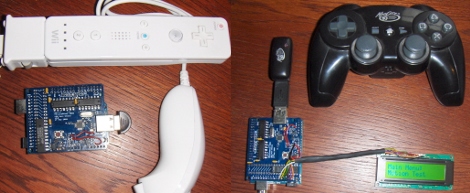
[I-Bot] has put together some libraries that make it easy to use gaming controllers with an Arduino. They interface through the USB host shield. This means that PS3 controllers connect via USB through a cable or a dongle. With the Wii remote things get a little more interesting. A Bluetooth dongle is used to make the connection wirelessly. What we have here is a cheap and easy way to add Bluetooth connectivity to your projects either through the USB Host shield, or by building your own hardware with the schematics and code that are available from Circuits@Home. There are several pages that walk you through the protocols using as well as a demonstration video you can see after the break. Continue reading “Game Controllers Using USB Host Shield”

Leapfrog Didj: Handheld Linux On The Cheap

Today our good friends over at Woot! are selling the Leapfrog Didj, a low cost educational toy aimed at little kids. Lucky for hackers out there, the Didj is actually a linux device, and gaining serial console access is as easy as soldering two wires. The documentation out there is a little outdated, with a number of broken links and stale wikis, but $25 for a portable linux device is a hard deal to beat. A list of sites which might be helpful are listed after the break, as well as the hardware specs of the Didj.

Let us know if you have played around with hacking the Didj before, and if you have any tips for other readers. Don’t forget to tell us what you do with the Didj as well!

Thanks to [Mark] for the tips and the hardware details.

Continue reading “Leapfrog Didj: Handheld Linux On The Cheap”

Snow Blower Robot

For those of us who are stuck in the middle of a cold and snowy winter, this project will seem like a stroke of genius. [Jimmy Bui] has put together this robotic pushing platform. While it is seen in the video (on the linked page) pushing a snow blower, it seems to be simply bolted on. This means it could push pretty much anything, such as a lawn mower. The platform itself looks like a common layout. He’s using the base of a motorized wheel chair, and some scavenged bits to protect the circuitry.  He says that he built it after seeing elderly people having a hard time shoveling their driveways in his neighborhood.  They don’t say if he loans it out to them now, but we suspect that he does.

[via Robots Dreams]

Android Audio-serial Connection

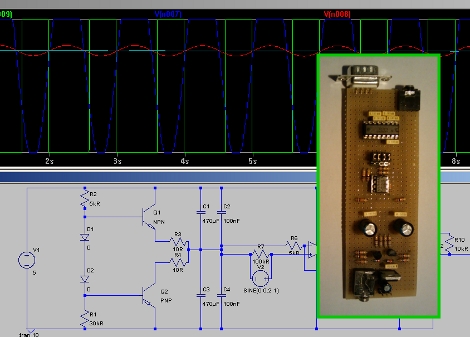
This seems like something of a throwback hack. [WilinNeofoxx] has built an audio modem interface for use with his Android phone. A program running on the Android device takes the accelerometer data and converts it into a 9600bps audio signal, kind of like a dial-up modem. His custom circuit board takes that sound in through the headphone jack and demodulates it for use on the serial port of a PC. This connection to controls a flight simulator using the G1‘s motion sensors. In the video at the bottom of his post he unplugs the audio cable for a few seconds and you can hear the audio datastream coming from the phone. It’s pretty annoying so you might want to turn down those speakers before viewing it.